
Introduction
Power distribution equipment — switchgear, switchboards, circuit breakers, and transformers — forms the backbone of every commercial, industrial, and utility facility. When these systems age or fall short of capacity demands, the consequences extend far beyond inconvenience: unplanned downtime costs manufacturing facilities an average of $260,000 per hour, while arc flash incidents result in an estimated 630 injuries annually in the U.S., with litigation costs averaging $10–15 million per incident.
Yet outcomes vary dramatically. Two facilities upgrading identical equipment can produce wildly different results: one stays on budget and resumes operations on schedule, while the other faces change orders, failed inspections, and extended downtime. The difference comes down to strategy — retrofit versus retrofill versus full replacement — along with the quality of upfront assessment, procurement decisions, and compliance planning.
This guide covers:
- Recognizing when an upgrade is needed
- Choosing the right modernization path (retrofit, retrofill, or full replacement)
- Executing the upgrade without costly delays
- Meeting compliance requirements before equipment can be energized
Key Takeaways
- Industrial switchgear typically needs upgrading after 20–30 years, though condition matters more than age
- Retrofit saves 40–70% when enclosures are sound; replace when capacity must grow or equipment exceeds 30 years
- A structured 5-step process covers assessment, scope definition, equipment specification, shutdown planning, and commissioning
- Arc flash studies and procurement lead times (35–62 weeks for large switchboards) are the two most common sources of costly project delays
- All equipment must meet NEC 2026, NFPA 70E, and UL 891 or UL 1558 certification before inspection approval
Signs Your Power Distribution Equipment Needs an Upgrade
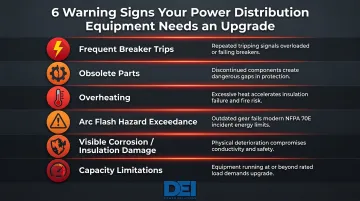
Low-voltage switchgear has a generally accepted service life of 20-30 years, though Schneider Electric notes that enclosures and bussing can function well beyond 50 years with proper maintenance. Age alone doesn't determine replacement timing — component life is measured in operational cycles: 10,000 mechanical operations and 50 maximum short-circuit operations for circuit breakers. Performance degradation, safety risks, and changing capacity requirements matter equally.
These warning signs are most meaningful when assessed together, not in isolation:
- Frequent unexplained breaker trips that disrupt operations and indicate protective device degradation
- Obsolete or discontinued parts making repairs impossible or requiring extended lead times that prolong downtime
- Overheating caused by insufficient capacity for current loads, often detected through thermographic surveys
- Arc flash hazard levels exceeding NFPA 70E limits, creating unsafe working conditions and compliance exposure
- Visible corrosion or insulation damage compromising equipment integrity and increasing failure risk
- Inability to support planned facility expansion due to maxed-out capacity or inflexible configurations
A common decision threshold: when repair costs approach or exceed 50% of replacement value — or parts are no longer sourceable within a reasonable timeframe — upgrading is typically more cost-effective than continued maintenance. Three factors tip the calculation further:
- Downtime losses: At $260,000 per hour for manufacturing facilities, a single extended outage can justify proactive replacement
- Regulatory fines: Non-compliance penalties for outdated equipment add direct financial exposure
- Arc flash liability: Incidents involving aging gear create significant legal and safety risk that insurance alone doesn't resolve
How to Upgrade Your Power Distribution Equipment: Step-by-Step
A successful power distribution upgrade doesn't begin with ordering equipment — it begins with understanding the existing system and creating a plan that accounts for safety, scheduling, and compliance at every stage.
Step 1: Assess and Document Your Existing System
Conduct a comprehensive site survey documenting existing equipment: single-line diagrams, equipment nameplates, ratings, age, condition, and current load data. Inaccurate or missing as-built drawings are among the most common sources of delays and field errors later in the project. Research shows that 10-25% of construction project costs are caused by errors, with missing documentation being a leading trigger.
Commission an arc flash hazard study to establish baseline incident energy levels across the system. NFPA 70E Article 130.5 requires this assessment to determine if an arc flash hazard exists — it's not optional. The study directly informs what equipment upgrades are needed and what PPE requirements apply during installation.
Identify capacity gaps by comparing current load demand against equipment ratings. Flag any equipment operating above rated capacity or running without adequate protection. Use those findings to decide whether retrofit, retrofill, or full replacement is the right path forward.
Step 2: Define Your Upgrade Scope and Strategy
Based on assessment findings, determine which equipment needs upgrading and to what extent. This decision defines whether you pursue retrofit (upgrade internal components), retrofill (replace breaker compartments), or full replacement (entirely new assembly).
Establish project constraints:
- Budget range and total cost of ownership calculations
- Maximum acceptable downtime and shutdown window availability
- Temporary power feasibility for critical loads
- Future expansion requirements that should be incorporated into the new design
These constraints guide equipment selection and determine the modernization strategy that delivers the best long-term value.
Step 3: Specify Equipment and Source Compliant Products
Develop detailed equipment specifications: voltage ratings, amperage, interrupting ratings, form factor, and site-specific layout requirements. Specifications must align with NEC 2026 code (or the edition enforced by your local AHJ) and require UL certification — UL 891 for low-voltage switchboards, UL 1558 for metal-enclosed switchgear. Non-compliant equipment will fail inspection and create significant delays.
Equipment lead times remain extended: Gaston Electrical's Q4 2024 market data shows switchboards over 1200A now require 35-62 weeks versus the 20-30 weeks once considered standard. Data center demand continues driving delays industry-wide.
Sourcing from suppliers with in-house manufacturing capabilities directly cuts schedule risk. DEI Power, for instance, builds custom UL 891-certified switchboards with 4-6 week lead times from their Ontario, California facility — a fraction of the current industry average for comparable equipment.
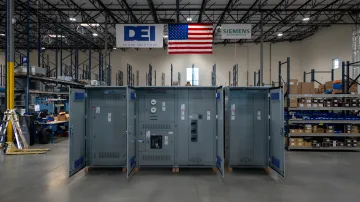
Confirm that all equipment ordered matches existing conduit locations, bus configurations, and spatial constraints. Mismatches discovered during installation are among the most expensive and time-consuming problems to fix.
Step 4: Plan the Shutdown, Permits, and Temporary Power
Coordinate shutdown windows with operations and production planning to minimize business impact. Schedule work during planned maintenance periods, weekends, or low-production cycles.
Pull all required electrical permits and arrange for inspections. Confirm whether a plan review or arc flash re-study is required post-upgrade by the local authority having jurisdiction (AHJ). Equipment must be UL-listed and labeled to pass inspection — verify this requirement with your AHJ before finalizing procurement.
Arrange temporary power for critical loads that cannot tolerate an outage during installation. Systems qualifying as critical typically include:
- Life safety systems and emergency lighting
- Process control systems and data networks
- Refrigeration and environmental controls
- Security and fire alarm systems
Temporary distribution should be set up with proper isolation, overcurrent protection, and documented switching procedures.
Step 5: Install, Test, and Commission
Execute installation per approved drawings, following all lockout/tagout (LOTO) procedures and NFPA 70E safe work practices throughout. OSHA 29 CFR 1910.333 mandates that live parts be de-energized before work begins unless additional hazards or infeasibility can be demonstrated.
Confirm that all connections, torque specs, and insulation requirements are met before energization. Torque values should match manufacturer specifications — both under-torqued and over-torqued connections create hotspots and failure points.
Conduct acceptance testing per ANSI/NETA ATS-2025 standards:
| Test Type | Test Voltage (600V Equipment) | Minimum Acceptance Value |
|---|---|---|
| Insulation Resistance (phase-to-phase, phase-to-ground) | 1,000V DC | 100 megohms |
| Contact/Bolted Connection Resistance | Micro-ohmmeter | Deviation <50% from lowest similar connection |
| Dielectric Withstand (Hi-Pot) | 75% of factory test voltage | No distress or breakdown |
| Control Wiring Insulation Resistance | 500V DC | 2 megohms minimum |
Additional tests include breaker trip timing verification (must match manufacturer time-current curves within ±10%) and relay functional tests. Do not energize equipment that has not passed all acceptance criteria.
Once testing is complete, close out the project:
- Commission the system and verify normal operation under load
- Update single-line diagrams, as-built drawings, and arc flash labels
- Train operations and maintenance personnel on the new equipment
- Log all test results and store documentation for future reference
Retrofit, Retrofill, or Full Replacement: Choosing the Right Upgrade Path
Three recognized modernization strategies exist for power distribution upgrades. Selecting the wrong one can result in unnecessary costs, insufficient performance improvement, or premature re-investment.
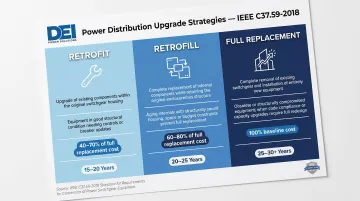
IEEE C37.59-2018 provides formal definitions:
- Retrofit (Direct Replacement): Modifying a new component so it fits into the existing switchgear cell with minimal or no changes to the cell itself
- Retrofill: A more intensive process involving modification of the switchgear cell (stationary structure) to accept a new type of component, often requiring changes to buswork or insulation
- Full Replacement: Entirely new switchgear or switchboard installed in place of the old unit
Retrofit: Best for Budget Constraints with Sound Enclosures
Retrofit is the right choice when the enclosure is structurally sound, the bus system is in good condition, and budget constraints are significant. Retrofit typically costs 40-70% of new equipment and can extend equipment life by 15-20 years.
Key limitation: Retrofit does not address enclosure aging, corrosion, or provide full capacity expansion. It's a component-level modernization that leaves structural elements in place.
Retrofill: Best for Obsolete Breakers with Serviceable Infrastructure
Retrofill fits when circuit breakers are obsolete or discontinued but enclosures remain serviceable. This approach preserves infrastructure investment while restoring proper protection and supporting modern digital trip units.
Costs typically run 60-80% of new equipment and can extend life 20-25 years. Retrofill covers more ground than a basic retrofit without the full disruption of a complete equipment swap.
Full Replacement: Best for Capacity Growth or Structural Issues
Full replacement is the right choice when:
- Enclosures are corroded or structurally compromised
- Facilities need significant capacity expansion
- Modern monitoring integration or arc-resistant designs are required
- Equipment exceeds 25-30 years and multiple components are failing
Full replacement carries the highest upfront cost but provides 25-30+ years of reliable service and the greatest flexibility for future changes. Schneider Electric's data shows that in a full replacement, lost production (downtime) accounts for nearly 45% of total project cost, while site preparation adds approximately 10%. Retrofit projects minimize both figures considerably.
Decision Framework
Use this quick reference to match your situation to the right path:
| Scenario | Recommended Path |
|---|---|
| Sound enclosure, tight budget | Retrofit |
| Obsolete breakers, serviceable infrastructure | Retrofill |
| Age 25-30+ years, capacity growth needed, structural damage | Full Replacement |
When building your business case, include energy savings, reduced maintenance, and avoided downtime — not just purchase price. A retrofit that saves $50,000 upfront but requires another upgrade in 8 years may cost more than a full replacement that lasts 30 years.
What You Need Before Starting Your Upgrade
Teams that skip documentation, compliance checks, or procurement planning consistently face change orders, field delays, and failed inspections. Getting these fundamentals in place before engineering or procurement work begins is what separates smooth upgrades from costly ones.
Equipment and Documentation Requirements
Ensure you have complete, accurate as-built drawings and single-line diagrams before any engineering or procurement work begins. These documents prevent mismatches between new equipment and existing infrastructure.
An updated load study and arc flash study are not optional — they drive equipment specifications and are required by NFPA 70E. The arc flash study must be performed by a qualified person and updated whenever major modifications occur.
Compliance and Permitting Readiness
Confirm which code edition your jurisdiction enforces. The NEC follows a 3-year revision cycle, with NEC 2026 now published, though some jurisdictions may still enforce 2023 or earlier editions. Local amendments apply and can add requirements beyond the base code.
Pull electrical permits before work begins. Verify whether your project requires a licensed engineer of record to stamp drawings. Equipment must be UL-listed and labeled to pass inspection — confirm this requirement with your AHJ before finalizing specifications.
Team and Contractor Qualifications
Upgrades of this complexity require licensed electrical contractors with demonstrated experience in industrial or commercial power distribution. Verify that field personnel are trained and current on NFPA 70E 2024 requirements.
LOTO procedures must be formalized and communicated to all affected departments before any switching or isolation work begins. OSHA requires:
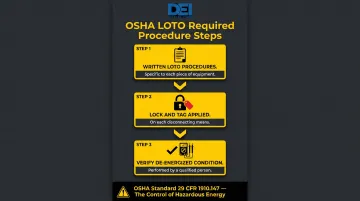
- Written LOTO procedures specific to each piece of equipment
- Lock and tag applied on each disconnecting means
- Verification of de-energized condition by a qualified person
Common Mistakes When Upgrading Power Distribution Equipment
Five mistakes account for the majority of upgrade project failures, delays, and cost overruns.
Skipping or shortcutting the assessment phase: Many projects stall or go over budget because engineering begins without accurate documentation of existing conditions. Discovering a mismatch between new equipment specs and existing conduit locations during installation, rather than during design, is an entirely avoidable and very costly problem. Field changes require rework, delay energization, and often necessitate permit amendments.
Choosing the upgrade path based on upfront cost alone: Selecting a retrofit when full replacement is needed, or ordering full replacement when a retrofill would suffice, leads to either re-investment within a few years or unnecessary overspend. The right path is determined by enclosure condition, equipment age, capacity requirements, and total cost of ownership — not just the purchase price line item.
Underestimating equipment lead times and procurement risk: Custom switchgear and switchboards carry lead times of 35–62 weeks from many manufacturers. Projects that lock in shutdown windows before confirming delivery dates frequently face costly delays. Working with manufacturers that handle in-house production and inventory, rather than relying on third-party assembly, can cut that timeline dramatically. DEI Power, for instance, delivers custom UL 891-certified switchboards in 4–6 weeks — a fraction of the industry average.
Failing to plan for temporary power: Facilities that don't arrange alternative power supply for critical loads during the upgrade window either compress the installation timeline unsafely or face production losses. Both outcomes are avoidable with proper pre-planning and coordination with operations teams.
Neglecting post-installation documentation and training: New equipment that isn't reflected in updated drawings and arc flash labels creates ongoing safety and compliance exposure. Operators who haven't been trained on new equipment characteristics — digital trip units and smart monitoring interfaces in particular — are more likely to miss early warning signs of developing problems.
Frequently Asked Questions
What are the examples of power distribution equipment?
Power distribution equipment includes switchboards, switchgear, circuit breakers, transformers, panelboards, motor control centers (MCCs), protective relays, and bus duct systems. These components work together to receive, distribute, and protect electrical power throughout a facility.
How much does a power distribution equipment upgrade cost?
Costs vary widely based on scope and facility scale. Retrofit projects typically run 40-70% of new equipment costs, while full replacement for industrial facilities can range from tens of thousands to several million dollars. Factoring in maintenance savings, reduced downtime, and extended lifespan often justifies the higher upfront investment.
How long does a power distribution equipment upgrade take?
Most projects run 3-12 months from initial assessment through commissioning. Procurement is usually the longest phase — large custom switchboards can require 35-62 weeks, though manufacturers with in-house production can significantly shorten that window.
Can I upgrade power distribution equipment without shutting down operations?
Partial operations are often possible using temporary power arrangements, phased upgrades (one section at a time), or scheduling work during planned maintenance windows. However, a full shutdown is typically required at some point during installation and final commissioning.
When should I replace vs. retrofit power distribution equipment?
Retrofit is appropriate when enclosures are structurally sound, bus systems are in good condition, and budget is limited. Full replacement is better when enclosures are compromised, equipment is more than 25-30 years old, or significant capacity expansion is needed to support facility growth.
What certifications should power distribution equipment have?
Equipment should be UL-listed for its application (UL 891 for low-voltage switchboards, UL 1558 for metal-enclosed switchgear), NEC-compliant, and meet NFPA 70E arc flash requirements. Confirm exact requirements with the local authority having jurisdiction (AHJ) before finalizing procurement.