This guide covers what a meter main combo is, how it works, its core benefits, where it's used, and what to verify before you buy. It's written for electrical contractors, engineers, and facility teams specifying or procuring service entrance equipment.
Key Takeaways
- A meter main combo combines a utility meter socket and main circuit breaker in one enclosure, serving as the building's service entrance point
- One enclosure means less space, simpler wiring, and fewer contractors to coordinate at rough-in
- 100A to 400A covers most direct-connect applications — beyond that, CT metering or switchboard solutions apply
- Always confirm utility approval and UL/NRTL listing before purchasing — catalog specs alone won't clear an inspection
- On commercial and industrial projects, mismatched service entrance and distribution equipment is a leading cause of costly field changes — spec them together
What Is a Meter Main Combo?
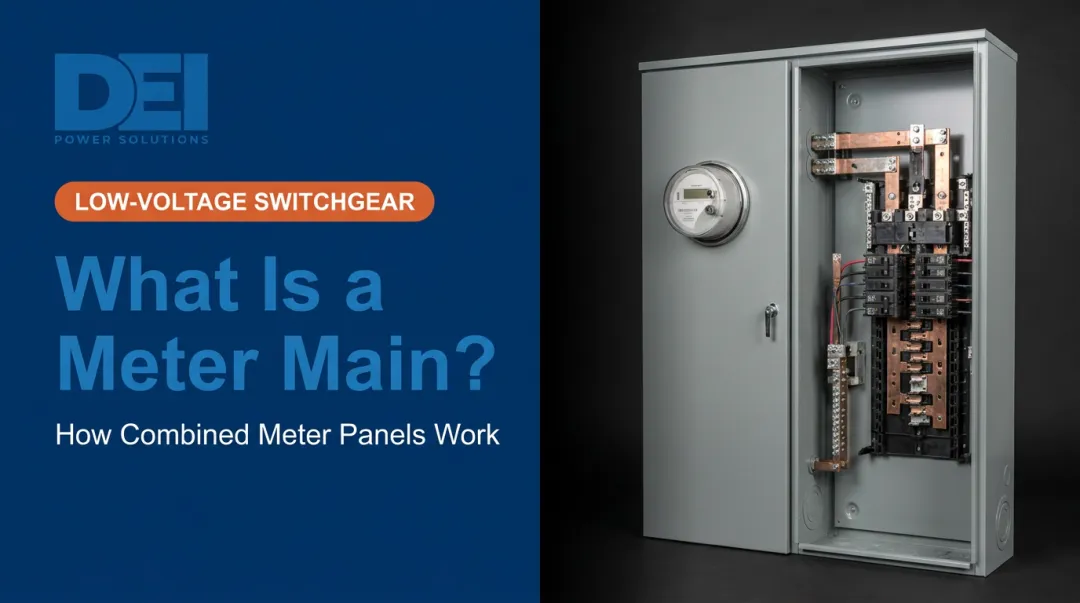
A meter main combo is an integrated service entrance assembly that houses both a utility meter socket and a main circuit breaker (or main disconnect) within a single enclosure. Manufacturers label it differently — Eaton and Schneider Electric use terms like "meter main," "CSED" (Combination Service Entrance Device), or "all-in-one" — but they all describe the same integrated assembly.
How It Functions
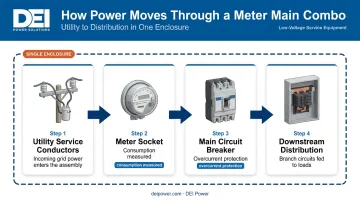
Utility power enters through the meter socket, which measures consumption and connects directly to the utility service conductors. From there, power passes through the main breaker — the protective and control mechanism that allows the entire downstream system to be de-energized in one action. Both functions sit within one weatherproof enclosure — no separate conduit runs, no extra connection points between components.
Code Context
The 2020 NEC added Section 230.85 requiring an emergency disconnect in a readily accessible exterior location for one- and two-family dwelling services. This residential rule isn't a blanket commercial/industrial mandate, but it reflects the broader principle under NEC Article 230: service disconnecting means must be accessible and clearly identified.
A properly located meter main combo satisfies that requirement. It gives utility crews and emergency responders a single exterior shutoff point — no hunting through a building to locate the disconnect.
System Hierarchy
Once a meter main combo handles the main disconnect at the service entrance, any interior panel fed from it becomes a sub-panel — not a main panel. Understanding this hierarchy matters when sizing downstream equipment and calculating available fault current for branch circuit devices.
Meter main combos appear across residential, light commercial, and industrial applications. The distinctions that matter most in each context:
- Residential: Primarily governed by NEC 230.85; simpler utility coordination
- Light commercial: Utility metering requirements and POCO approval add complexity
- Industrial: Amperage ratings, available fault current, and equipment certifications carry direct project consequences
This guide focuses on commercial and industrial contexts, where those factors shape procurement and installation decisions.
Key Components of a Meter Main Combo
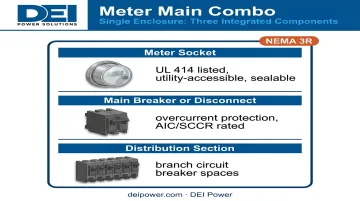
A meter main combo brings three distinct electrical functions into one assembly. Understanding each component helps you verify that a unit meets your project's code, utility, and environmental requirements.
Meter Socket
The meter socket compartment accepts the utility company's watthour meter. The socket is built weatherproof, utility-accessible for reading, and sealable against tampering — meeting standards under UL 414, which covers meter sockets for watthour and similar meters. It connects directly to the incoming utility service conductors.
Main Breaker or Disconnect
The main breaker provides overcurrent protection and serves as the primary shutoff for everything downstream. For commercial applications, this component must carry an interrupting rating (AIC/SCCR) sufficient for the available fault current at the service point — a figure that varies by utility and location. Underspecifying this rating is one of the more common and costly field errors on service entrance equipment.
Enclosure and Distribution Section
Most meter main combos use a NEMA-rated enclosure. NEMA Type 3R is the standard for outdoor installations — it protects against rain, sleet, snow, and external ice formation. Many units also include a distribution section with branch circuit breaker spaces, combining service entrance and load-side distribution in one cabinet.
Benefits of a Meter Main Combo
Space and Cost Efficiency
One enclosure instead of two means a smaller wall footprint, fewer conduit penetrations, and lower material cost. On retrofit projects or sites with constrained service entrance locations, this alone can determine whether a design is feasible.
Faster Installation
Pre-integrated units reduce field coordination. Rather than aligning two separate pieces of equipment, wiring them together, and verifying component ratings, electricians install and wire a single enclosure. Fewer connection points also means fewer opportunities for wiring errors.
Code Compliance Built In
A properly rated meter main combo comes pre-engineered with service-equipment markings required under UL 67 (panelboards) and UL 414 (meter sockets). That pre-certification reduces the risk of inspection failures — provided the unit is also on the serving utility's approved equipment list, which is a separate verification step covered below.
Safety for First Responders and Maintenance Crews
The exterior disconnect benefit is straightforward: fire departments, utility crews, and maintenance personnel can de-energize the building from outside without entering the structure. NEC 230.85 codifies this requirement for residential services, with Article 230 extending general accessibility requirements to all services.
Simplified Procurement
Sourcing one integrated unit instead of a separate meter base and disconnect from different suppliers eliminates specification mismatch risk. Component compatibility, including enclosure dimensions, breaker ratings, and bus configurations, is handled at the manufacturing level rather than resolved in the field.
Common Use Cases for Meter Main Combos
Residential and Light Commercial New Construction
Meter main combos are the standard choice for new builds where the utility service entrance lands on an exterior wall. As code increasingly requires exterior disconnects, the combined meter/disconnect design satisfies that requirement in a single, pre-engineered unit.
Manufactured Homes, Temporary Power, and Modular Installations
The self-contained design makes meter main combos practical wherever compactness matters. Construction site power pedestals, manufactured housing, and modular units all rely on this form factor — one enclosure, no separate disconnect panel, minimal footprint.
Commercial and Industrial Facilities
Heavy-duty meter main configurations serve as the primary service entrance for many commercial sites, feeding downstream switchboards or panelboards. At this scale, the metering method matters:
- Direct-connect metering typically applies at 400A or below for single-phase and 200A or below for three-phase service, though thresholds vary by utility
- Above those limits, utilities like PacifiCorp and PG&E require CT-rated metering — which shifts the design toward CT cabinets, meter centers, or service switchboard sections instead of a standard meter main
- Always confirm the serving utility's metering threshold before specifying a meter main combo for larger commercial or industrial loads
Types of Meter Main Combos
Amperage Ratings
100A, 200A, 320A, and 400A are well-supported by multiple manufacturers including Siemens, Eaton, Schneider Electric, ABB, and Milbank. These cover the majority of direct-connect meter main applications.
For commercial and industrial service entrances above 400A, equipment terminology and configuration shift. DEI Power's meter main switchgear, for example, is available from 400A through 4000A — these are UL 891-certified switchboard assemblies built to utility-specific requirements, not commodity single-enclosure combos. Units in this range require utility coordination and specification review before ordering.
One common specifying error: undersizing the main breaker. Select the amperage based on calculated load demand with adequate headroom for future expansion, not the minimum rating that covers current loads.
Single-Phase vs. Three-Phase
Single-phase meter main combos (120/240V) serve residential and light commercial loads. Three-phase units are required for industrial equipment, large commercial facilities, and any site with motors or high-demand machinery. These configurations are not interchangeable — the unit must match the utility service.
NEMA Ratings
NEMA 3R is the baseline for outdoor service entrance installations. Indoor installations may use NEMA 1 enclosures where environmental exposure isn't a factor. Corrosive or extreme environments may require higher NEMA ratings — verify with the serving utility and AHJ.
Number of Breaker Spaces
Many meter main combos include an integrated load center with a fixed number of breaker spaces (commonly 8, 16, or 24). Account for both current branch circuits and anticipated future circuits when selecting a unit. Choosing the minimum available space typically creates problems at the first renovation or tenant improvement — plan for growth from the start.
How to Choose the Right Meter Main Combo
Start With Utility Approval, Not the Catalog
This is the most common procurement mistake on commercial projects: selecting a meter main combo based on amperage rating and price, then discovering the unit isn't on the serving utility's approved equipment list. Utilities like PG&E, SDG&E, and PacifiCorp impose their own approval requirements — EUSERC compliance, NRTL listing, outdoor accessibility, sealability — that override catalog specifications.
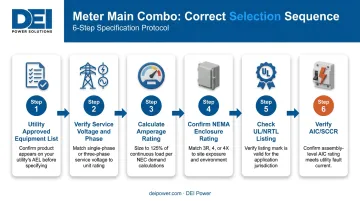
The correct selection sequence is:
- Confirm the serving utility's approved equipment list and metering method requirements (self-contained vs. CT)
- Verify service voltage and phase (120/240V single-phase, 208Y/120V, 480Y/277V, etc.)
- Calculate amperage rating with appropriate headroom for future load growth
- Confirm NEMA enclosure rating for the installation environment
- Check UL/NRTL listing and service-equipment markings
- Verify AIC/SCCR matches available fault current at the service point
Specification Checklist
| Parameter | What to Verify |
|---|---|
| Service voltage | Matches utility supply |
| Phase configuration | Single-phase or three-phase |
| Amperage rating | Load calc + growth headroom |
| Metering method | Self-contained vs. CT |
| NEMA enclosure | 3R minimum for outdoor |
| UL/NRTL listing | Required by most utilities |
| AIC/SCCR | Matches available fault current |
| Utility approval | On the utility's approved list |
Work With a Supplier Who Understands the Full System
For commercial and industrial projects, the meter main combo anchors the entire distribution system. Service entrance equipment must coordinate with downstream switchboards, panelboards, and branch circuit protection — and those coordination decisions are far easier to make before equipment is ordered than after.
DEI Power's UL 891-certified meter main switchgear (400A–4000A) is built to utility-approved specifications using Siemens components, with EUSERC approval and seismic zone compliance included. Because each unit is configured to specific utility requirements, orders go through a specification review before production — covering ratings guidance, enclosure selection, and submittal documentation. That review catches configuration mismatches early, reducing the inspection failures and field rework that derail project schedules.
Frequently Asked Questions
What is a meter main combo?
A meter main combo is an integrated electrical enclosure that combines a utility meter socket and a main circuit breaker or disconnect in one unit. It serves as the service entrance for a building, measuring consumption through the meter socket and controlling downstream power through the main breaker.
What is the difference between a meter main combo and a separate meter base and panel?
A separate setup uses two distinct enclosures, one for the meter socket and one for the main panel, connected by conduit and wiring. A meter main combo consolidates both into one enclosure, reducing installation footprint, wiring complexity, and the number of connection points in the service entrance assembly.
What amperage ratings are available for meter main combos?
Direct-connect meter main combos are commonly available in 100A, 200A, 320A, and 400A ratings. Above 400A (and often above 200A for three-phase), utilities typically require CT metering equipment rather than a standard single-enclosure combo. Confirm the serving utility's requirements before specifying. For larger commercial and industrial projects in the 400A–4000A range, UL 891-certified switchgear assemblies handle distribution beyond what direct-connect meter combos support.
Does a meter main combo require a permit to install?
Yes. Installing or replacing service entrance equipment requires utility coordination, an electrical permit, inspection, and a licensed electrical contractor in virtually all jurisdictions. The local authority having jurisdiction (AHJ) governs the specific requirements.
Who is responsible for the meter box on a building?
The utility company owns the meter itself. The building owner is responsible for the meter socket enclosure, the associated wiring, and all equipment on their side of the service point.
Is it safe to be near a meter box?
A properly installed, listed meter enclosure poses no safety risk to nearby occupants. EPRI research on smart meter RF emissions found levels below FCC exposure limits. Any damaged or non-code-compliant enclosure should be inspected promptly by a licensed electrician.