Introduction
The US switchgear market reached $17.31 billion in 2025 and is projected to grow to $22.79 billion by 2031 at a CAGR of 4.69%, with low-voltage products commanding the largest segment at 40% of total revenue. This growth is driven by grid modernization, hyperscale data center buildouts that will consume 68% of total US load growth through 2030, renewable energy integration, and federal pressure to reshore critical electrical infrastructure.
Meanwhile, incumbent manufacturers are quoting 18-36 month lead times and imposing 20% price increases on existing orders, leaving a real and growing gap between supply and demand.
More engineers, contractors, and capital-backed entrepreneurs are evaluating switchgear manufacturing as a viable entry point into electrical infrastructure. The business case rests on persistent multi-sector demand, a contracting domestic manufacturing base (down 1.1% annually according to IBISWorld), and real differentiation available on lead time, BABA compliance, and custom engineering capability.
The barriers are real, though:
- Six-figure equipment investments before production begins
- UL certification timelines measured in months, not weeks
- Licensed electrical engineers required on staff from day one
This guide walks through the actual requirements for starting a switchgear manufacturing business in the United States—covering facility planning, certification sequencing, equipment investment, staffing, and the step-by-step path from initial planning to first sale.
Key Takeaways
- Switchgear manufacturing produces electrical protection equipment—switchboards, panels, and distribution assemblies—for utilities, data centers, and industrial facilities
- Startup costs are high: facility lease, fabrication equipment, powder coating systems, and UL certification are all required before your first shipment
- UL 891 listing for low-voltage switchboards is mandatory for selling to commercial customers and takes several months minimum to secure
- The path to market follows 8 steps: market validation, business model definition, facility build-out, certification, hiring, and stabilizing operations
- Expect 12–24 months to stable revenue, depending on facility readiness and sales cycle length
What Is a Switchgear Manufacturing Business?
A switchgear manufacturer designs, fabricates, assembles, and tests electrical switching and protection equipment used to control, protect, and distribute power across commercial, industrial, and utility electrical systems. This includes switchboards, distribution panels, and switchgear assemblies built to customer specifications or standard catalog configurations.
The core work is physical production: sheet metal enclosure fabrication, component integration, precision wiring, quality testing, and delivery of engineered equipment.
Main product categories include:
- Low-voltage switchboards (UL 891-rated, 600V or less, up to 4000A)
- Medium-voltage switchgear (typically 1kV to 36kV)
- Custom-configured assemblies built to project specs
- Standard catalog products for faster fulfillment
Manufacturers can operate as OEMs for larger brands or under their own label. The low-voltage segment captured 63.53% of US air-insulated switchgear revenue in 2024, making it both the largest and fastest-growing voltage class. Lower capital requirements, well-established UL certification pathways, and a broad commercial customer base make it the most practical entry point for new manufacturers.
What to Know Before You Start a Switchgear Manufacturing Business
Most people entering this space underestimate how capital-intensive and compliance-heavy switchgear manufacturing is compared to electrical contracting or distribution. Here's what the reality looks like before you commit.
Key realities:
Expect heavy upfront costs before shipping anything: facility lease (national industrial rates average $10.34/sq ft), CNC fabrication equipment ($50K–$150K+ per machine), powder coating systems ($200K–$2M installed), testing labs, and component inventory all hit before revenue starts
UL 891 certification alone takes several months to over a year, depending on product complexity and audit readiness. Add facility setup, equipment commissioning, and B2B sales cycles — plan for 12–24 months before consistent income arrives
You cannot start lean here. Licensed electrical engineers, experienced fabricators, wiring technicians, and QA personnel must be in place before credible production begins — there's no founder-runs-solo phase
Compliance never stops. UL requires unannounced quarterly factory audits, NEMA standards govern product design, and OSHA rules apply to your facility — treat this as a permanent operational layer, not a one-time checklist
Why Start a Switchgear Manufacturing Business? (When It Makes Sense)
When market conditions align, switchgear manufacturing offers sustainable upside. The opportunity is real under these circumstances:
Structural demand growth: The US data center electrical equipment market is projected to surge from $20 billion to $65 billion between 2025 and 2030, with data centers accounting for 68% of total US load growth. Federal grid modernization funding adds further tailwinds:
- DOE's $1.9 billion SPARK program targeting grid resilience
- Prior $10.5 billion GRIP investment for transmission and distribution
- $7.5 billion in IIJA EV infrastructure funding over five years
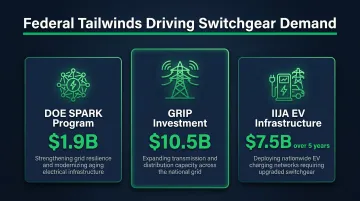
Demand is multi-sector and recurring.
Multi-sector customer base: Utilities, hyperscale and enterprise data centers, healthcare facilities (18% of hospital construction projects currently include switchgear), industrial plants, and commercial construction all require switchgear on ongoing replacement and expansion schedules. These customers create repeat purchasing relationships — not one-off transactions.
Differentiation opportunities: Faster domestic lead times (versus 18-36 months from incumbents), custom configuration capability, UL 891 and BABA compliance for federally funded infrastructure projects, and in-house engineering support are areas where focused manufacturers outperform slower competitors. BABA requires 55% domestic content for manufactured products in federal projects — a structural advantage for US-based production.
Tariff and reshoring tailwinds: Reciprocal tariffs of 15-50% on key electrical components from China and Mexico are driving local manufacturing investment. Eaton alone is investing over $30 million in a new 370,000 sq ft Nebraska facility. — a sign that even large players are running tight on capacity.
Early Decisions That Matter When Starting a Switchgear Manufacturing Business
Early-stage manufacturing failures are rarely about weak demand. They trace back to setup complexity that founders underestimated at the start. Get these foundational decisions right, and they set the trajectory for everything that follows:
Product Scope and Specialization
Attempting to manufacture all switchgear types from day one spreads capital and engineering too thin. Decide upfront:
- Low-voltage switchboards (UL 891) versus medium-voltage switchgear
- Specific industry vertical focus (data centers, utilities, industrial)
- Custom project-based builds versus standard catalog products
- Voltage class specialization (480V, 600V, or higher)
Each of these choices cascades directly into facility layout, certification sequencing, and what equipment you actually need to buy on day one.
Facility Planning
Switchgear manufacturing demands meaningful floor space. Established manufacturers operate from 20,000 to 50,000+ sq ft facilities with dedicated zones for fabrication, assembly, wiring, testing, and storage. DEI Power, for instance, operates a 50,000 sq ft facility in Ontario, California — purpose-built to support rapid deployment and strict quality control across its full production line.
Underbuilding the facility creates bottlenecks that cap production capacity and compromise delivery reliability. Regional costs vary significantly:
- Midwest: $6.50-$7.80/sq ft
- South: $7.50-$9.00/sq ft
- West (California/Inland Empire): $14.00-$17.50/sq ft
With facility size and location locked in, the next constraint to resolve is certification — because what you're permitted to sell depends entirely on what listings you hold.
Certification Sequencing
UL listing and OEM approvals define what you can sell, to whom, and at what price. UL 891 certification is mandatory for low-voltage switchboards in commercial applications—local electrical inspectors (AHJs) cannot approve equipment lacking NRTL listing under NEC requirements.
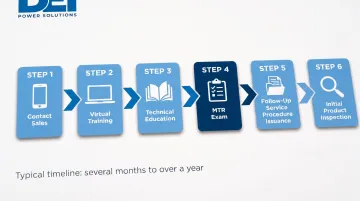
The UL 891 General Coverage Program (Annex G) streamlines the process for switchboards up to 4000A at 480V and 100kA SCCR, involving six steps: contact sales, virtual training, technical education, MTR exam, follow-up service procedure issuance, and initial product inspection. The full process typically runs several months — start it before facility buildout is complete, not after.
How to Start a Switchgear Manufacturing Business – Step by Step
This section breaks the process into eight sequential stages. Skipping or rushing any stage creates compounding problems.
Common early mistakes to avoid:
- Launching facility build-out before validating customer demand
- Underestimating UL certification timelines
- Trying to serve too many customer segments before achieving operational consistency
- Pricing based on material cost alone without accounting for engineering and production overhead
Step 1 – Identify Your Market, Customer, and Differentiation
Define target end markets first:
- Utilities
- Data centers (hyperscale, enterprise, colocation)
- Industrial facilities
- Healthcare
- Commercial construction
Each segment has distinct purchasing decision-makers: electrical engineers who write specifications, EPC contractors who procure, and facility teams who operate. Understanding these roles is critical.
Identify the specific problem you solve better than existing manufacturers:
- Faster lead times (critical when incumbents quote 18-36 months)
- Domestic BABA-compliant production
- Custom engineering support
- Superior technical documentation
- Competitive pricing without sacrificing quality
Without a clear answer, winning customers from established suppliers is difficult. Step 2 turns that answer into validated market evidence.
Step 2 – Validate Demand, Pricing, and Viability
Validate buying intent directly: Have conversations with electrical engineers, contractors, and procurement contacts in your target segments. Understand:
- How they currently source switchgear
- What frustrates them about existing suppliers
- What would make them qualify a new manufacturer
Research pricing and build a cost model: Include materials, labor, overhead, certification, freight, and realistic sales costs. Confirm the math produces viable margin before committing capital to facility and equipment. Underpricing early to win customers is a trap; once you've set expectations, raising prices is hard.
Step 3 – Define the Business Model and Product Scope
Choose your manufacturing model:
- Custom: Each project is designed to individual customer requirements
- Catalog: Standard configurations sold as defined SKUs at fixed price points
- Hybrid: A mix of stock units and custom builds
This choice affects production scheduling, cash flow, engineering staffing, and sales positioning.
Factor all cost layers into pricing from the start:
- Engineering design time
- Fabrication and component sourcing
- Wiring labor and QA testing
- Certification overhead
- Delivery logistics
- Sales cycle costs (can run months before PO)
Step 4 – Handle Legal, Compliance, and Certifications
Register the business: Entity formation, business licenses, and any state-specific manufacturing or electrical contractor registrations. Establish insurance appropriate for manufacturing operations: product liability, general liability, and workers' compensation.
Pursue required certifications:
- UL 891 is the standard for low-voltage switchboards in commercial/industrial applications
- NEMA compliance for product design and application standards
- IEEE-based testing protocols where applicable
- BABA compliance for federally funded infrastructure projects (requires 55% domestic content documentation)
A UL 891 listing combined with an approved OEM relationship with a major component brand like Siemens demonstrates the credibility that opens doors to specification-driven projects. DEI Power operates under exactly this model from its Ontario, California facility.
Begin UL certification early: The process involves product design review, facility audit, and ongoing quarterly compliance audits. Plan for 6-18 months — it's typically the longest bottleneck in the entire startup timeline.
Step 5 – Build the Facility, Equipment, and Production Process
Secure an appropriately sized facility: Ensure the layout supports logical production flow from raw material intake through fabrication, assembly, wiring, QA testing, and finished goods shipment. For reference, 20,000-50,000 sq ft is typical for entry-level LV switchboard production. DEI Power operates from a 50,000 sq ft facility in Ontario, California.
Invest in core production equipment:
| Equipment Category | Approximate Cost Range |
|---|---|
| CNC Press Brake (100-200T) | $18K-$150K+ |
| Fiber Laser Cutter | $15K-$600K+ (industrial-grade from $30K+) |
| Powder Coating System | $200K-$2M installed |
| Welding Stations | Variable |
| Busbar Fabrication Tools | Variable |
| Hi-pot Tester | $2K-$3K per unit |
| Insulation Resistance Tester | $1K-$2K per unit |
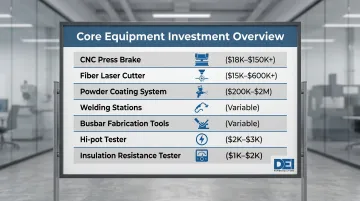
Each piece directly affects product quality and throughput. Plan for both entry-level and production-grade tiers depending on volume targets.
Build documented production workflows: Cover every stage from design intake through final packaging. Process consistency allows quality, lead time, and capacity to scale without error rates rising proportionally.
Step 6 – Hire and Build the Technical Team
Non-negotiable roles from day one:
- Licensed electrical engineer (product design and certification support)
- Skilled fabricators and assemblers
- Experienced wiring technician
- QA specialist (testing and documentation)
Licensed electrical engineers with switchgear-specific experience are not easy to recruit quickly. Competitive compensation packages are required. Factor hiring lead time and salary cost into the startup budget and timeline.
Step 7 – Go to Market and Win First Customers
Target the right decision-makers: Electrical engineers and consultants who write project specifications are often the real decision-makers. Getting your product specified by name in project documents (CSI MasterFormat Division 26 sections like 26 24 13 for Switchboards) is more valuable than broad advertising.
Build credibility before pursuing large accounts:
- UL 891 certification
- Clear product catalog with accurate lead times
- Reference installations
- Technical documentation and submittal packages
- Engineering support capability
In this market, buyers are conservative and risk-averse. Credibility signals matter more than pricing in many cases. The average B2B sales cycle runs 60-120 days, and specification-driven procurement can extend this further.
Step 8 – Monitor, Improve, and Stabilize Operations
Track the metrics that define manufacturing health:
- Production lead time vs. promised delivery
- Defect and rework rates
- On-time shipment percentage
- Customer satisfaction after installation
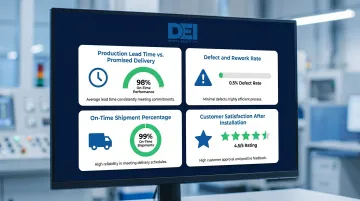
Fix process, quality, and capacity gaps before scaling. In a specification-driven market like switchgear, one late delivery or failed UL audit can unwind supplier relationships that took months to build. Earn the right to grow by proving you can deliver consistently at your current volume first.
Conclusion
Starting a switchgear manufacturing business is a high-investment, sequenced undertaking. Validate demand first, pursue certifications early, build a capable technical team, and earn customer trust before scaling. Cutting corners on any of these steps creates compounding risk — buyers in this market have zero tolerance for compliance gaps or inconsistent delivery.
Long-term success comes down to one thing buyers can verify: consistency. Consistent lead times, compliant products, solid engineering support, and a clear answer to why a customer should choose you over an established manufacturer. The underlying demand is strong — data centers are expanding, grid modernization is accelerating, and federal infrastructure spending continues to create project volume. But none of that matters without the capital, patience, and operational discipline to execute reliably from day one.
Frequently Asked Questions
How much capital do you need to start a switchgear manufacturing business?
Total capital requirements typically range from $500K to $2M+ depending on scale and equipment tier. Major cost drivers include facility lease ($200K–$500K+ annually for 20,000–50,000 sq ft), production equipment (press brakes, laser cutters, powder coating), testing equipment, and initial component inventory.
What certifications are required to manufacture switchgear in the US?
UL 891 is the primary listing for low-voltage switchboards in commercial and industrial applications—it's mandatory for equipment to pass local electrical inspector (AHJ) approval under NEC requirements. NEMA compliance and IEEE-based testing may also apply. For federally funded projects, BABA certification requires documenting 55% domestic content for manufactured products.
How long does UL certification take for a switchgear manufacturer?
Expect several months to over a year, depending on product complexity and audit readiness. The General Coverage Program (Annex G) can streamline the process but still requires passing the MTR exam and an Initial Product Inspection. Plan for this early—it's typically the longest gate in the startup timeline.
What is the difference between a switchgear manufacturer and a switchgear wholesaler?
A manufacturer designs, fabricates, and assembles switchgear in their own facility using raw materials and sourced components—like DEI Power's 50,000 sq ft Ontario, California facility. A wholesaler purchases finished products from manufacturers and resells them. Manufacturing carries significantly higher capital requirements, technical staffing needs, and compliance obligations.
What types of switchgear are most in demand right now?
Low-voltage switchboards (UL 891-rated, 600V or less) serve the broadest market including commercial construction, industrial plants, and data centers. This segment holds 40% of US switchgear market share and captured 63.53% of air-insulated switchgear revenue in 2024. Medium-voltage switchgear is growing fastest in hyperscale data centers supporting AI workloads, but LV remains dominant across most commercial and industrial applications.
Do I need licensed engineers on staff to start a switchgear manufacturing business?
Yes. Licensed electrical engineers are essential for product design, UL certification support, and quality assurance. This is a technical manufacturing business where engineering expertise cannot be outsourced or deferred without significant compliance and quality risk. Experienced fabricators, wiring technicians, and QA personnel are also required before production can begin.