Introduction
Low voltage (LV) switchgear covers equipment operating below 1,000V AC — circuit breakers, contactors, fuses, protective relays, and distribution boards. From data centers and hospitals to manufacturing plants and utility substations, these systems protect circuits, control power flow, and isolate faults, sitting between the incoming utility feed and every downstream load.
Despite this, LV switchgear maintenance remains one of the most overlooked aspects of electrical asset management. The consequences of neglect are concrete:
- Arc flash explosions injure approximately 2,000 workers annually
- Unexpected shutdowns cripple operations and trigger costly emergency repairs
- Failed protective devices allow faults to cascade through entire distribution systems
- Accelerated equipment aging shortens replacement cycles and inflates capital budgets
In 2023, 7,400 nonresidential electrical malfunction fires caused $354.4 million in property losses across the United States.
This guide covers why maintenance matters, the four maintenance types (preventive, corrective, predictive, and overhaul), warning signs to watch for, key tasks within each approach, and a scheduling framework aligned with NETA Appendix B and IEC 60364-6.
Key Takeaways
- LV switchgear degrades continuously from temperature cycles, humidity, dust, and load stress — maintenance prevents safety incidents and extends equipment life
- Four maintenance types apply: preventive, corrective, predictive/condition-based, and major overhaul
- Key warning signs include thermal damage, nuisance tripping, rising contact or insulation resistance readings, and abnormal noise
- Maintenance intervals depend on environmental severity, load profile, and equipment criticality — not universal fixed schedules
- Qualified personnel must follow equipment-specific procedures and lockout/tagout (LOTO) protocols for every task
Why LV Switchgear Maintenance Is Important
Aging Occurs Whether Equipment Operates or Not
LV switchgear ages continuously, even when circuits are energized but carrying no load. Common environmental and operational stressors include:
- Temperature swings that degrade insulation polymers
- Humidity that accelerates corrosion on silver-plated contacts
- Dust buildup that creates tracking paths and reduces dielectric strength
- Vibration that loosens torqued connections over time
- Corrosive atmospheres that attack busbars and enclosures
- Harmonic currents that generate excessive heat in neutral conductors
These factors compound over time, causing insulation to crack, contacts to oxidize, mechanical components to wear, and protective devices to drift out of calibration. Equipment that appears fully functional can fail suddenly under fault conditions once these weaknesses reach a critical threshold — which is why scheduled inspection matters.
Safety Implications: Arc Flash and Electrical Fires
Poorly maintained switchgear is a leading cause of arc flash events, which occur when electrical energy vaporizes conductive material and creates a plasma explosion. An estimated 5 to 10 arc flash explosions occur daily in the United States, with per-injury costs ranging from $10,000 to $15,000,000 depending on severity. Electric arcs reach temperatures up to 35,000 degrees Fahrenheit — hotter than the surface of the sun — and can cause devastating burns, blindness, and fatality.
The regulatory framework reflects this risk. IEC 60364-6 mandates periodic verification of electrical installations, requiring tests of insulation resistance, protective conductor continuity, and earth fault loop impedance. In the United States, NFPA 70B shifted from a "Recommended Practice" to a mandatory "Standard" in 2023, requiring annual infrared thermography inspections with defined severity thresholds. Non-compliance now carries enforceable consequences, not just liability exposure.
Financial Case: Reactive vs. Preventive Maintenance
The cost differential between reactive and preventive maintenance is stark. Switchboards that are not properly maintained are 62% more likely to fail than those receiving regular preventive maintenance, according to Schneider Electric citing IEEE Standards Association data. Reactive maintenance is approximately 3 to 4 times more expensive than preventive maintenance, driven by emergency repair premiums, expedited parts shipping, overtime labor, collateral equipment damage, and unplanned downtime costs.
The downtime costs in high-stakes environments make this math even more unforgiving. A single hour of unplanned outage in a data center can exceed $100,000; in a hospital, it directly affects patient safety. More than two-thirds of electrical system failures can be prevented through a routine preventive maintenance program, according to Hartford Steam Boiler.
Equipment Lifespan and Replacement Timing
Well-maintained LV switchgear can achieve its full rated service life — often 20-30 years for structural components like enclosures and busbars. However, individual components have much shorter replacement cycles, according to ABB's Life Cycle Management documentation:
| Component | Typical Replacement Cycle |
|---|---|
| Molded-case circuit breakers | 10–15 years |
| Electronic trip units | 10–12 years |
| Power factor correction capacitors | 5–8 years |
| Control batteries | 2–3 years |
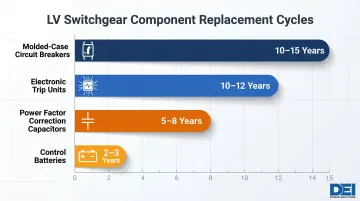
Neglected equipment degrades faster, shortening these cycles and creating schedule risk for facilities that cannot tolerate outages. Tracking component-level aging, not just overall system age, allows facilities teams to replace parts on their schedule rather than the equipment's.
Types of LV Switchgear Maintenance
No single maintenance strategy covers all situations. The right approach depends on equipment criticality, environmental severity, and operational profile. Most facilities use a combination of all four types described below.
Preventive (Periodic) Maintenance
Scheduled inspections and servicing carried out at predetermined intervals — regardless of observed condition — form the backbone of most maintenance programs. This approach aligns with manufacturer guidelines and standards like NETA Appendix B, making it the most universally recommended starting point.
Core tasks include:
- Inspect enclosures, busbars, and connections for physical damage, corrosion, or discoloration
- Clean with dry cloth or vacuum — no solvents — to remove dust and contaminant buildup
- Torque-check electrical connections to manufacturer specifications (75-80% of initial torque)
- Lubricate mechanical components — hinges, latches, operating mechanisms — per manufacturer specs
- Run insulation resistance (Megger) testing at rated voltage to detect degradation
- Test contact resistance to catch high-resistance joints before they overheat
- Functionally test circuit breakers (trip/close cycles) and protective relays
- Run infrared thermography scans to detect hotspots from loose connections or overloaded components
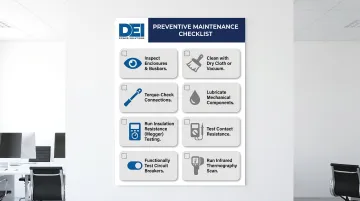
Record every test result and trend it over time. Declining insulation resistance or rising contact resistance rarely announces itself — trending data catches both patterns early and gives teams the evidence to adjust maintenance frequency based on real equipment condition rather than arbitrary schedules.
Corrective (Reactive) Maintenance
Repairs and replacements triggered by an identified fault are unavoidable — but reactive maintenance becomes a liability when it's the default strategy rather than the exception.
Risks of over-reliance on reactive maintenance:
- Higher emergency repair costs (3-4x preventive costs)
- Extended downtime due to parts sourcing delays
- Potential safety incidents when failures occur unexpectedly
- Cascading failures when a protective device fails to operate correctly during a fault condition
- Collateral damage to connected equipment when faults are not isolated quickly
Facilities should limit corrective maintenance to 20-30% of total maintenance activities, reserving it for truly unpredictable failures rather than allowing it to become the default strategy.
Predictive (Condition-Based) Maintenance
Rather than following a fixed calendar, condition-based maintenance fires when the equipment says so — an electronic trip unit signaling that operation count has exceeded durability limits, or thermal sensors detecting sustained elevated temperatures.
Tools that enable predictive maintenance:
- Infrared thermography cameras — detect hotspots and temperature differentials
- Ultrasonic detectors — identify corona discharge or tracking in insulation
- Smart trip units with embedded diagnostics — operation counters, contact wear tracking, cumulative energy let-through
- IoT-connected monitoring systems providing real-time alerts on equipment status
- Power quality analyzers tracking harmonics, load trends, and voltage disturbances
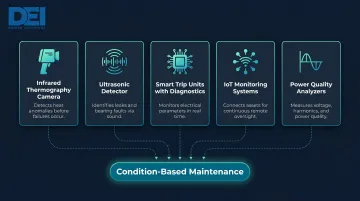
Predictive maintenance is a complement to periodic maintenance, not a replacement for it. It optimizes intervals by reducing unnecessary shutdowns while ensuring critical interventions happen before failure. For example, ABB's Ekip Touch trip units track contact wear percentage; when wear exceeds 80%, the system triggers immediate overhaul regardless of where the equipment falls in its scheduled maintenance cycle.
Major (Overhaul) Maintenance
Major overhaul consists of deep-service events that go beyond routine inspection, including arc chute replacement, main contact replacement in air circuit breakers, full mechanical overhaul of the operating mechanism, and trip unit replacement or manufacturer-level diagnostics.
Overhaul is required when:
- A significant short-circuit event occurs (especially faults exceeding the service short-circuit breaking capacity, or Ics)
- Contact wear indicators reach their limits (80% wear or manufacturer-specified threshold)
- Defined operating cycle limits are reached (varies by frame size: 12,000-25,000 operations for ABB Emax 2)
- Calendar time reaches manufacturer recommendations (5 years for power circuit breakers >630A in harsh environments, 10 years in standard environments)
IEC 60947-2 provides the post-fault decision framework: faults at or below Ics (service breaking capacity) allow continued service after inspection, while faults exceeding Ics up to Icu (ultimate breaking capacity — the point at which the breaker may no longer be reused) require thorough inspection or replacement. When embedded diagnostics aren't tracking fault energy, inspect after any significant fault event. The cost of an unnecessary inspection is far lower than the cost of missing a damaged breaker in service.
Warning Signs Your LV Switchgear Needs Maintenance
Catching problems early is the difference between a scheduled inspection and an unplanned outage. These are the clearest warning signs that your LV switchgear needs attention — sorted by type so maintenance teams can triage quickly.
Visible Physical and Thermal Indicators
Look for these during any visual walkthrough:
- Burn marks, discoloration, or scorching on busbars, terminals, or enclosure surfaces
- Cracks in circuit breaker cases indicating mechanical stress or thermal damage
- Blackened arc chute fins with structural damage (note: some blackening is normal; cracking or missing fins is not)
- Corroded or discolored contacts — silver-plated contacts should be bright; dark oxidation signals high resistance buildup
- Moisture or condensation inside enclosures (especially in coastal or high-humidity environments)
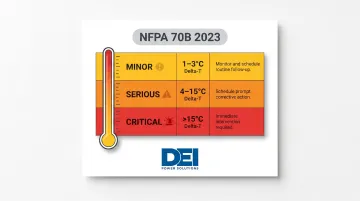
Whenever thermal discoloration appears, order an infrared thermography scan immediately to assess the severity. NFPA 70B 2023 defines three severity classifications: Minor (1–3°C delta-T vs. similar components), Serious (4–15°C delta-T), and Critical (>15°C delta-T) — each with a corresponding required response timeline.
Operational and Electrical Anomalies
Electrical behavior often reveals problems before anything is visible:
- Nuisance tripping not attributable to legitimate overloads or ground faults
- Circuit breakers that fail to reset or close reliably (indicating mechanical binding or low control voltage)
- Elevated contact resistance compared to baseline trending data (increasing resistance generates heat)
- Declining insulation resistance on periodic Megger tests — values below 1 MΩ per IEC 60364-6 indicate severe degradation requiring immediate investigation
- Unusual heat detected during IR thermography scans (hotspots indicating loose connections or overloaded components)
Don't wait for a value to cross a threshold — a consistent downward trend in insulation resistance is reason enough to investigate, even when readings are still within acceptable range.
Mechanical and Environmental Warning Signs
Operating sounds and environmental conditions both tell you when something is wrong:
- Abnormal noise or vibration during breaker operation (grinding, buzzing, or chattering sounds)
- Sluggish or obstructed mechanical travel — if a breaker takes noticeably longer to open or close, the operating mechanism needs inspection
- Excessive dust or contaminant buildup inside enclosures (especially in environments with coal dust, chemical vapors, or salt air)
- Gear motor charging times that exceed normal limits (indicating motor wear or low control voltage)
- Visible corrosion on busbars, terminals, or enclosure surfaces (especially in coastal installations)
Facilities in coastal, chemical, or high-particulate environments should shorten inspection intervals — degradation compounds faster than standard schedules account for.
LV Switchgear Maintenance Schedule (General Guidelines)
Maintenance intervals are not universal — they must be adjusted based on environmental severity, equipment criticality, load profile (continuous vs. intermittent), and manufacturer-specific recommendations. A single more-severe condition (e.g., harsh environment or poor equipment condition) requires more frequent servicing; favorable conditions across all parameters support extended intervals.
General Frequency Framework
The following table provides reference intervals aligned with NETA Appendix B, IEC 60364-6, and manufacturer guidance. These should be customized to your facility's specific conditions.
| Maintenance Type | Interval | Tasks | Applicable Equipment |
|---|---|---|---|
| Visual Checks | Monthly/Quarterly | Enclosure condition, environmental monitoring, accessible connection inspection | High-load or harsh-environment installations |
| Annual Preventive | 12 months | Full visual inspection, functional testing of circuit breakers/relays, Megger insulation testing, connection torque checks, IR thermography scan, faulty accessory replacement | All LV switchgear (baseline) |
| Electrical Testing | 24-36 months | Detailed electrical measurements, secondary injection testing of trip units, contact resistance testing | Power circuit breakers >630A; 36 months for medium-reliability equipment per NETA Appendix B |
| Extraordinary Maintenance | 18-36 months | Lubrication of mechanical components, operating mechanism inspection, contact surface examination | Power circuit breakers in standard environments (3 years); harsh environments (18 months) |
| Major Overhaul | 5-10 years | Arc chute replacement, main contact replacement, full mechanical overhaul, trip unit diagnostics | 5 years for harsh environments or power breakers >630A; 10 years for standard environments |
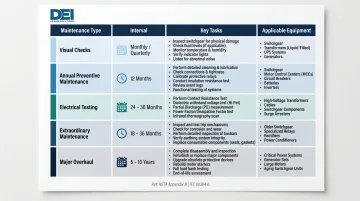
NETA Appendix B Multiplier Matrix: ANSI/NETA MTS-2011 Appendix B uses a condition/reliability multiplier to scale base intervals. High-reliability equipment in poor condition uses a 0.25 multiplier (a 36-month base becomes 9 months); low-reliability equipment in good condition uses 2.5 (a 12-month base becomes 30 months).
Post-Event Maintenance
Any significant short-circuit event should trigger an immediate out-of-cycle inspection, regardless of where the equipment falls in its scheduled maintenance cycle.
Post-fault inspection must cover:
- Arc chute condition (structural integrity, fin damage)
- Main contact wear (visual examination and contact resistance testing)
- Case integrity (cracks, deformation, thermal damage)
- Trip unit response (verify correct operation and review stored event logs if available)
- Busbar connections (torque check and IR scan)
IEC 60947-2 defines the Ics/Icu framework: faults at or below the service short-circuit breaking capacity (Ics) allow continued operation after inspection; faults exceeding Ics up to the ultimate short-circuit breaking capacity (Icu) typically require replacement or thorough overhaul. For facilities without embedded fault energy tracking, conservative practice dictates inspection after any fault that trips upstream protective devices.
Mission-Critical Environment Intervals
For environments where uptime is essential — data centers, hospitals, utility substations, and continuous-process manufacturing — quarterly or semi-annual inspection cycles are standard practice.
Typical mission-critical schedule:
- Quarterly: Visual inspection, enclosure cleaning, IR thermography scan, environmental condition monitoring
- Semi-annual: Functional testing of circuit breakers and relays, connection torque checks, accessible component inspection
- Annual: Full electrical testing (Megger, contact resistance, protective device calibration), documentation review and trending analysis
- Post-event: Immediate inspection following any fault, voltage transient, or environmental event (flooding, extreme temperature)
For UL 891-certified switchboards, always reference the equipment-specific submittal documentation — manufacturers like DEI Power include interval recommendations aligned with both UL 891 requirements and Siemens component OEM schedules.
Conclusion
LV switchgear maintenance is a structured, ongoing responsibility — not a one-time event. The right combination of preventive, condition-based, and overhaul strategies protects personnel, preserves equipment life, and ensures uptime in environments where power reliability is non-negotiable. Neglecting maintenance doesn't just increase costs through reactive repairs; it creates safety hazards, jeopardizes regulatory compliance, and shortens equipment service life.
Maintenance effectiveness starts with equipment quality. Switchboards built to UL 891 standards — like those DEI Power manufactures using genuine Siemens components — arrive at your facility in verified, documented condition, giving maintenance teams a reliable, well-characterized baseline from day one.
But even the highest-quality equipment requires a disciplined maintenance program to perform at its best over the long term. Pair quality equipment with a documented, trending-based maintenance plan that adapts to your facility's specific environmental conditions, load profile, and criticality. Done consistently, that combination reduces unplanned outages, keeps total cost of ownership in check, and extends equipment service life well beyond standard expectations.
Frequently Asked Questions
What is LV switchgear maintenance?
LV switchgear maintenance refers to the scheduled inspection, testing, cleaning, lubrication, and repair of low-voltage electrical distribution equipment (operating below 1,000V) to preserve its safety, protective function, and operational reliability over its service life. Activities span visual inspections and functional testing through insulation resistance measurement and component replacement.
How often should LV switchgear maintenance be performed?
Annual inspections are the standard baseline, with quarterly or semi-annual checks recommended for mission-critical or harsh-environment installations. NETA Appendix B and manufacturer guidelines define the primary reference intervals, adjusted based on equipment condition and criticality.
What are the main types of maintenance for LV switchgear?
There are four types, and most facilities use all of them in combination:
- Preventive — scheduled inspections and servicing at set intervals
- Corrective — reactive repairs triggered by faults or failures
- Predictive/condition-based — maintenance driven by monitoring data, thermal sensors, or operation counters
- Major overhaul — deep servicing including contact replacement and full mechanical overhaul
What tests are required for LV switchgear and how are they performed?
Standard tests include:
- Insulation resistance — Megger test at rated voltage
- Contact resistance — low-resistance ohmmeter measurement
- Functional/trip testing — manual and automatic verification of circuit breakers and relays
- Infrared thermography — thermal imaging under load to identify hot spots
All testing requires qualified personnel, strict lockout/tagout compliance, and adherence to manufacturer procedures.
What is the life expectancy of LV switchgear?
Major structural components — enclosures and busbars — can last 20-30 years with proper maintenance. Individual parts have shorter cycles: MCCBs (10-15 years), electronic trip units (10-12 years), capacitors (5-8 years), and control batteries (2-3 years). Actual lifespan depends on operating frequency, environment, and maintenance quality.
What are the key elements of preventive maintenance for LV switchgear?
A complete preventive maintenance program covers:
- Visual inspection for physical damage and corrosion
- Enclosure cleaning with dry cloth or vacuum
- Connection torque verification per manufacturer specs
- Lubrication of mechanical components
- Insulation and contact resistance testing
- Functional testing of circuit breakers and protective relays
- Infrared thermography scanning under load
- Documentation and trend analysis across cycles to catch degradation early