Introduction
When contractors, engineers, and facility teams specify control panels, they see UL markings on nearly every unit—yet most struggle to explain what those markings actually guarantee. Failed inspections, rejected installations, and costly rework often trace back to that gap. The confusion runs deeper than surface-level labeling: a panel built in a UL-certified shop isn't necessarily a UL-certified panel, and a UL sticker on the outside doesn't confirm every internal component meets the standard.
That distinction matters at every stage — from spec sheets to final inspection. This guide cuts through the ambiguity: what UL certification actually covers, which standard applies to your application, what inspectors verify on-site, and how to confirm you're buying genuine compliance rather than a sticker and a handshake.
Key Takeaways
- UL certification confirms a control panel was tested and built to nationally recognized safety standards required by the NEC and OSHA
- UL 508A covers most industrial control panels; UL 891 applies to switchboards; UL 698A and UL 1203 cover hazardous locations
- Inspectors, insurers, and project owners routinely require UL compliance—making it effectively mandatory on most commercial and industrial jobs
- Shop certification doesn't equal panel certification—verify each panel has its own UL Listing with a traceable file number
- For switchboards and power distribution equipment, UL 891 certification is the standard that governs safe design, construction, and field acceptance
What Is UL Certification for Control Panels?
UL Solutions (formerly Underwriters Laboratories) is the largest Nationally Recognized Testing Laboratory (NRTL) in the United States, operating under OSHA recognition per 29 CFR Part 1910.7.
In 2022, UL Inc. restructured into three separate entities: UL Solutions handles commercial certification and testing, UL Research Institutes conducts independent safety research, and UL Standards & Engagement develops consensus-based standards. For panel buyers, UL Solutions is the entity that tests, certifies, and inspects control panels.
Three Levels of UL Certification
UL operates three distinct certification categories, each serving different purposes:
| Certification Level | What It Covers | Example Applications |
|---|---|---|
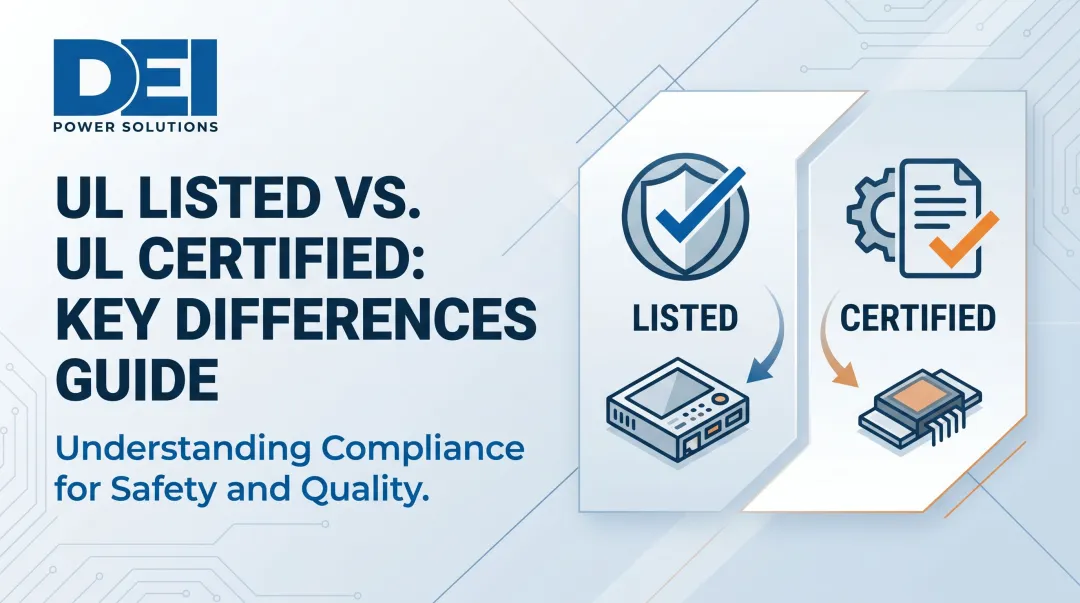
| UL Listed | Complete, ready-to-use products tested for safe operation | Assembled control panels, switchboards |
| UL Recognized | Components designed for use within larger Listed products | Power supplies, switches, terminal blocks |
| UL Classified | Products evaluated only for specific properties or hazards | Fire-resistance ratings, limited-scope testing |
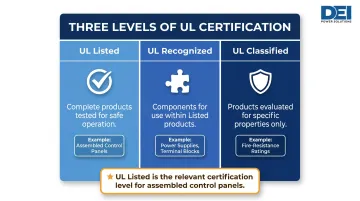
For control panels, UL Listed is the relevant certification—it means the complete assembled panel meets all applicable safety requirements for its intended use. A UL Listing Mark on a control panel indicates:
- UL Solutions tested representative samples against the applicable standard
- Construction, wiring, components, and protective measures all meet compliance requirements
- Ongoing compliance is verified through UL's Follow-Up Services program, which conducts periodic factory inspections
A panel with a UL Listing Mark is not the same as a panel assembled using some UL-listed components. The mark applies to the entire system as an integrated assembly, not just individual parts. Some panels carry only an enclosure-level listing rather than a full assembly listing—buyers must confirm which type applies before purchase.
UL Solutions is consolidating legacy Listed and Classified marks into a modular Enhanced UL Certification Mark that includes unique identifiers linking to certification details via UL Product iQ. During the transition, both legacy and enhanced marks remain valid—so a Listing Mark on a panel you're evaluating today is still fully enforceable regardless of which format it uses.
Which UL Standards Apply to Control Panels?
The applicable standard depends on panel type and intended use. Using the wrong standard creates compliance gaps that inspectors will catch.
UL 508A — Industrial Control Panels
UL 508A is the primary standard for industrial control panels in ordinary (non-hazardous) locations. Its scope covers panels operating at 1,000 volts or less in environments where ambient temperature doesn't exceed 40°C (104°F). The standard addresses:
- Component selection and ratings (all must be UL Listed or UL Recognized)
- Wiring methods, circuit separation, and conductor sizing
- Short-Circuit Current Rating (SCCR) calculation and labeling
- Enclosure ratings for environmental protection
- NEC and Canadian Electrical Code (CEC) conformance
Current edition: 3rd Edition, published April 2018, most recently revised June 2025 (ANSI approved).
UL 891 — Switchboards and Power Distribution Panels
UL 891 governs low-voltage switchboards and power distribution equipment—distinct from UL 508A because it covers larger assemblies used in commercial, industrial, and utility applications rather than machine-level control panels. The standard covers dead-front switchboards rated at 1,000V or less.
Under Annex G, UL's General Coverage Program allows approved manufacturers to apply UL marks at their factories for designs within specified parameters. Key rating limits include:
- Up to 480V at maximum amperage (or 600V for constructions under 2,000A)
- Maximum 4,000A (U.S.) and 3,000A (Canada)
- SCCR ratings up to 100kA
DEI Power holds UL 891 certification for its switchboards and power distribution equipment, manufactured in Ontario, California. Engineers and contractors specifying facility-level power distribution—data centers, commercial buildings, industrial plants, utility substations—will find UL 891 the applicable standard for these assemblies.
Other Standards for Specialized Applications
UL 698A (Edition 4, November 2022) covers industrial control panels installed in unclassified locations that have intrinsically safe circuit extensions into hazardous (classified) locations—Class I, II, and III, Division 1, plus Zone 0, 1, 20, and 21 AEx.
UL 1203 (Edition 6, May 2024) covers explosion-proof and dust-ignition-proof equipment for direct installation in hazardous locations. Covered locations include Class I Division 1 (Groups A–D), Class II Division 1 (Groups E–G), Class I Zone 1 (Groups IIA–IIC), and Zone 20, 21, and 22 locations per NFPA 70. Equipment must withstand ambient temperatures as low as -60°C.
UL 60947-4-1 replaces UL 508 for individual control components—magnetic motor controllers, manual motor controllers, combination motor controllers, and overload relays—bringing U.S. certification in line with IEC standards. The transition started January 2012 and completed January 2017. UL 508 is no longer available for new certifications in these categories.
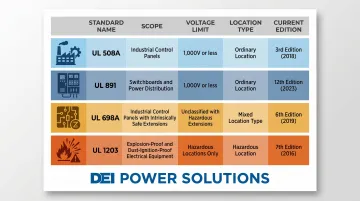
Quick-reference comparison:
| Standard | Scope | Voltage Limit | Location Type | Current Edition |
|---|---|---|---|---|
| UL 508A | Industrial control panels | 1,000V or less | Ordinary | 3rd Ed, rev. June 2025 |
| UL 891 | Switchboards and power distribution | 1,000V or less | Ordinary | Active (GC to 480V/4000A) |
| UL 698A | ICPs with intrinsically safe extensions | Per panel rating | Unclassified (with hazardous extensions) | Ed 4, Nov 2022 |
| UL 1203 | Explosion-proof/dust-ignition-proof | Per equipment | Hazardous (Class I/II, Div 1) | Ed 6, May 2024 |
What Does UL Certification Actually Require?
UL 508A certification covers the entire assembled panel—not just individual components—and verifies that construction, wiring, grounding, labeling, and protective measures all meet the standard together. Core requirement categories include:
- Components: All must be UL Listed or UL Recognized and rated for their specific application
- Wiring: Power and control circuits must be properly separated, with correct sizing, insulation, and routing
- Enclosures: Must provide appropriate environmental protection against moisture, dust, and mechanical damage
- Markings: Panels must display required information including voltage, phase, and Short-Circuit Current Rating (SCCR)
SCCR: Why It Matters and How It's Calculated
The National Electrical Code (NEC Section 409.110) requires industrial control panels to be labeled with a Short-Circuit Current Rating (SCCR) that meets or exceeds the available fault current at the installation site. The SCCR represents the maximum fault current the panel can safely withstand without component failure or fire.
UL 508A Supplement SB provides an calculation method to calculate SCCR without destructive physical testing:
- Assess individual component SCCRs using manufacturer-published ratings or default values from Table SB4.1 for components without marked ratings
- Apply current-limiting device effects where fuses or circuit breakers reduce peak fault current to levels within downstream component ratings
- Determine overall panel SCCR based on the lowest-rated component or branch circuit in the assembly
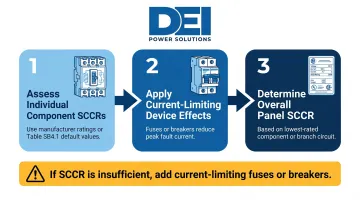
If calculated SCCR is inadequate for the installation site's available fault current, current-limiting fuses or circuit breakers can be added to protect downstream components.
UL Industrial Control Panel (ICP) Shop Program
UL's Panel Shop Program allows certified manufacturers to apply UL Certification Marks in-house without UL Solutions reviewing each individual panel design. For buyers, this translates to faster turnaround and lower per-panel costs compared to individual UL evaluation. Key requirements include:
- Mandatory initial training on UL 508A upon program entry
- At least one qualified Manufacturer Technical Representative (MTR) on staff who has passed UL's examination
- A UL-issued Follow-Up Service procedure serving as the factory production manual
- Initial product inspection by a UL field engineer before authorization to apply marks
- Ongoing periodic Follow-Up Service inspections
Buyers who work directly with UL Solutions—outside the shop program—face higher costs and longer timelines because every panel requires individual evaluation. For time-sensitive projects, sourcing from a certified shop program manufacturer is the practical choice.
Enclosed vs. Open Type Panel Listings
The listing type stamped on a panel determines what's actually certified—and what still needs to be addressed in the field. UL 508A recognizes two distinct configurations:
- Enclosed panels: Complete assemblies with protective enclosures, rated for indoor use or carrying NEMA type ratings (3R, 4, or 12)
- Open-type panels: Designed to be installed into an enclosure in the field
Each type carries a different UL Listing label. The distinction matters because an open-type listing does not include the enclosure, which must be separately rated and applied in the field. Specifying the wrong type can leave a gap in your enclosure compliance—an issue that typically surfaces during inspection, not before.
Why UL Certification Matters — and What Buyers Often Get Wrong
Practical Consequences of Non-Compliance
UL certification directly impacts project success in three ways:
- Inspection approval: NEC Sections 110.2 and 110.3 require electrical equipment to be listed or labeled for its intended use. A UL Listing satisfies this requirement, simplifying AHJ approval and keeping inspections on track.
- Insurance coverage: Insurance carriers commonly require UL Listing as a prerequisite for coverage on commercial and industrial electrical installations. Certification may also reduce premiums.
- Project risk: Non-compliant panels risk rejection at inspection, requiring costly rework or replacement. The combined expenses of expedited replacement, labor rework, and schedule delays can easily exceed the original panel cost.
The Certified Shop Misconception
The most common buyer mistake: assuming every panel from a UL-certified shop automatically carries UL certification. It doesn't.
Being a "UL Listed Panel Shop" means the manufacturer is authorized to apply UL marks. It does not obligate them to do so on every panel. Shops apply UL listing only when customers specifically request and pay for it, typically adding around 10% to the panel price.
The distinction matters more than most buyers realize. You can receive a panel from a fully certified shop that carries no UL mark at all.
To verify: ask whether the specific panel you're purchasing carries UL Listing and request the file number. Shop certification is irrelevant if the panel itself isn't listed.
When Certified Components Still Aren't Enough
A UL 508A sticker on the outside does not guarantee all internal components are individually UL Listed or Recognized. Some discount panels are assembled in certified shops but use non-certified internal components. To verify full compliance:
- Confirm each component is UL Listed or UL Recognized for its specific application
- Request component documentation and traceability records
- Verify the shop maintains qualified staff to produce Material Test Reports (MTRs)
How to Source UL-Certified Control Panel Equipment
Essential Questions for Any Panel Supplier
Before purchasing, ask:
- Is this specific panel UL Listed—not just the shop? Request the file number and verify it in UL Product iQ.
- Are all internal components UL Listed or UL Recognized for their application? Request component documentation.
- What UL standard is the panel built to, and does that match your installation requirements? For power distribution—switchboards and distribution assemblies—that means UL 891. Other applications (industrial control panels, hazardous locations) fall under different standards, so confirm the match before purchasing.
- Does the supplier provide documentation, including the UL Listing file number and labeling traceability? Legitimate listings are always traceable.
Power Distribution Applications: UL 891 Certification
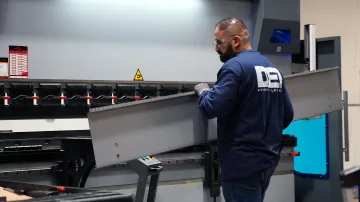
For power distribution applications—switchboards, switchgear, and distribution panels serving commercial buildings, data centers, industrial plants, or utility infrastructure—UL 891 certification is the relevant standard to require. DEI Power's UL 891-certified switchboards, manufactured at their 50,000 sq. ft. facility in Ontario, California, demonstrate what compliant sourcing looks like in practice:
- Vertically integrated production prevents component substitution and keeps documentation trails clean for inspectors and insurance carriers
- Specification reviews, compliance verification, and submittal preparation are available before shipment — so contractors and engineers confirm compliance before equipment arrives on site
- In-stock units ship in 3–5 business days; custom configurations complete in 4–6 weeks
- Built with genuine Siemens components as an approved Siemens OEM, ensuring long-term reliability with UL Listed parts throughout
- Manufactured in the USA with domestic materials, meeting Buy America Build America (BABA) requirements for federally funded projects
Verify Lead Times and Manufacturing Transparency
In-house manufacturing (versus outsourced fabrication) reduces the risk of substituted components and certification gaps. Ask suppliers:
- Where is the panel manufactured and assembled?
- Is production vertically integrated or outsourced?
- What documentation confirms component traceability?
- What are lead times for in-stock versus custom units?
Suppliers who can answer these questions with specifics—file numbers, facility locations, documented component sources—are the ones least likely to create compliance surprises during inspection.
Frequently Asked Questions
Do control panels need to be UL listed?
While UL Listing is not universally mandated by federal law, most jurisdictions require control panels to meet NRTL-certified safety standards. Inspectors, insurance carriers, and project owners routinely require UL compliance—making it effectively necessary on most commercial and industrial projects.
Which is better, CE or UL?
The right certification depends on where the equipment is installed. UL is the accepted standard for the US market, recognized by OSHA and AHJs nationwide. CE is required for EU countries. CE-marked equipment does not satisfy US workplace safety requirements, so for domestic projects, UL is the applicable standard.
What is the difference between NEC and UL?
UL standards govern how control panels are constructed and tested (the product), while the NEC (National Electrical Code) governs how electrical equipment is installed (the application). UL 508A is recognized by NEC Section 409.110 as the construction standard for industrial control panels, but a panel can have a valid UL listing and still need to meet local NEC installation requirements enforced by the AHJ at the site.
What makes an electrical panel UL listed?
A UL Listed panel must satisfy four conditions:
- Tested against the applicable UL standard (UL 508A for industrial control panels; UL 891 for switchboards)
- Built with UL Listed or Recognized components
- Compliant with wiring, labeling, and SCCR marking requirements
- Subject to ongoing UL Follow-Up Services inspections to maintain listing status
How do I look up a UL listing for an electrical panel?
Use UL's free online database at productiq.ulprospector.com, where you can search by manufacturer name, product category, or file number printed on the panel's UL label. Every legitimately UL Listed panel will have a traceable file number that can be verified in this database.
What is a UL panel shop?
A UL panel shop participates in UL's Industrial Control Panel (ICP) Shop Program, which authorizes the manufacturer to apply UL Listing Marks at the factory. Shop certification does not guarantee every panel produced is UL Listed—buyers should confirm the specific panel was built to UL standards and carries a traceable file number.