Introduction
As solar, wind, and battery storage installations accelerate across commercial and utility sectors, the focus often lands on the generation technology itself—solar panels, turbines, inverters—but power distribution equipment determines whether a renewable energy system works reliably at scale. Unlike conventional power plants that produce steady output, renewable sources generate electricity at variable voltages, frequencies, and intermittent rates—creating distribution challenges that demand purpose-built equipment.
That's where balance-of-system (BOS) equipment comes in. Switchgear, transformers, inverters, Battery Energy Storage Systems (BESS), and safety disconnects condition, control, store, and safely deliver power to end users or the grid. According to DOE/NREL Q1 2024 benchmarks, electrical and structural BOS alone account for nearly 30% of total utility-scale solar system cost—making specification decisions here as consequential as any technology choice upstream.
TLDR:
- Distribution equipment stabilizes the variable voltage, frequency, and power flow that renewable sources produce before grid integration
- Core equipment includes UL 891 switchgear, UL 1741 inverters, bidirectional transformers, BESS, and safety disconnects
- Electrical BOS represents 17% of utility-scale PV cost; specification errors directly impact project economics
- Grid-connected systems require UL 1741 inverters and IEEE 1547 compliance; off-grid configurations add battery banks and charge controllers
- BABA compliance and UL 891 certification are critical for federally funded projects and interconnection approval
Why Power Distribution Equipment Is Critical for Renewable Energy Systems
Renewable energy systems present fundamentally different distribution challenges than conventional fossil-fuel generation. Fossil plants produce steady, predictable output at consistent voltage and frequency. Solar and wind generate electricity at variable voltages and intermittent rates that must be conditioned and stabilized before the power can be used or fed to the grid.
Balance-of-System (BOS) refers to all equipment required beyond the energy generator itself—solar panels, turbines, or fuel cells. It includes everything that conditions, controls, stores, and safely delivers power to end users or the grid: inverters, switchgear, transformers, BESS, charge controllers, safety disconnects, and metering equipment.
That equipment carries real cost weight. According to DOE/NREL data, electrical BOS accounts for $0.19/Wdc (17.0%) and structural BOS for $0.14/Wdc (12.5%) of the $1.12/Wdc total utility-scale PV system cost.
Grid Integration Requirements
Connecting renewable sources to the grid requires meeting strict technical and regulatory standards. Distribution equipment must:
- Match grid voltage and frequency (60 Hz in the US)
- Support bidirectional power flow (DERs can both import and export power)
- Provide voltage/frequency ride-through during disturbances
- Deliver reactive power for grid stability
IEEE 1547 and utility interconnection agreements make these technical requirements mandatory, not optional.
High Stakes of Failure
In commercial and utility-scale contexts, a fault or misconfiguration can take an entire project offline, delay interconnection approval, or trigger costly field rework. With power transformer lead times averaging 128 weeks and switchgear 44 weeks, procurement delays alone can push project timelines by months.
Growing System Complexity
The proliferation of distributed energy resources (DERs)—rooftop solar, utility BESS sites, EV charging stations, microgrids—creates multi-directional power flows and dynamic grid conditions that distribution equipment must manage without compromising power quality or stability.
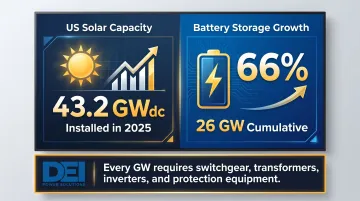
The scale of this buildout is significant. The US installed 43.2 GWdc of solar capacity in 2025, and battery storage capacity grew 66% in 2024 to exceed 26 GW cumulative. Every GW of new capacity requires switchgear, transformers, inverters, and protection equipment to tie it safely to the grid.
Essential Power Distribution Equipment for Renewable Energy Systems
Switchgear and Switchboards
Switchgear controls, isolates, and protects electrical equipment at critical points in the distribution network—solar farm collection points, BESS interconnects, wind substation interfaces. It quickly isolates faults such as short circuits and overloads before they cascade into wider outages, making it essential for system protection and maintenance safety.
Low-Voltage vs. Medium-Voltage
- Low-voltage switchboards (UL 891): Handle collection and distribution at the facility or generation level, typically 600V or less, rated from 400A to 4000A
- Medium-voltage switchgear: Manages connections to the transmission network, typically 5kV to 35kV
UL 891 Certification
This standard covers low-voltage dead-front switchboards and specifies requirements across three areas:
- Construction: Dead-front design, steel enclosures, copper or aluminum busbars sized for current rating with temperature rise limits
- Short-Circuit Current Ratings (SCCR): Marked in RMS symmetrical amperes (common ratings: 10kA, 22kA, 35kA, 42kA, 65kA, 100kA)
- Insulation/Dielectric: Hi-Pot testing at 2x rated voltage + 1000V for one minute; specified clearance and creepage distances
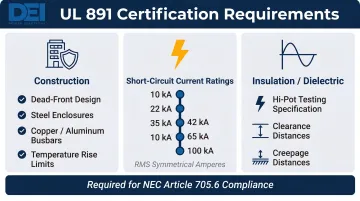
UL 891 certification is required for code compliance and interconnection approval — NEC Article 705.6 mandates listed and labeled equipment. Non-certified equipment can delay interconnection approval, create liability exposure, and require costly field replacement.
DEI Power manufactures UL 891-certified switchboards in Ontario, California, covering voltage classes from 120/240V to 480Y/277V and amperage ratings from 400A to 4000A — configured specifically for renewable energy interconnection requirements.
Inverters and Power Conditioning Equipment
Inverters convert DC electricity from solar PV panels and battery storage into grid-compatible AC at the correct voltage, frequency (60 Hz in the US), and sine wave quality. Without proper power conditioning, renewable generation cannot serve AC loads or feed the grid.
UL 1741 Standard: This standard covers inverters, converters, controllers, and interconnection equipment for distributed energy resources. It serves as the testing standard for IEEE 1547 compliance. Key requirements include:
- Anti-islanding detection: Inverters must detect utility loss and cease power export within 2 seconds to prevent energizing isolated grid sections
- UL 1741 Supplement A (SA): Published in 2016, adds testing for advanced grid support functions — Low/High Voltage Ride-Through (L/HVRT), Low/High Frequency Ride-Through (L/HFRT), Volt-Var control, Freq-Watt control, and Soft-Start Ramp
California's CPUC Rule 21 mandates UL 1741 SA certification for interconnection, and utilities reference it as a condition of grid connection approval.
Inverter Sizing Considerations:
- Load requirements and starting surge capacity
- Future expansion allowance
- Compatibility with site power conditioning needs
- Grid-tied vs. stand-alone configuration requirements
Transformers
Transformers step up voltage for efficient long-distance transmission from generation sites and step it down for safe distribution to commercial, industrial, or residential end users. The growth of DERs has significantly changed how transformers must perform — adding bidirectional flow requirements that many legacy units weren't designed to handle.
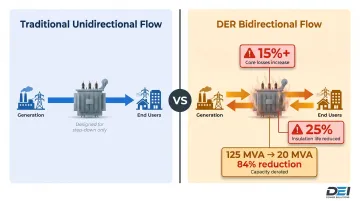
Bidirectional Power Flow Capability: Traditional grid flow is unidirectional—from central generation to end users. DERs create bidirectional power flow, forcing transformers to support reverse power flow (RPF) when DER generation exceeds local demand. IEEE Transformer Committee data shows RPF can increase core losses by 15%+ and reduce insulation life by 25%. One case study found a 125 MVA transformer designed for step-down had to be derated to just 20 MVA—an 84% reduction—when subjected to reverse power flow conditions.
Demand Growth: An estimated 60-80 million distribution transformers exist in the US, with approximately 55% exceeding 33 years of service life. Replacement demand overlaps with new renewable interconnection demand, creating supply constraints.
Energy Storage Systems and Charge Controllers
Battery Energy Storage Systems (BESS) store surplus generation during peak production and dispatch it during low production or peak demand. This reduces intermittency and supports grid stability services including frequency regulation and voltage support. US utility-scale battery storage capacity exceeded 26 GW in 2024, with 10.4 GW added in a single year.
Two FERC orders directly shape how BESS participates in wholesale markets:
- FERC Order 841: Requires wholesale markets to allow storage to participate in energy, capacity, and ancillary services on a nondiscriminatory basis
- FERC Order 755: Mandates two-part compensation for frequency regulation, rewarding faster-ramping resources like BESS
Both orders mean distribution equipment on BESS projects must support rapid charge/discharge cycling and reactive power injection.
Charge Controllers: For stand-alone (off-grid) systems, charge controllers regulate the charge rate from the renewable source into the battery bank, prevent overcharging, and protect battery life. Every off-grid renewable installation requires one.
Safety Equipment, Disconnects, and Metering
Three safety equipment categories are required by the NEC and applicable standards:
Safety Disconnects: Both automatic and manual disconnects to isolate the system during faults, maintenance, or grid emergencies. NEC Article 690.13 requires a PV system disconnecting means; Article 705.20 mandates readily accessible, lockable disconnects that simultaneously open all ungrounded conductors.
Grounding Equipment: Provides a low-resistance path for surge protection and fault current, per NEC Article 250.
Surge Protection Devices: Protect against lightning strikes and grid transients.
Beyond safety disconnects, grid-connected systems require utility-approved metering to track generation output, battery state-of-charge, and net energy exchange. Net metering arrangements typically require a dedicated second meter to separately record exported and imported energy.
Grid-Connected vs. Off-Grid: How Distribution Equipment Differs
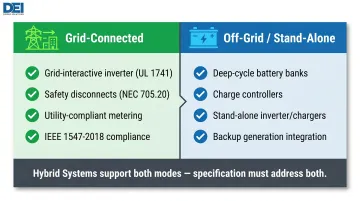
Grid-connected systems synchronize with the utility grid, exporting and importing power as needed. Off-grid (stand-alone) systems must be entirely self-sufficient, requiring additional components—deep-cycle battery banks and charge controllers—that grid-tied systems do not need.
Grid-Connected Requirements:
- Grid-interactive inverter (UL 1741 listed)
- Safety disconnects for grid isolation per NEC Article 705.20
- Utility-compliant metering
- IEEE 1547-2018 compliance for interconnection
Off-Grid Requirements:
- Deep-cycle battery banks
- Charge controllers to prevent overcharging
- Stand-alone inverter/chargers
- Backup generation integration (if applicable)
These added components drive up off-grid balance-of-system (BOS) costs considerably. That said, the DOE estimates grid extension can cost $15,000–$50,000 per mile, which often makes off-grid systems more cost-effective for remote locations despite the added battery storage and power conditioning requirements.
Hybrid Systems: These systems operate both grid-tied and in island mode during outages—now standard in commercial microgrids and resilience-focused facilities. Equipment specification must explicitly support both operating modes to avoid costly field changes.
Power Quality and Grid Stability Challenges in Renewable-Heavy Systems
Renewable-heavy grids face power quality challenges that conventional fossil-fuel grids largely avoided. Variable generation from solar and wind creates fluctuations in voltage and frequency that must be actively managed to stay within tight tolerances required for grid stability and downstream equipment function.
Key Technologies for Power Quality:
- Battery energy storage (BESS) provides sub-second reactive power compensation to stabilize voltage and frequency
- Power factor correction capacitors reduce reactive power demand and improve overall power factor
- Flexible AC Transmission Systems (FACTS) use advanced power electronics for dynamic, real-time grid control
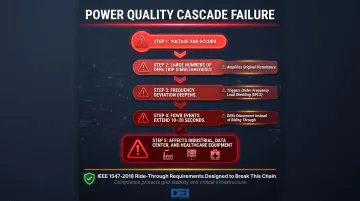
IEEE 1547-2018 Ride-Through Requirements: DER interconnection equipment must now provide voltage/frequency ride-through and reactive power control across three performance categories. Categories II and III require dynamic voltage support with rapid reactive power exchanges during voltage excursions. This replaces the legacy "trip and disconnect" paradigm.
Consequences of Poor Power Quality: NERC's Integration of Variable Generation Task Force identified critical risks, including:
- Voltage sags can simultaneously trip large numbers of DERs, amplifying the original disturbance across the grid
- DER tripping during frequency events deepens deviations and can trigger Under-Frequency Load Shedding (UFLS)
- Fault Induced Delayed Voltage Recovery (FIDVR) events — already lasting 10–20 seconds — grow worse when DERs disconnect instead of riding through
These cascading failure modes directly affect industrial machinery, data center UPS systems, and healthcare equipment — all of which depend on tight voltage and frequency tolerances. For commercial and utility renewable projects, power quality compliance belongs in the design spec from day one, not as a retrofit after problems emerge.
What to Look for When Specifying Power Distribution Equipment
Code Compliance
Equipment must meet applicable certification standards:
- UL 891: Low-voltage switchboards
- UL 1741: Grid-interactive inverters
- NEC Article 690/705: Solar interconnections
- IEEE 1547: Distributed resource interconnection
Per NEC Article 705.6, all interconnected equipment must be listed and labeled for the application — non-compliant gear can delay interconnection approval and require costly replacement.
Custom vs. Standard Configurations
Many renewable projects require custom-engineered switchboards — specific voltage class, amperage ratings, busbar configurations, and physical layouts tied to site conditions. Manufacturers that handle these requirements without extended delays help keep interconnection timelines intact. DEI Power offers custom manufacturing with typical lead times of 4–6 weeks, compared to 1 business day for in-stock units.
Lead Times and Supply Chain Realities
Power transformer lead times averaged 128 weeks and switchgear 44 weeks as of Q2 2025, up from roughly 50 weeks in 2021. Early procurement and domestic sourcing are no longer optional — they're schedule-critical.
USA-Manufactured and BABA Compliance
The Build America, Buy America Act (BABA), enacted November 15, 2021, requires manufactured products in federally funded infrastructure to contain >55% domestic component cost. This applies to all federal financial assistance obligated after May 14, 2022.
DEI Power's switchboards are USA-manufactured at their 50,000 sq. ft. Ontario, California facility and are BABA-compliant, helping contractors and engineers satisfy these requirements without sourcing abroad.
Engineering Support and Documentation
Clear configuration documentation and accurate specs are essential for interconnection approval packages — engineering gaps here translate directly into change orders and field adjustments. DEI Power provides:
- Specification review before production begins
- Finalized drawings and submittals for approval packages
- Responsive communication through design, build, and delivery phases
Frequently Asked Questions
What types of power distribution systems and equipment are used with renewable energy?
Core equipment includes switchgear/switchboards, inverters, transformers, battery energy storage systems (BESS) and charge controllers, safety disconnects, and metering. The specific combination depends on whether the system is grid-connected or off-grid, and the scale of deployment.
What power electronics are used in renewable energy systems?
The core power electronics are inverters (DC-to-AC conversion), charge controllers (battery regulation in off-grid systems), and power conditioning equipment. These must meet UL 1741 and other applicable standards for grid-interactive use.
What is the difference between grid-connected and off-grid power distribution for renewable energy?
Grid-connected systems require grid-interactive inverters and utility-compliant metering but not necessarily battery storage. Off-grid systems, by contrast, rely on deep-cycle batteries and charge controllers to operate without any utility grid connection.
What certifications should power distribution equipment have for renewable energy projects?
Before specifying equipment, confirm compliance with the following standards:
- UL 891 — low-voltage switchboards
- UL 1741 — grid-interactive inverters
- NEC Articles 690/705 — solar photovoltaic and interconnected power systems
- IEEE 1547 — distributed resource interconnection with the utility grid
How does switchgear protect renewable energy systems?
Switchgear isolates faults such as short circuits and overloads, prevents damage from propagating across the system, and allows safe disconnection for maintenance—essential at solar farm collection points, BESS sites, and wind substation interfaces.
What is balance-of-system equipment in a renewable energy installation?
Balance-of-system (BOS) refers to all components required beyond the energy generator itself. This includes inverters, switchgear, transformers, batteries, charge controllers, safety disconnects, and metering — everything that conditions, protects, stores, and delivers generated power. Electrical and structural BOS together represent nearly 30% of utility-scale solar system cost.