
Introduction
NVIDIA's flagship NVL72 AI racks demand 132 kW per rack. That number puts enormous pressure on the equipment distributing power inside data center cabinets — elevating PDUs from commodity hardware to mission-critical infrastructure. According to a Vertiv summary of Uptime Institute's 2025 Global Data Center Survey, mean rack density reached 7.6 kW in 2025, up from 6.8 kW the year before.
Choosing the wrong PDU manufacturer creates real consequences: insufficient capacity, failed code inspections, costly field modifications, and monitoring blind spots.
This guide helps data center operators, electrical engineers, and contractors identify the right PDU partners based on power density requirements, certifications, monitoring capabilities, and long-term scalability.
Key Takeaways
- PDUs distribute electrical power from upstream sources to IT equipment within racks
- Top manufacturers include Schneider Electric (APC), Eaton, Vertiv, Legrand, and ABB
- Selection depends on rack density, monitoring needs, certifications, and DCIM integration
- Intelligent and monitored PDUs are now standard in hyperscale and AI-intensive facilities
- Mapping the full power chain from switchgear through rack PDUs closes compliance gaps before they become capacity problems
What Are PDUs and Why Do They Matter in Data Centers?
A Power Distribution Unit (PDU) is a device that receives power from an upstream source—such as a UPS, switchboard, or power panel—and redistributes it to servers, networking equipment, and storage within a rack or cabinet. PDUs are distinct from UPS systems (which provide battery backup and power conditioning) and from switchboards/switchgear (which distribute power at the facility level before it reaches the rack).
Modern data centers rely on a layered power distribution architecture:
Utility/Generator → Switchgear/Switchboards → Floor PDUs/RPPs → Rack PDUs → IT Equipment
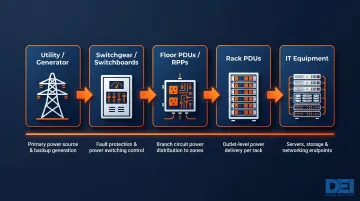
Failures or mis-specifications at any layer create cascading uptime risks. Uptime Institute's 2025 Annual Outage Analysis confirms that power-related incidents remain the leading cause of serious data center outages. The Ponemon Institute estimates unplanned outages cost enterprises an average of $8,662 per minute.
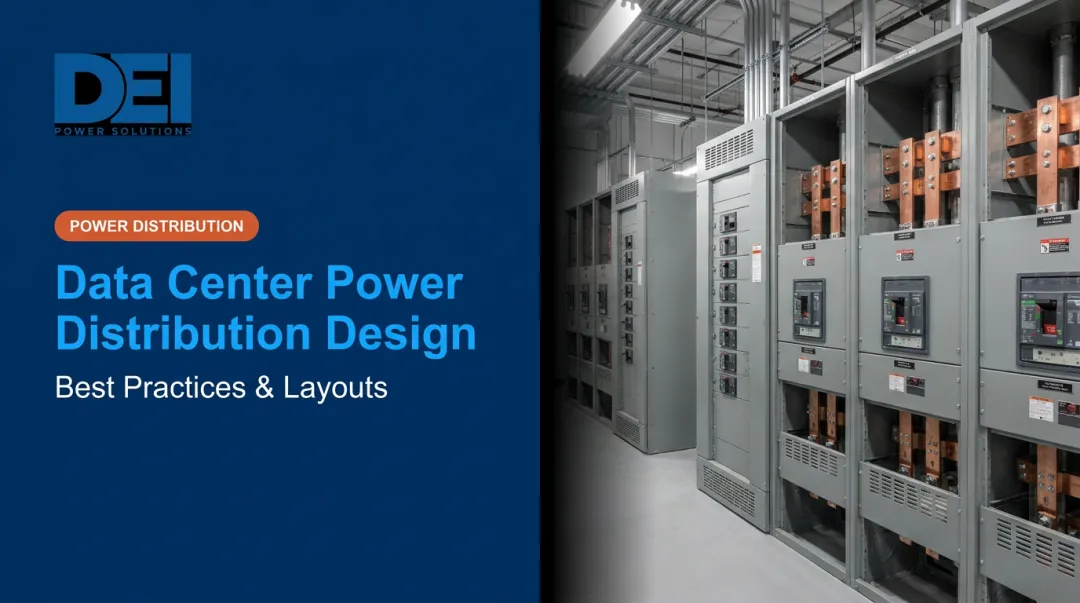
Before rack-level PDUs receive power, the upstream layer — switchboards and Remote Power Panels (RPPs) — must distribute it safely from the utility feed. DEI Power manufactures UL 891-certified switchboards and RPPs (400A–4000A) in Ontario, California, providing the foundational infrastructure that feeds your rack PDUs with code-compliant, US-made equipment.
For the rack level itself, manufacturer selection directly affects uptime, energy visibility, and capacity planning — which is what this guide covers.
Top PDU Manufacturers for Data Centers
These five manufacturers were selected based on product depth, data center market presence, certifications, innovation track record, and ability to support enterprise through hyperscale deployments.
Schneider Electric (APC)
APC by Schneider Electric has been a market leader in data center power management since 1981. Their PDU portfolio spans basic, metered, switched, and intelligent units under the NetShelter™ brand, with EcoStruxure IT integration for centralized analytics and DCIM compatibility. Schneider Electric posted EUR 40.2 billion revenue in FY2025, with data center demand showing "triple-digit growth" in Q4 2025.
Key differentiators:
- Outlet-level monitoring and remote power cycling
- EcoStruxure-ready architecture for AI-era data centers
- ISO 9001 certification
- November 2025 product launch: NetShelter Rack PDU Advanced, built for AI clusters with integrated cooling compatibility and support for rack power densities projected to reach "1 MW and beyond"
| Category | Details |
|---|---|
| Product Line | NetShelter™ Rack PDU Advanced, Metered, Switched, and EcoStruxure IT-ready PDUs |
| Key Features | Outlet-level monitoring, remote load control, DCIM integration, user-defined overload alarms |
| Certifications / Standards | ISO 9001; UL listed; compatible with EcoStruxure™ platform |
Eaton
ABB is a Swiss multinational operating in 100+ countries with extensive manufacturing infrastructure. Their data center power distribution portfolio spans the full one-line — from transformers and switchgear through to floor-level PDUs — making them one of the few vendors capable of providing end-to-end power infrastructure. Unlike the other manufacturers on this list, ABB's products primarily serve floor-level and upstream distribution rather than rack-level PDUs. ABB reported $33.2 billion revenue in FY2025 (+9% reported, +7% comparable).
Key differentiators:
- PDU line (Cyberex®, TruFit, MNS) designed for modular, scalable data center architectures
- Cyberex PDUs support ratings up to 1.3 MW; TruFit PDUs handle 50–800 kVA applications
- Active partnership with Applied Digital to supply 300 MW of power infrastructure for AI factory campuses
| Category | Details |
|---|---|
| Product Line | Cyberex® PDU, TruFit PDU, MNS Switchgear; also covers upstream switchgear, transformers, and busway |
| Key Features | Modular design, full one-line portfolio, intelligent grid connections, DCIM integration capability |
| Certifications / Standards | IEC and UL compliant; ISO certified; active AI infrastructure partnerships |
Types of PDUs Used in Data Centers
PDU type selection depends on the level of power visibility and control the operation requires. The global data center PDU market was valued at $3.74 billion in 2025, growing at a 12.4% CAGR, driven by intelligent PDU adoption for AI and high-density workloads.
| PDU Type | Capabilities | Best For |
|---|---|---|
| Basic PDU | Power distribution only; no monitoring | Small or non-critical racks; cost-sensitive deployments |
| Metered PDU | Rack-level power measurement; local/remote display | Capacity planning and overload prevention |
| Monitored PDU | Outlet-level visibility, threshold alerts, DCIM integration | Colocation and enterprise environments requiring per-device visibility |
| Intelligent PDU | Remote outlet on/off, power cycling, API integration, full monitoring | Hyperscale and AI-driven facilities; standard in modern data centers |
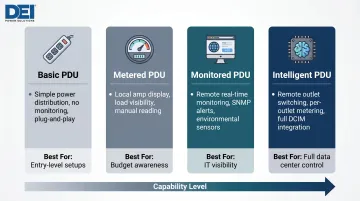
That shift toward intelligent PDUs is well underway. Mordor Intelligence reports that data centers held 54.3% of the intelligent PDU market in 2024, with hyperscale AI facilities driving adoption at a 9.6% CAGR — making intelligent PDUs the baseline expectation for new builds rather than a premium option.
How to Choose the Right PDU Manufacturer for Your Data Center
Start with Power Density Requirements
Rack density (measured in kW per rack) is the most critical starting point. Basic PDUs max out at low densities, while AI/HPC racks exceeding 20–50+ kW require three-phase intelligent PDUs. Choosing a manufacturer without a high-density portfolio creates a scalability ceiling.
Power density benchmarks:
- NVIDIA NVL72 racks: 132 kW per rack
- 64-GPU standard racks: 80–90 kW
- 32-GPU configuration: ~50 kW
- Industry average (2025): 7.6 kW
Eaton's HDX PDUs support up to 46 kW; Vertiv's PowerIT reaches 57.6 kW. For racks above 60 kW, consider busway-based distribution or integrated pod architectures like Schneider's EcoStruxure Pod.
Evaluate Certifications and Compliance Posture
Certifications like UL listing, IEC 62368, ISO 9001, and cybersecurity standards (UL 2900-1, IEC 62443-4-2) are required for facilities subject to insurance audits, federal procurement rules, and colocation SLAs. Skipping compliance verification at the procurement stage typically surfaces as failed inspections, forced rework, and project delays — costs that far exceed any upfront savings.
Eaton's dual cybersecurity certifications (UL 2900-1 and IEC 62443-4-2) differentiate it for government, financial services, and healthcare deployments.
Assess Monitoring and Integration Depth
Distinguish between manufacturers offering basic metering versus those with full DCIM integration, API access, and outlet-level control. For colocation facilities with tenant chargeback requirements or operators managing PUE targets, the monitoring layer directly affects revenue and efficiency.
Schneider's EcoStruxure IT and Legrand's Raritan PDUs provide outlet-level metering that feeds into DCIM platforms — giving operators the data to identify wasteful loads and optimize workload placement. When evaluating monitoring depth, look for:
- Outlet-level current and power metering
- REST API or SNMP integration with DCIM platforms
- Threshold-based alerting and remote outlet switching
- Tenant-level reporting for chargeback billing
Consider Lead Times, Manufacturing Origin, and Support Infrastructure
When schedules are tight, a manufacturer's lead time and geographic support network can be as consequential as product specs. Ask whether the vendor manufactures domestically, offers rapid deployment, and has field engineers to support commissioning.
The same lead time scrutiny applies to the upstream power distribution layer — the switchboards and remote power panels feeding your rack PDUs. Delays there stall the entire deployment, regardless of how quickly rack PDUs arrive. DEI Power manufactures UL 891-certified switchboards and Remote Power Panels domestically, with the following for data center projects:
- USA-manufactured switchboards (400A–4000A) and Remote Power Panels (225A–1200A)
- 3–5 business day delivery on in-stock units nationwide
- In-house engineering support: one-line diagram review, configuration guidance, and compliance documentation
- BABA-compliant options for federally funded projects
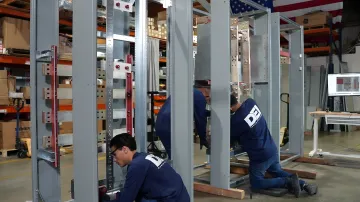
By ensuring your upstream infrastructure is code-compliant and deployment-ready, you eliminate a common source of project delays and field issues.
Conclusion
Choosing a PDU manufacturer comes down to fit: power density, compliance requirements, and how well the product supports your facility's scalability roadmap—not just brand recognition.
Evaluate manufacturers across the full power distribution chain—from upstream switchgear and switchboards through to rack-level PDUs—to avoid gaps in compliance, monitoring, or capacity. A mis-specified switchboard creates the same downtime risk as a mis-specified rack PDU.
If your project includes upstream infrastructure, DEI Power manufactures UL 891-certified, USA-manufactured switchboards and low-voltage switchgear—the switchgear layer that feeds your rack PDUs. Contact DEI Power at (866) 773-8050 or sales@deipower.com to discuss your project specifications.
Frequently Asked Questions
Who makes power supplies for data centers?
Data center power supply involves multiple layers: upstream switchgear and switchboard manufacturers (such as DEI Power, ABB, Schneider Electric) distribute power from the utility/generator to distribution panels, while rack-level PDU manufacturers (Eaton, Vertiv, Legrand, APC) distribute it within cabinets. Understanding where each fits in the power chain is critical for proper specification.
What is the difference between a PDU and a UPS in a data center?
A UPS (Uninterruptible Power Supply) conditions and protects power during outages using battery backup, while a PDU distributes already-conditioned power from the UPS or switchboard to IT equipment within a rack. Sizing both correctly for your load requirements is essential to a reliable power architecture.
What are the four types of PDUs used in data centers?
The four main types are Basic (power delivery only), Metered (rack-level monitoring), Monitored (outlet-level monitoring with DCIM integration), and Intelligent (remote control + API integration). Hyperscale facilities typically require Intelligent PDUs because their automation pipelines depend on real-time API data from every rack.
What certifications should I look for when selecting a PDU manufacturer?
Key certifications include UL listing (US compliance), IEC 62368 (international safety), ISO 9001 (quality management), and for security-sensitive environments, UL 2900-1 and IEC 62443-4-2 for cybersecurity compliance.
How do intelligent PDUs support energy efficiency in data centers?
Intelligent PDUs provide outlet-level power data that feeds into DCIM and energy management platforms, enabling operators to identify wasteful loads, optimize workload placement, and improve PUE without manual audits.
What is the difference between a rack PDU and a switchboard in a data center?
A switchboard (or low-voltage switchgear) distributes power at the facility level—from the utility or generator to distribution panels and UPS systems—while a rack PDU operates at the IT equipment level inside the cabinet. Both must be properly specified and certified for a reliable power architecture.