Introduction
A contractor ordering equipment for a 2,000A service entrance faces a choice that carries real consequences: specify a panelboard and risk a failed inspection, or order switchgear and blow the budget on a small commercial project. The decision between switchgear and a panelboard isn't just about what fits on the wall—it affects fault protection, maintenance access, code compliance, and total installed cost. Get it wrong, and you're looking at costly field changes, AHJ rejections, or undersized protection that creates genuine safety hazards.
The differences are concrete: panelboards cap at 1,200A with front-access-only maintenance, while switchgear handles thousands of amps with draw-out breakers and compartmentalized protection. Between them sits the switchboard, a middle-tier option that handles load ranges neither panelboard nor full switchgear covers cleanly. For contractors and engineers on time-sensitive projects, knowing which to specify means fewer change orders, faster AHJ approvals, and equipment that won't need replacing when load demands grow.
Key Takeaways
- Panelboards (UL 67): wall-mounted, front-access units rated up to 1,200A, designed for branch circuit distribution in light commercial applications
- Switchgear (UL 1558): freestanding, high-capacity equipment rated up to 6,000A with draw-out breakers for mission-critical industrial and utility environments
- Switchboards (UL 891) sit between the two — higher capacity than panelboards, less complexity than full switchgear
- Core differences: current/voltage rating, form factor, access requirements, fault protection, and applicable standards
- Choosing wrong risks underpowered systems, failed inspections, and unsafe maintenance conditions
Switchgear vs Panelboard: Quick Comparison
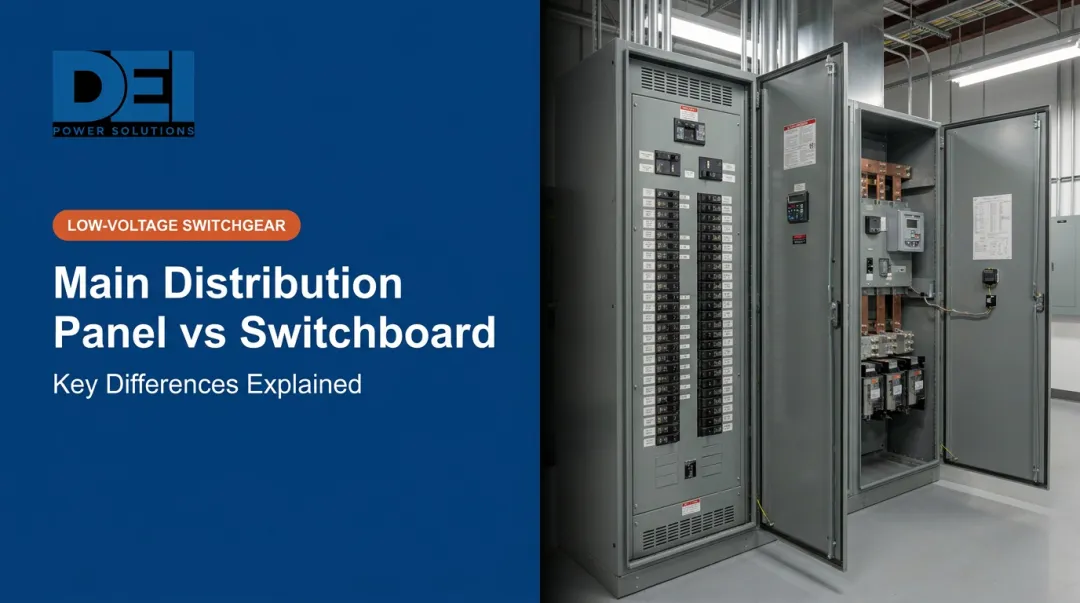
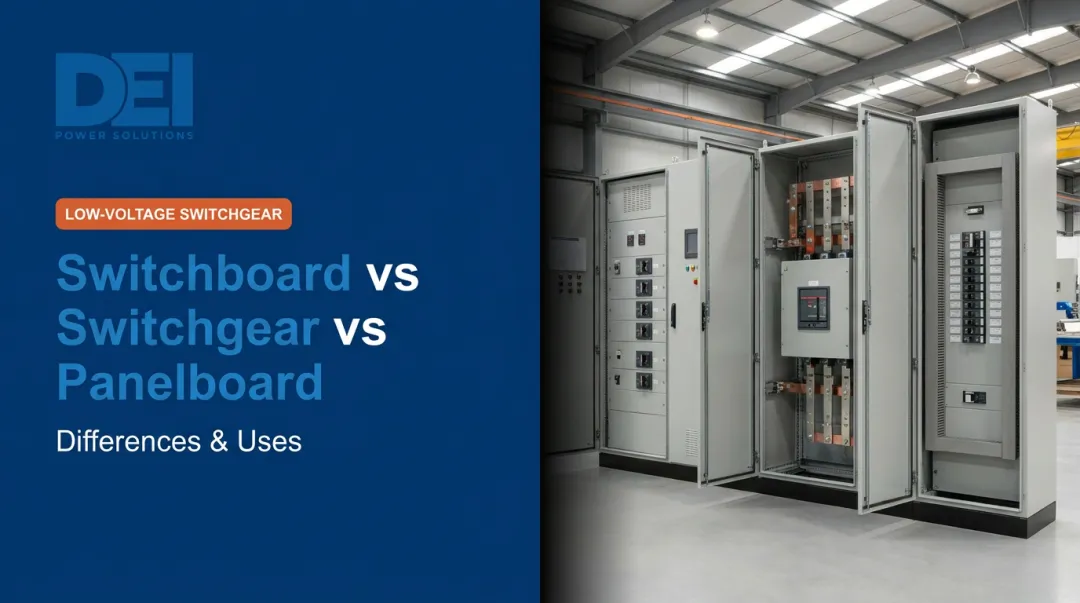
The three equipment tiers — panelboard, switchboard, and switchgear — each occupy a distinct place in the distribution hierarchy. Use this table to compare them side by side across the specs that matter most for project selection.
| Specification | Panelboard (UL 67) | Switchboard (UL 891) | Switchgear (UL 1558) |
|---|---|---|---|
| Current Rating | Up to 1,200A | Up to 6,000A | Up to 6,000A+ |
| Voltage Rating | Up to 600VAC, 250VDC | Up to 600VAC | Up to 1,000VAC |
| Enclosure/Mounting | Wall-mounted, cabinet or flush | Freestanding, floor-mounted | Freestanding, metal-enclosed |
| Access | Front-only | Front and rear (or front-only) | Front and rear required |
| Breaker Type | UL 489 MCCBs (fixed) | UL 489 MCCBs (group-mounted) | UL 1066 (draw-out) |
| Interrupting Capacity | 10–65 kAIC typical | 25–100 kAIC | Up to 200 kAIC |
| Standards | UL 67, NEMA PB-1, NEC 408 | UL 891, NEMA PB-2, NEC 408 | UL 1558, ANSI C37, NEC 408 |
| Typical Applications | Branch circuits, lighting, small commercial | Main service, commercial buildings, hospitals | Data centers, industrial plants, utility substations |
| Cost Tier | Lowest | Mid-range | Highest (50–100% premium over switchboards) |
| Maintenance | Full shutdown required | Full or partial shutdown | Individual breaker isolation |
Note: These are general ratings. Always confirm specifications against project-specific fault current analysis and local code requirements.
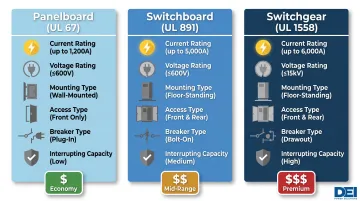
The sections below break down each tier in detail — with particular focus on the switchboard (UL 891) category, which covers most commercial, industrial, and data center distribution requirements in the 400A–4,000A range.
What is Switchgear?
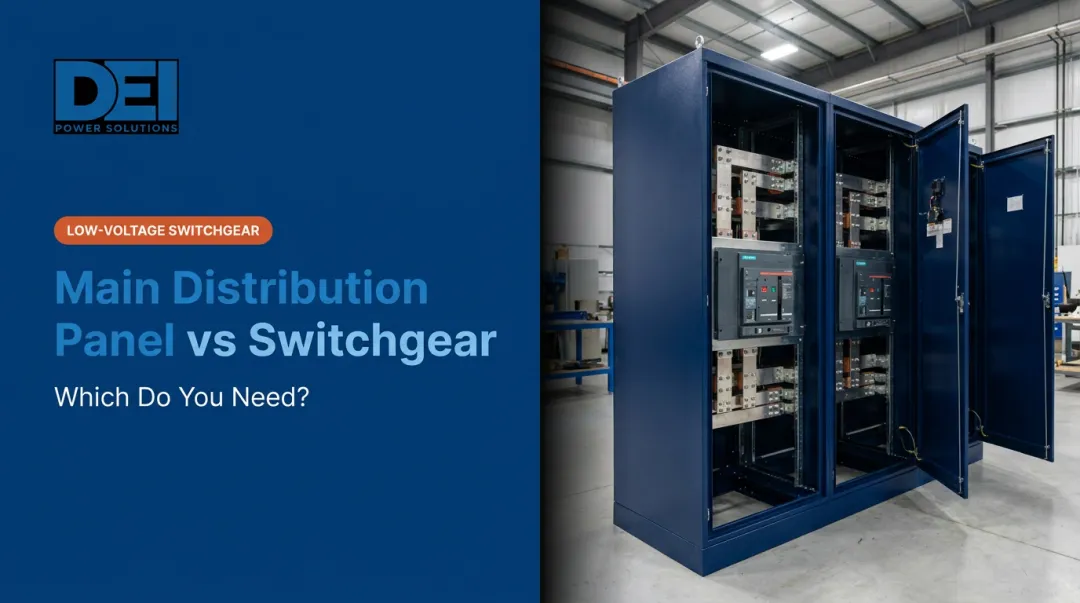
Switchgear is a broad category of power distribution and protection assemblies that combine circuit breakers, disconnect switches, fuses, relays, and bus systems within metal-enclosed or metal-clad compartments. In everyday commercial and industrial usage, the term "switchgear" often refers to UL 891 low-voltage switchboards (up to 600V, up to 6,000A) as well as UL 1558 switchgear (up to 1,000V). DEI Power manufactures UL 891-certified low-voltage switchgear for commercial, industrial, and utility power systems, built with Siemens components in its 50,000 sq. ft. Ontario, California facility.
Key Technical Characteristics
The defining features that separate switchgear from simpler distribution equipment:
- Freestanding form factor requiring dedicated electrical rooms and floor space
- Front and rear access for maintenance and inspection
- Draw-out circuit breakers (UL 1558) that allow component replacement without de-energizing the entire busbar
- High interrupting capacity (up to 100–200 kAIC for full switchgear)
- Compartmentalization with insulated busbars (UL 1558) for arc-flash containment
UL 891 switchboards use UL 489 molded-case circuit breakers (MCCBs) in group-mounted configurations with non-insulated busbars. UL 1558 switchgear uses UL 1066 power circuit breakers, individually mounted in separate compartments with draw-out capability and insulated busbars.
The draw-out design lets you physically withdraw a breaker for testing or maintenance while the rest of the system stays energized—a critical safety feature in 24/7 operations.
Safety and Control Features
Switchgear distinguishes itself through:
- Arc-flash containment: Metal-enclosed compartments and insulated busbars reduce incident energy exposure to adjacent sections
- Automatic fault detection: Integrated relays and protective devices monitor for overcurrent, ground faults, and short circuits
- Isolation compartments: Each breaker occupies its own space, limiting the spread of arc events
- Monitoring integration: Modern switchgear accepts power monitoring, metering, and automation systems—critical for data centers and mission-critical facilities
Switchgear Subtypes
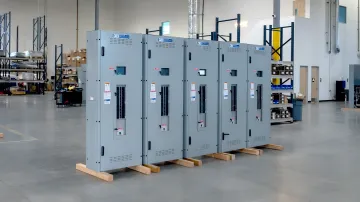
Low-voltage switchboards (UL 891): Up to 600VAC, up to 6,000A; the workhorse for commercial and industrial main distribution. DEI Power manufactures these in amperage ratings from 400A to 4,000A, with voltage configurations including 120/240V, 208Y/120V, 480V, and 480Y/277V. Available in NEMA 1 (indoor) or NEMA 3R (outdoor) enclosures.
Low-voltage switchgear (UL 1558): Up to 1,000VAC with draw-out breakers and compartmentalized construction; specified for critical facilities requiring live maintenance capability.
Medium-voltage switchgear: 5kV–38kV, governed by UL 1558 and ANSI C37 standards; used in utility substations and large industrial plants.
Service entrance switchgear: Main distribution point receiving utility power and directing it to downstream panels; DEI Power offers configurations from 400A to 4,000A with main breaker layouts.
Use Cases of Switchgear
Switchgear is specified—or required by code—in:
- Data centers and colocation facilities where power issues account for 45% of impactful outages
- Healthcare facilities requiring NFPA 99 essential electrical systems with 10-second restoration time
- Industrial manufacturing plants with high fault current exposure and continuous uptime requirements
- Utility substations and energy distribution infrastructure
- Large commercial campuses with main service distribution above 1,200A
Mission-critical environments demand switchgear because high fault current exposure, 24/7 uptime requirements, and the need for live maintenance—via draw-out breakers—make lower-tier equipment inadequate.
The reliability gap is measurable. Uptime Institute's 2025 analysis found that 50% of data centers experienced at least one impactful outage over the past three years, with 10% causing serious disruption. Per IEEE-493 data cited by secondary sources, UL 891 switchboard failure rates run 156% higher than UL 1558 switchgear, with average downtime of approximately 4 hours per failure.
What is a Panelboard?
A panelboard, per NEC Article 408 and UL 67, is a wall-mounted or flush-mounted assembly that distributes power from a single feed into multiple branch circuits via circuit breakers or fuses, all accessible from the front only. Standard ratings top out at 1,200A incoming, 600VAC, and 250VDC, as defined by UL 67 and NEMA PB-1.
Physical and Functional Characteristics
Panelboards are defined by simplicity and compactness:
- Mounts to a wall (cabinet or cutout box), requiring minimal floor space
- Accessible from the front only per NEC Article 100; no rear access for maintenance
- Uses fixed (non-draw-out) UL 489 MCCBs — breakers cannot be removed live
- Interrupting capacity typically ranges from 10–65 kAIC (25kA at 600V for UL 67 units)
- Standard configurations include no built-in metering or utility-grade monitoring
- Most maintenance requires de-energizing the entire panel
Standard main ratings: 30, 60, 100, 200, 400, 600, 800, or 1,200 amperes. The 42-circuit limit for lighting and appliance branch-circuit panelboards was removed in the 2008 NEC; physical size and heat dissipation of the busbar now govern maximum overcurrent devices.
Common Panelboard Subtypes
- Lighting panelboards serve lighting circuits and small receptacle loads
- Power distribution panelboards feed heavier loads like HVAC equipment and small motors
- Main panels receive service entrance conductors as the first distribution point
- Sub-panels are fed downstream from a main panel or switchboard
- Load centers are the residential-grade variant; the NEC does not formally distinguish them from panelboards
Use Cases of Panelboards
Panelboards sit downstream of switchboards or main service entrances, distributing power to end-use circuits in:
- Small commercial spaces — retail stores, offices, clinics
- Light industrial settings — warehouses, workshops, small manufacturing
- Residential buildings — apartment complexes and condos
- Branch circuit loads — lighting, receptacles, HVAC zones, small motors
Panelboards work best where loads are predictable and moderate, fault current stays within UL 67 ratings, and space is limited. They cost less and install faster than switchboards or switchgear, but they trade off capacity, compartmentalization, and maintenance flexibility to get there.
Switchgear vs Panelboard: Key Differences Explained
Physical Form Factor and Installation Requirements
Panelboards are wall-mounted (flush or surface), requiring minimal floor space and no rear clearance. They fit in tight spaces and don't need dedicated electrical rooms.
Switchgear and switchboards are freestanding units requiring dedicated floor space for front and rear access. NEC 110.26 mandates minimum working clearances:
| Voltage to Ground | Condition 2 (grounded wall opposite) |
|---|---|
| 0-150V | 3 ft |
| 151-600V | 3 ft 6 in |
| 601-1,000V | 4 ft |
Equipment rated 1,200A or more and over 6 ft wide requires two entrance/exit points with panic hardware within 25 ft (NEC 110.26(C)(2)).
Specifying a panelboard where switchgear is needed creates unsafe working conditions and fails inspection. Over-specifying switchgear wastes budget and floor space.
Current and Voltage Capacity
The capacity gap is the clearest distinction:
- Panelboards: Cap at 1,200A, up to 600VAC
- Switchboards (UL 891): Handle up to 6,000A, up to 600VAC
- Switchgear (UL 1558): Up to 6,000A and beyond, up to 1,000VAC
- Medium-voltage switchgear: 5kV–38kV for utility and heavy industrial applications
A 4,000A service entrance cannot be fed through a panelboard — the physics don't allow it. DEI Power manufactures UL 891-certified switchboards in ratings from 400A to 4,000A specifically to bridge this gap.
Standards, Codes, and Compliance
| Equipment | UL Standard | NEMA Standard | NEC Article |
|---|---|---|---|
| Panelboard | UL 67 | NEMA PB-1 | 408 |
| Switchboard | UL 891 | NEMA PB-2 | 408 |
| Switchgear | UL 1558 | — | 408 (added 2014) |
AHJ inspections, insurance requirements, and BABA compliance for federally funded projects all depend on using correctly certified equipment.
OMB final guidance requires manufactured products on federally funded infrastructure projects to contain greater than 55% domestic component cost, with iron and steel processed entirely in the U.S. DEI Power manufactures all switchgear in Ontario, California, meeting BABA requirements for public sector projects.
Fault Protection and Safety Architecture
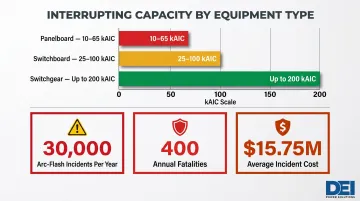
Interrupting capacity differences:
- Panelboards: 10–65 kAIC typical
- Switchboards: 25–100 kAIC
- Switchgear: Up to 200 kAIC
Undersized interrupting capacity in a high fault-current environment can result in equipment failure or arc flash events. Arc-flash incidents cost an average of $15.75 million each, with $1.5M in medical costs per survivor and $5–10M in litigation.
Roughly 30,000 arc-flash incidents occur annually in the U.S., resulting in 400 fatalities. Choosing equipment rated for the actual fault current at your service point is a code requirement — and a life-safety one.
Switchgear's draw-out breaker design adds a maintenance safety layer absent in panelboards. You can rack a breaker to a "test" or "disconnected" position for servicing while the rest of the lineup remains energized — reducing arc-flash exposure and eliminating the need for full shutdowns.
Cost, Maintenance, and Lifecycle Considerations
Cost tiers:
- Panelboards: Lowest initial investment, minimal maintenance
- Switchboards (UL 891): Mid-range cost, moderate maintenance needs
- Switchgear (UL 1558): 50–100% premium over switchboards, but designed for longevity and lower downtime risk
The lifecycle argument favors switchgear in mission-critical applications despite the premium. Per IEEE-493 data, switchboards carry 156% higher failure rates than switchgear, with approximately 4 hours of downtime per failure. For a data center where one in ten outages causes serious or severe disruption, that downtime translates to hundreds of thousands in lost revenue.
Reliability gains only matter if the equipment arrives in time. Current supply chain conditions put panelboards at 28–48 weeks and switchboards with MCCBs at 52 weeks. DEI Power's in-house manufacturing delivers custom UL 891 switchboards in 4–6 weeks — a difference that has kept more than a few projects out of schedule trouble.
Which One Should You Choose?
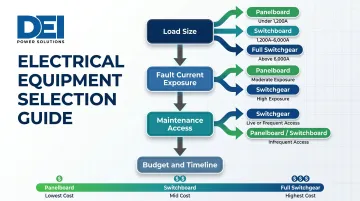
Decision Framework
Base your choice on four criteria:
1. Load Size
- Under 1,200A and low-voltage branch circuits → Panelboard
- Main distribution 1,200A–6,000A → Switchboard (UL 891)
- Above 6,000A or medium-voltage → Full switchgear (UL 1558)
2. Fault Current Exposure
- High available fault current at service entrance → Higher interrupting capacity required → Switchgear
- Moderate fault current, downstream circuits → Panelboard acceptable
3. Maintenance Access Needs
- Frequent servicing or live maintenance requirements → Draw-out switchgear (UL 1558)
- Infrequent maintenance, acceptable downtime → Panelboard or switchboard
4. Budget and Timeline
- Fastest, lowest cost → Panelboard
- Mid-range cost, higher capacity → Switchboard
- Highest initial investment but non-negotiable in mission-critical settings → Switchgear
Situational Recommendations
Choose a panelboard for branch circuit distribution in small commercial, retail, or residential projects where loads are under 1,200A and front-access maintenance is acceptable. Best fit: office tenant spaces, apartment buildings, retail stores, light industrial warehouses.
Choose a low-voltage switchboard (UL 891) for main service distribution in commercial buildings, campuses, hospitals, and industrial facilities where higher ampacity, metering, and custom bus configurations are needed. Typical applications: 2,000A–4,000A service entrances, multi-tenant commercial buildings, and manufacturing plants.
Choose switchgear for utility substations, data centers, industrial plants, and any environment requiring medium-voltage switching, arc-resistant enclosures, or draw-out breaker capability. Best fit: mission-critical facilities where 45% of outages are caused by power issues and downtime costs exceed $250,000 per incident.
UL 891 Switchboards for Time-Sensitive Projects
Once you've confirmed a UL 891 switchboard fits your project, sourcing speed and configuration accuracy become the next critical factors.
DEI Power manufactures UL 891-certified, USA-built switchboards from 400A to 4,000A, with in-house engineering support and BABA-compliant construction. Their team helps contractors and engineers nail down voltage, ampacity, and layout requirements upfront — avoiding costly last-minute spec changes during construction. Call (866) 773-8050 or visit deipower.com to review your project specs with their engineering team before finalizing your equipment schedule.
Conclusion
Panelboards and switchgear serve distinct roles in a power distribution system. The right choice is always determined by factors that go well beyond cost alone:
- Load requirements and fault current exposure
- Available space and installation environment
- Maintenance protocols and access needs
- Code compliance and inspection requirements
Engineers and contractors who treat these as interchangeable risk inspection failures, safety hazards, and expensive redesigns.
Selecting correctly from the start means fewer change orders, faster project completion, and systems that perform reliably for the life of the facility—whether that's a retail strip mall on a panelboard or a hyperscale data center on custom switchgear.
That demand for reliability isn't slowing down. The global switchgear monitoring system market is projected to grow from $2.17B (2025) to $3.22B (2030), driven by increasing emphasis on power quality and uptime. Knowing the distinctions between panelboards, switchboards, and switchgear means you're specifying equipment that matches your facility's operational demands—and keeps it compliant for the long term.
Frequently Asked Questions
What's the difference between switchgear and panelboards?
Switchgear is a freestanding, high-capacity system (6,000A+) used for power protection and distribution in industrial and utility settings. Panelboards are wall-mounted, front-access units capped at 1,200A, designed for branch circuit distribution in commercial and residential buildings. Key standards: UL 891 for switchgear, UL 67 for panelboards.
What's the difference between a switchboard and a panelboard?
Switchboards are freestanding, higher-capacity units (up to 6,000A, UL 891) with front and rear access, while panelboards are wall-mounted, front-access-only units capped at 1,200A (UL 67). Switchboards serve as main distribution points; panelboards distribute power to branch circuits downstream.
Is an electrical panel considered switchgear?
No. A standard electrical panel lacks the high interrupting capacity, draw-out breaker design, and arc-fault protection that define switchgear. The term gets used loosely in the field to mean any enclosed distribution assembly, which creates real confusion on job sites.
What are other names for switchgear and distribution panels?
Switchgear may also be called "metal-enclosed switchgear," "metal-clad switchgear," or "low-voltage switchboards" (UL 891). Panelboards are sometimes called "breaker panels," "load centers" (residential version), "distribution boards," or "circuit breaker panels."
What is the difference between a main switchboard and a distribution board?
A main switchboard is the primary distribution point, receiving power from the utility service entrance and routing it to downstream circuits or sub-panels. A distribution board (or panelboard) is a downstream device that feeds individual branch circuits within a specific area or floor.
What are the latest trends in switchboard design and can I customize a switchboard?
Current switchboard design trends include integrated power monitoring, modular bus configurations, arc-resistant enclosures, and BABA-compliant domestic manufacturing for public sector work. Switchboards can be fully customized to project-specific voltage, ampacity, breaker type, and physical layout. DEI Power builds UL 891-certified switchboards to spec with 4–6 week lead times.