Introduction
Every electrical contractor has encountered this moment: you're holding project specifications that call for both panelboards and distribution panels, and the documentation offers little clarity on which component goes where, or whether one could substitute for the other. This confusion isn't trivial. Misspecifying distribution equipment triggers expensive field rework, creates code compliance gaps during inspection, and forces rushed change orders that blow through project contingencies and delay occupancy.
These two components operate at different points in the electrical distribution chain. Panelboards divide incoming power into individual branch circuits, serving as the final stage before electricity reaches lighting, receptacles, and equipment loads. Distribution panels sit upstream as intermediate routing hubs, receiving high-capacity supply from utility feeds or transformers and passing it down to multiple panelboards or large machinery.
They differ in amperage capacity, governing UL standards, physical configuration, and installation requirements. This article breaks down each distinction clearly, so contractors, facility engineers, and electrical teams can specify the right equipment the first time.
Key Takeaways
- Panelboards (UL 67, up to 1,200A) split a single feed into branch circuits for offices, healthcare, and tenant spaces.
- Distribution panels (UL 891, up to 6,000A) route high-capacity power to multiple panelboards or large equipment loads.
- Distribution panels belong upstream; panelboards serve the branch level — they occupy different positions in the power chain.
- Swapping one for the other creates overload risk, code violations, and inspection failures that stall projects.
- Right selection hinges on load scale, current rating, distribution chain position, and applicable NEC and UL standards.
Panelboards vs Distribution Panels: Quick Comparison
| Feature | Panelboard | Distribution Panel (Switchboard) |
|---|---|---|
| Primary Function | Divides incoming feed into multiple individually protected branch circuits | Routes high-capacity power from main source to downstream panelboards or equipment |
| Current Rating | Up to 1,200A | Typically 400A–6,000A |
| Voltage Rating | Up to 600V | Up to 600V |
| Governing Standard | UL 67, NEC Article 408 | UL 891, NEC Article 408 |
| Installation Type | Wall-mounted (flush or surface) | Floor-mounted, free-standing |
| Access | Front access only | Front and optional rear access |
| Typical Application | Commercial offices, light industrial, healthcare branch circuits, tenant spaces | Industrial plants, data centers, utility infrastructure, large commercial campuses |
| Physical Size | Compact enclosure in cabinet | Large assembly on frame, modular sections |
| Cost Profile | Lower equipment cost, simpler installation | Higher equipment cost, more complex installation, greater capacity |
Understanding the Distribution Hierarchy
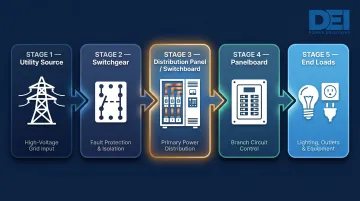
Electrical distribution moves through a defined sequence: utility source → switchgear → distribution panel (intermediate routing) → panelboard (branch circuit protection) → end loads. This hierarchy explains why both components often coexist in the same facility — they serve distinct, non-overlapping roles. A distribution panel receives bulk power and routes it to specific zones; panelboards within each zone then divide that power into circuits serving lights, receptacles, and individual equipment.
How Load Centers Differ from Panelboards
In residential contexts, the term "load center" refers to a smaller, lower-cost panelboard rated for a maximum of 240V and typically 400A or less. Load centers accept only plug-in circuit breakers and serve single-family homes or small buildings.
Commercial and industrial panelboards support higher voltages (up to 600V), accept both bolt-on and plug-in breakers, and handle current ratings up to 1,200A — as detailed in Eaton's panelboard vs. load center comparison. Both load centers and panelboards fall under UL 67, but the terminology reflects application and capacity differences, not a formal code distinction.For contractors and engineers specifying equipment above 400A or in commercial/industrial settings, the distinction matters: a load center won't meet the demand, and the project requires a full panelboard or distribution panel instead.
What Is a Panelboard?
A panelboard is a distribution assembly governed by UL 67 and NEC Article 408 that takes a single incoming electrical feed and divides it into multiple individually protected branch circuits using circuit breakers or fuses. The NEC defines a panelboard as "a single panel or group of panel units designed for assembly in the form of a single panel, including buses and automatic overcurrent devices...designed to be placed in a cabinet or cutout box placed in or against a wall, partition, or other support; and accessible only from the front."
Key Components
A typical panelboard consists of:
- Enclosure ("can"): The protective metal housing that mounts flush or surface on a wall
- Interior chassis: Busbars that distribute power, main overcurrent device or main lug terminals, and slots for branch breakers
- Trim/door assembly: Front cover with hinged or removable door and circuit directory label
Configuration Options:
- Main Circuit Breaker (MCB): Includes an integral main breaker at the top or bottom of the panel; if the MCB rating is lower than the panel's rating, the unit must be marked accordingly
- Main Lug Only (MLO): Features main terminals without a main breaker; protection comes from an upstream device such as a switchboard breaker or another panelboard's feeder circuit
Electrical Ratings
Panelboards support voltages up to 600V and a maximum incoming current of 1,200A. Branch device ratings vary by application, typically ranging from 15A to 200A per circuit. This contrasts with load centers (240V maximum, 400A typical ceiling) and distribution panels (which begin around 400A and extend to 6,000A).
Panelboard Types
While the NEC removed the formal "lighting and appliance vs. power" panelboard classification in 2008, several specialized types remain common in commercial and industrial settings:
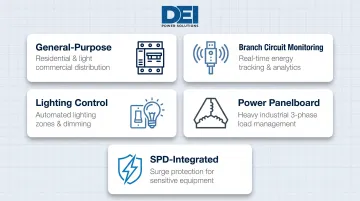
- General-purpose panelboards: Standard branch circuit protection for lighting, receptacles, and light equipment
- Branch circuit monitoring panelboards: Feature integrated current sensors and communication modules for per-circuit energy tracking across data center rack loads and tenant billing applications
- Lighting control panelboards: Support dimming, occupancy sensing, and daylighting integration to meet energy code compliance requirements
- Power panelboards: Three-phase configurations serving larger downstream equipment or feeder circuits supplying sub-panels
- SPD-integrated panelboards: Built-in surge protection devices guard sensitive electronics in healthcare imaging suites and data center environments
Use Cases of a Panelboard
Panelboards are the correct choice when you need to:
- Distribute power at the final stage, serving lighting, receptacles, HVAC units, and small equipment within a defined zone
- Isolate faults at the circuit level — each branch breaker trips independently without affecting adjacent loads
- Meet tenant separation requirements in multi-tenant buildings, where each suite receives its own panelboard fed from a central distribution panel
Real-World Scenario:
In a five-story office building, a main switchboard receives the utility service and distributes power to one panelboard per floor. Each floor panelboard then divides that feed into branch circuits serving lighting zones, receptacle circuits, HVAC equipment, and elevator machine rooms. This configuration isolates circuit faults to individual floors and allows maintenance without shutting down the entire building.
What Is a Distribution Panel?
A distribution panel is an intermediate power routing assembly that receives high-capacity electrical supply from a main switchboard, transformer, or utility feed and distributes it to multiple downstream panelboards, motor control centers, or large equipment loads. In North American standards, equipment serving this function is typically referred to as a switchboard and is governed by UL 891, "Switchboards."
Governing Standards
UL 891, Edition 12 (published July 2019, last revised March 2025), covers "switchboards nominally rated at 1,000V or less...for use in accordance with the Canadian Electrical Code (Part I), the National Electrical Code (NEC), ANSI/NFPA 70, and the Mexican Standard for Electrical Installations (NOM-001-SEDE)." This standard applies to dead-front switchboards (enclosed designs with no exposed live parts on the front panel) for circuits with available short-circuit currents up to 200,000A.
UL 891 differs fundamentally from UL 67. Specifying the wrong standard is a compliance failure, not a paperwork technicality, for any equipment operating at the distribution tier.
Key Components
- Main incoming breaker: Rated for the full incoming service ampacity
- Busbars: Copper or aluminum horizontal and vertical bus systems distributing power to outgoing positions; often silver-plated copper or tin-plated aluminum for corrosion resistance
- Outgoing breaker or disconnect positions: Feeder circuits routed to downstream panels or large equipment loads
- Neutral and ground bar assemblies: Sized to handle full system load and fault current demands
- Optional devices: Metering modules, branch circuit monitoring, surge protection, and communication interfaces for building management systems
Physical and Capacity Differences
Distribution panels can accommodate bus ratings up to 5,000–6,000A and overcurrent devices up to 5,000A. Unlike panelboards, they are free-standing assemblies constructed on metal frames with one or more vertical sections. They offer front access and optional rear access for terminating incoming and outgoing conductors. Enclosures are available in NEMA 1 (indoor) or NEMA 3R (outdoor weather-resistant) ratings. Modular construction allows additional sections to be added as facility loads grow.
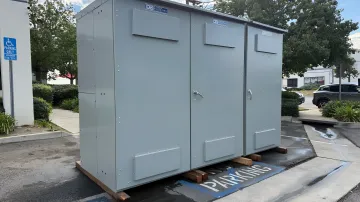
DEI Power manufactures UL 891-certified low-voltage switchboards in this category, building each assembly to custom voltage, layout, and jobsite specifications from its 50,000 sq. ft. facility in Ontario, California. As an approved Siemens OEM, DEI Power typically completes custom orders within 4–6 weeks and ships in-stock units within 1 business day.
Use Cases of a Distribution Panel
Distribution panels are required when:
- Receiving power at the utility service entrance: The first point of distribution after the utility meter or transformer
- Routing high-capacity feeds to multiple zones: Feeding 5, 10, or 20 downstream panelboards across a campus or facility
- Supporting loads exceeding panelboard capacity: Any installation requiring more than 1,200A or multiple high-amperage feeder circuits
- Providing modular scalability: When future load growth is anticipated and additional feeder positions will be needed
These requirements translate across a range of facility types:
- Industrial manufacturing plants: Primary distribution point feeding machinery panels, motor control centers, and process equipment
- Hyperscale and enterprise data centers: Main distribution frame supplying PDUs, RPPs, and downstream panelboards with optional branch circuit monitoring
- Utility substations and infrastructure projects: Service entrance switchboards rated for high fault currents and compliant with utility specifications
- Large commercial campuses: Multi-building sites requiring centralized distribution with individual building panels
- Healthcare facilities: Redundant distribution paths supplying life-safety, critical care, and normal branch circuit panels
Real-World Scenario:
In an industrial facility, the utility transformer feeds a 2,000A main switchboard. This distribution panel routes power to six downstream locations: a 1,200A panelboard serving the production floor, an 800A motor control center for conveyors and pumps, and a 600A panelboard for office and warehouse lighting. Three additional 400A panelboards handle ancillary equipment zones. Each panelboard then subdivides its feed into branch circuits. The switchboard's modular design allows a seventh feeder position to be added when the facility expands.
Panelboards vs Distribution Panels: Which One Do You Need?
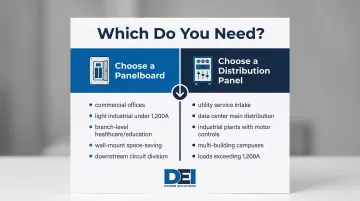
Once you understand how each device functions, the choice usually comes down to two factors: scale of load and position in the distribution chain. If the equipment will serve branch circuits directly — lighting, receptacles, individual equipment drops — in a defined zone, specify a panelboard. If it will receive power from the utility or main switchgear and route it to multiple downstream panels or large equipment, specify a distribution panel.
Situational Guidance
Choose a panelboard for:
- Commercial office fit-outs and tenant improvements
- Light industrial zones with localized loads under 1,200A
- Branch-level circuit protection in healthcare, education, and hospitality
- Installations where wall-mounting saves floor space
- Downstream circuit division after power has been routed to a specific area
Choose a distribution panel (switchboard) for:
- Primary power intake from utility service or transformers
- Data centers requiring main distribution to multiple PDUs, RPPs, or floor panels
- Industrial plants with heavy machinery, motor control centers, and multiple production zones
- Any multi-building or multi-zone campus needing centralized high-current routing
- Projects where current requirements exceed 1,200A or future load growth is anticipated
Compliance Considerations
Panelboards must meet UL 67 and NEC Article 408; switchboards operating as distribution panels must meet UL 891. The NEC distinguishes them by physical characteristics and installation context: panelboards are "accessible only from the front" and designed to be placed "in a cabinet or cutout box placed in or against a wall," while switchboards are "generally accessible from the rear as well as from the front and are not intended to be installed in cabinets."
Specifying equipment that doesn't match the intended function creates code compliance failures at inspection. An AHJ (authority having jurisdiction) will reject a panelboard installed where a switchboard is required, resulting in project delays, change order costs, and delays to occupancy sign-off.
Scalability and Future Growth
Distribution panels offer built-in scalability. Their modular frame construction with horizontal and vertical bus systems lets you add outgoing feeder positions without replacing the primary assembly. Panelboards have a hard capacity ceiling at 1,200A and limited space for additional breakers. They are not designed for upstream routing duties or expansion beyond their rated capacity.
Conclusion
Panelboards and distribution panels occupy distinct, non-overlapping roles in the electrical distribution hierarchy. Panelboards handle the final branch circuit split closest to the load—wall-mounted, front-accessible, rated up to 1,200A, and governed by UL 67. Distribution panels manage high-capacity intermediate routing from the source to downstream assemblies—floor-mounted, free-standing, rated up to 6,000A, and governed by UL 891. The choice is determined by position in the system, current requirements, and applicable standards—not by preference, convenience, or cost alone.
Specifying the correct equipment from the start reduces field rework, eliminates compliance risk, and keeps projects on schedule. For teams sourcing distribution-level switchboards, DEI Power offers UL 891-certified, USA-manufactured assemblies built to custom specifications—with lead times as short as 4–6 weeks for custom builds and 1-day shipping on in-stock units.
Reach DEI Power at sales@deipower.com or (866) 773-8050 to talk through your specifications and get engineering support before equipment is ordered.
Frequently Asked Questions
What is the difference between a panel board and a distribution board?
A panelboard divides an incoming feed into branch circuits (UL 67, up to 1,200A, wall-mounted, front-access only), while a distribution board—also called a switchboard—routes high-capacity power from the main source to multiple downstream panelboards or equipment loads (UL 891, up to 6,000A, floor-mounted, front and rear access).
What is an electrical distribution panel?
An electrical distribution panel (referred to as a switchboard in North American standards) receives supply from a utility feed or transformer and distributes it to panelboards, motor control centers, or other subsystems throughout a facility—sitting upstream of panelboards in the power distribution chain.
What are the main components of a distribution panel?
Core components include a main circuit breaker, copper or aluminum busbars (horizontal and vertical), multiple outgoing breaker or disconnect positions, neutral and ground bar assemblies rated for full system load, and optional metering, monitoring, or surge protection devices.
What are the four types of electrical panels?
The four common types are: load centers (residential, plug-in breakers, max 240V/400A), panelboards (commercial/industrial branch circuit protection, up to 600V/1,200A), switchboards/distribution panels (intermediate high-current routing, up to 600V/6,000A), and switchgear (highest voltage/fault-current applications used in utility and industrial settings with ratings exceeding switchboard capacity).
How much does it cost to replace an electrical distribution panel?
Costs depend on amperage, custom configuration, labor, permits, and site conditions. Full industrial service upgrades range from $15,000–$30,000 for 400A systems to $100,000–$200,000+ for 2,000A+ installations, including equipment, labor, and permits.
What standards govern panelboards and distribution panels?
Panelboards fall under UL 67 and NEC Article 408; distribution panels operating as switchboards fall under UL 891 and NEC Article 408. Using equipment certified to the correct standard is required for code compliance and inspection approval on commercial and industrial projects.