Introduction
Engineers, contractors, and facility teams face a critical choice when specifying power distribution equipment. Selecting the wrong UL standard can result in code violations, costly retrofits, or system failures under fault conditions. Many facilities struggle with the decision between UL 891 switchboards and UL 1558 switchgear, unaware that equipment rated for the wrong environment can mean costly downtime or expose maintenance workers to preventable arc flash hazards.
Both standards govern low-voltage power distribution equipment, yet they serve fundamentally different applications, environments, and risk profiles. Choosing between them isn't about picking the "better" product. It's about matching the equipment's design philosophy, fault tolerance, and safety features to what your facility actually demands.
This guide breaks down how each standard differs in construction requirements, application scope, fault current ratings, and safety philosophy — so you can specify with confidence.
Key Takeaways
- UL 891 applies to dead-front switchboards up to 600V AC, using fixed molded-case circuit breakers (UL 489)
- UL 1558 covers metal-enclosed switchgear up to 1,000V AC with draw-out power circuit breakers (UL 1066)
- On cost: UL 1558 switchgear runs roughly 2–3× more than UL 891 systems at equivalent amperage ratings
- Choose UL 891 for budget-conscious commercial projects; UL 1558 when uptime and arc flash protection are non-negotiable
UL 891 vs UL 1558: Quick Comparison
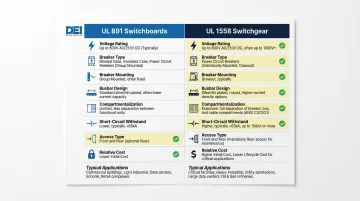
Here's how the two standards stack up across the specifications that matter most for project selection:
| Attribute | UL 891 Switchboards | UL 1558 Switchgear |
|---|---|---|
| Voltage Rating | Up to 600V AC | Up to 1,000V AC |
| Breaker Type | Molded-case circuit breakers (UL 489) | Low-voltage power circuit breakers (UL 1066) |
| Breaker Mounting | Fixed, group-mounted | Draw-out, individually mounted |
| Busbar Design | Non-insulated with defined spacing | Insulated with increased clearances |
| Compartmentalization | Not required | Required between each breaker and bus |
| Short-Circuit Withstand | 3-cycle minimum | 30-cycle minimum (up to 85 kA) |
| Access | Front-access only | Front and rear access standard |
| Production Tests | 3 minimum | 7 minimum |
| Typical Applications | Commercial buildings, schools, retail, light industrial | Data centers, hospitals, heavy industrial, utility infrastructure |
| Relative Cost | Baseline | 2–3× higher |
Both standards operate under the broader NEC Article 408 framework and sit alongside UL 67 (panelboards up to 1,200A) and the breaker-specific standards UL 489 and UL 1066.
What is UL 891?
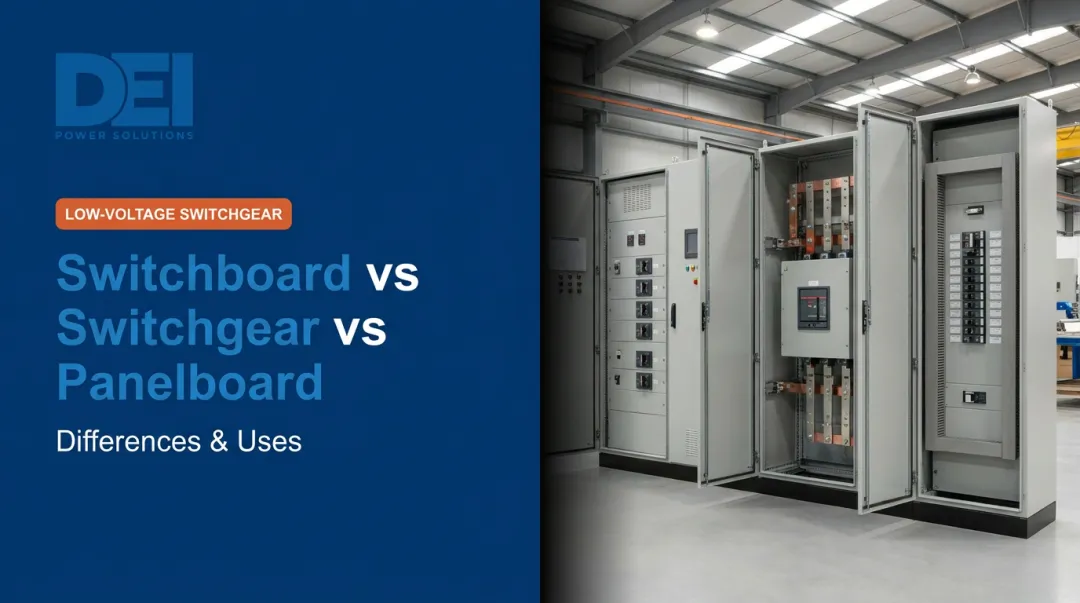
UL 891 is the UL standard governing dead-front switchboards for commercial and light industrial applications operating at nominal AC voltages up to 600V. The term "dead-front" means all live parts are enclosed and inaccessible during normal operation—a baseline safety requirement distinct from the compartmentalized construction required by UL 1558.
Core Design Characteristics
UL 891 switchboards feature:
- Fixed molded-case circuit breakers tested to UL 489, group-mounted within the assembly
- Non-insulated copper or aluminum busbars with defined spacing rather than full insulation
- Flexible physical configurations including in-line, back-to-back, U-shaped, and L-shaped layouts
- Current capacity ranging from approximately 400A to 6,000A (maximum bus rating varies by manufacturer)
- Short-circuit withstand ratings from 10,000 to 200,000A over a 3-cycle period
- Minimum three production tests required per UL 891
- Compact footprint with minimum 18-inch depth and typical 90-inch height
Maintenance and Certification Profile
Fixed-mounted breakers require the system to be de-energized for servicing, which increases downtime compared to draw-out designs.
UL certification is not legally mandated by name in the NEC, but it is industry-standard practice and typically required for code compliance under NEC Article 408 and project approval by authorities having jurisdiction. Manufacturers must submit drawings, material specifications, and performance data, then pass factory audits to maintain UL 891 listing.
Cost and Practicality Advantages
That simpler certification footprint reflects the broader design philosophy: UL 891 systems cost significantly less than UL 1558 switchgear, with lower material and manufacturing costs driven by straightforward construction. Three factors account for most of the savings:
- No compartmentalization requirements
- Fixed breakers instead of draw-out designs
- Non-insulated busbars with defined spacing rather than full insulation coverage
For facilities with moderate electrical demands, these trade-offs make UL 891 the practical, budget-efficient choice.
Use Cases of UL 891
Appropriate environments for UL 891 switchboards:
- Commercial office buildings
- Retail spaces
- Schools and universities
- Hotels and hospitality facilities
- Multi-tenant residential buildings
- Light industrial or manufacturing facilities with moderate load requirements
Why UL 891 is not appropriate for mission-critical environments: The 3-cycle withstand rating means breakers trip immediately under high fault conditions rather than withstanding the fault. This leads to full system shutdowns during fault events—a risk that is acceptable in a retail facility but unacceptable in a hospital operating room or a data center hosting customer workloads under strict uptime SLAs.
What is UL 1558?
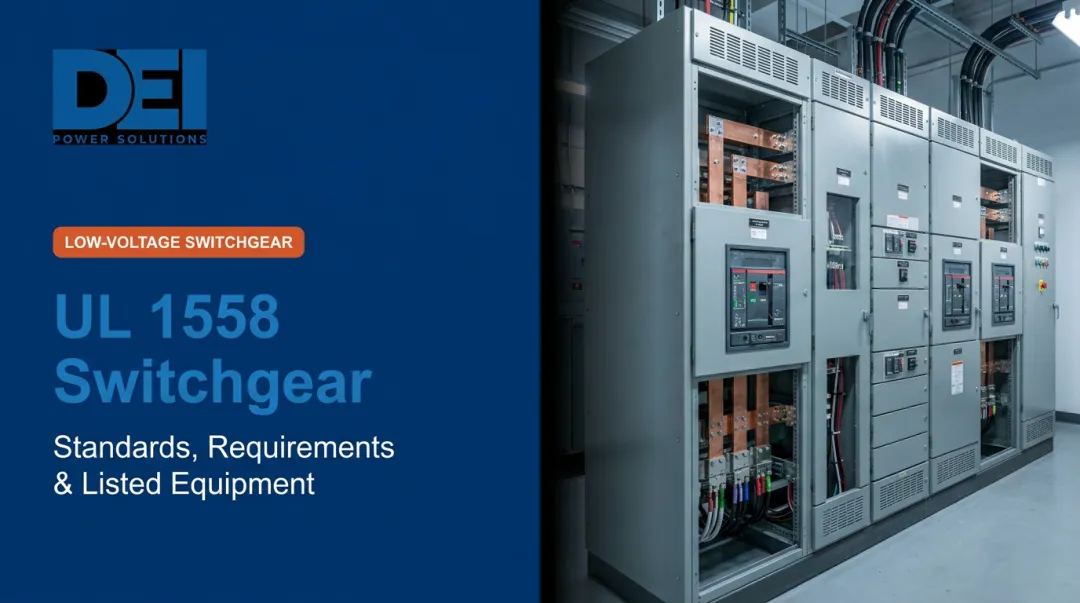
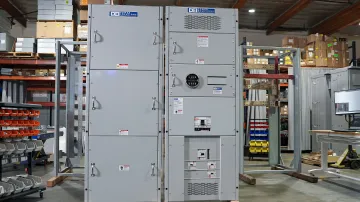
UL 1558 is the UL standard governing metal-enclosed low-voltage power circuit breaker switchgear, operating at nominal AC voltages up to 1,000V. The "metal-enclosed" designation means each circuit breaker is individually housed in its own compartmentalized section with barriers between breakers and bus components—a fundamental structural requirement that distinguishes it from UL 891.
Core Design Characteristics
UL 1558 switchgear features:
- Draw-out low-voltage power circuit breakers tested to UL 1066—100%-rated devices that can be operated remotely
- Insulated busbars with increased clearances for enhanced safety
- Individually mounted breakers with required compartmentalization between each breaker and the bus
- Front and rear access standard for maintenance flexibility
- Continuous current ratings from 1,600A to 10,000A
- Short-circuit withstand rating of minimum 30 cycles on a 60Hz system (up to 85 kA)
- Seven production tests required per UL 1558
- Larger footprint with minimum 54-inch depth (standard 72 inches) and typical 96-inch height
Maintenance Advantage of Draw-Out Construction
Because breakers are individually mounted on removable draw-out mechanisms, technicians can remove, inspect, maintain, or replace a breaker without shutting down the entire system or exposing themselves to adjacent live components. This capability is critical in facilities where any downtime has operational or safety consequences—such as hospitals, data centers, or continuous-process manufacturing plants.
Safety Advantages
Insulated busbars, compartmentalization, and optional arc-resistant construction reduce arc flash risk during maintenance. UL 1558 also supports zone-selective interlocking (ZSI) and enhanced protective relay coordination, which allow selective fault isolation—meaning only the faulted circuit goes down rather than the entire distribution system.
Arc-resistant switchgear construction, tested per IEEE C37.20.7, is available for UL 1558 but not for UL 891 switchboards.
Cost Profile
UL 1558 switchgear costs approximately 2–3 times more than a comparable UL 891 system. For industrial and infrastructure environments, the total cost of a single unplanned outage event often justifies or exceeds this premium.
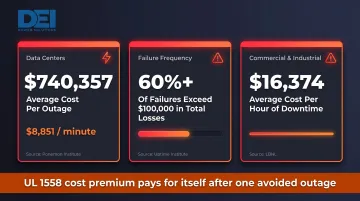
Outage cost benchmarks:
- Data centers experienced an average cost of $740,357 per outage, or $8,851 per minute (Ponemon Institute, 2016)
- Over 60% of failures result in at least $100,000 in total losses, with million-dollar outages increasing from 11% to 15% between 2019 and 2022 (Uptime Institute)
- Medium and large commercial/industrial facilities average $16,374 per hour of downtime (LBNL, 2018)
At $16,000 or more per hour of downtime, the 2–3× cost premium for UL 1558 pays for itself after a single avoided outage in most industrial or infrastructure settings.
Use Cases of UL 1558
Environments where UL 1558 is required or strongly recommended:
- Hyperscale and enterprise data centers
- Hospitals and healthcare facilities
- Industrial manufacturing plants with heavy machinery
- Utility substations and infrastructure projects
- Airports and stadiums
- Government facilities
- Large-scale commercial campuses where power outages have significant financial or safety consequences
As load requirements grow and uptime SLAs tighten, the case for UL 1558 shifts from preference to necessity—the next section breaks down where UL 891 fits instead.
UL 891 vs UL 1558: Key Differences and How to Choose
Protection Philosophy: The Most Critical Difference
UL 891 uses molded-case circuit breakers (UL 489) that trip instantly during a fault with no intentional time delay. These breakers are sealed, not field-maintainable, and designed to interrupt the fault immediately. UL 489 breakers are typically rated at 80% continuous current unless marked otherwise.
UL 1558 uses power circuit breakers (UL 1066) that can withstand and operate through a fault for up to 30 cycles, enabling selective coordination. These 100%-rated devices allow the protection system to isolate only the faulted branch while maintaining power to the rest of the facility.
Construction and Compartmentalization
UL 891 has no required separation between breakers and bus components, meaning maintenance workers are exposed to adjacent live components during servicing. UL 1558's compartmentalization physically isolates each circuit, reducing arc flash exposure and enabling safer maintenance. Only UL 1558 qualifies for arc-resistant switchgear construction — UL 891 does not.
Footprint and Installation
UL 891 switchboards:
- Minimum 18-inch depth
- Typical 90-inch height
- Front-access only
- Suitable for space-constrained electrical rooms
UL 1558 switchgear:
- Minimum 54-inch depth (standard 72 inches)
- Typical 96-inch height
- Front and rear access standard
- Requires more clearance per NEC 110.26
For high-amperage applications, the difference in footprint narrows, and correct breaker frame selection can optimize the UL 1558 layout.
These physical and safety distinctions feed directly into application selection. Use the questions below to identify which standard fits your project.
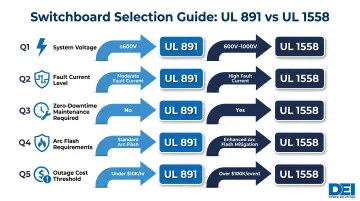
Practical Decision Framework: 5 Key Questions
1. What is the system voltage?
- ≤ 600V AC: UL 891 is code-compliant and cost-effective
- 600V–1,000V AC: UL 1558 required
2. What are the expected fault current levels?
- Moderate fault currents with acceptable downtime: UL 891
- High fault currents requiring selective coordination: UL 1558
3. Is zero-downtime maintenance a requirement?
- No: UL 891 requires de-energization for breaker service
- Yes: UL 1558 draw-out breakers enable live maintenance without shutting down the system
4. What are the arc flash risk and safety requirements?
- Standard commercial safety protocols: UL 891
- Enhanced arc flash protection required: UL 1558 (compartmentalization + arc-resistant options)
5. What is the budget and outage cost threshold?
- Outage cost < $10,000/hour: UL 891 is likely sufficient
- Outage cost > $100,000/event: UL 1558 cost premium is justified
Situational Recommendations by Application
Choose UL 891 for:
- Commercial buildings
- Schools and educational facilities
- Retail and hospitality
- Light industrial plants
- Multi-tenant residential
- Projects where upfront cost is the primary driver
Choose UL 1558 for:
- Healthcare facilities
- Data centers — hyperscale and enterprise alike
- Utility infrastructure
- Heavy industrial plants with continuous processes
- Any facility where a single outage event would cause significant financial loss or safety risk
Conclusion
UL 891 and UL 1558 are purpose-built standards designed for different risk environments. Choosing between them comes down to what level of fault tolerance, maintenance flexibility, and arc flash protection your facility actually requires.
Before specifying, evaluate:
- Voltage requirements and fault current exposure
- Uptime demands and maintenance access needs
- Arc flash risk and worker safety requirements
- Total cost of ownership, not just capital budget
The right standard matches your operational risk profile — and that determination should drive the specification, not price alone.
DEI Power's engineering team supports UL 891 switchboard specification, configuration, and rapid fulfillment for projects where code-compliant, USA-manufactured switchboards are the right fit. Contact DEI Power at (866) 773-8050 to discuss your project requirements.
Frequently Asked Questions
What is UL 891 and what does it cover?
UL 891 is the UL standard for dead-front switchboards operating at up to 600V AC, covering fixed group-mounted molded-case circuit breakers, non-insulated busbars, and a minimum 3-cycle short-circuit withstand rating—used in commercial and light industrial applications.
What is UL 1558 switchgear?
UL 1558 governs metal-enclosed low-voltage power circuit breaker switchgear operating up to 1,000V AC, requiring individually compartmentalized draw-out power circuit breakers, insulated busbars, and a 30-cycle withstand rating—designed for mission-critical and high-demand industrial environments.
What are the differences between UL 1558, UL 891, and UL 67?
UL 67 covers panelboards (up to 1,200A, branch circuit protection), UL 891 covers switchboards (up to 6,000A, commercial/light industrial distribution), and UL 1558 covers low-voltage power circuit breaker switchgear (up to 10,000A, mission-critical environments). Each standard represents a step up in capacity, fault withstand capability, and installed cost.
What is the maximum voltage permitted by UL 891 for switchboards?
UL 891 switchboards are rated for nominal AC voltages up to 600V. Applications requiring voltages up to 1,000V AC fall under UL 1558 instead.
What does UL 489 cover?
UL 489 is the standard for molded-case circuit breakers—the type used in UL 891 switchboards. These breakers are sealed, fixed-mounted, and rated at 80% continuous current per NEC requirements, and they interrupt the circuit on fault rather than sustaining current flow through a withstand period.
What is the difference between switchgear and LV switchboards?
Low-voltage switchboards (UL 891) use fixed, group-mounted molded-case breakers in an open bus arrangement — compact, cost-effective, and suited for standard distribution. LV switchgear (UL 1558) places draw-out power circuit breakers in individually compartmentalized enclosures, which supports higher fault withstand ratings and allows safer live maintenance in critical power environments.