This guide focuses specifically on commercial and industrial electrical switchboard upgrades — UL 891-rated low-voltage switchboards rated between 400A and 4000A, not residential panels. It's written for contractors bidding projects, engineers specifying equipment, and facility managers responsible for aging infrastructure.
We'll cover what defines a commercial switchboard, how to recognize when an upgrade is unavoidable, the five-step upgrade process, what to look for when sourcing replacement equipment, and how to budget and plan for lead times, costs, and project execution.
Key Takeaways
- Commercial switchboards (400A–4000A, UL 891-certified) are purpose-built for large facilities — not scaled-up versions of residential panels
- Key upgrade triggers: frequent tripping, visible damage, equipment age beyond 30 years, insufficient capacity, and non-compliance with current NEC editions
- The upgrade process involves load assessment, engineering design, permitting, planned outage installation, and post-install testing with AHJ inspection
- Specify UL 891 certification and the correct NEMA enclosure rating; prioritize manufacturers that offer custom builds
- Standard lead times run 10–30 weeks — domestic, vertically integrated manufacturers can cut that significantly
What Is an Electrical Switchboard (and How Does It Differ from a Basic Panel)?
A commercial or industrial electrical switchboard is a centralized power distribution assembly that receives electricity from a utility source and routes it through multiple circuit breakers or fusible switches to branch circuits throughout a facility. Unlike a residential load center (typically 100A–200A, front-access only, installed in a cabinet), a commercial switchboard operates in the 400A–4000A range, features rear or dual-access construction, and meets stringent UL 891 certification requirements for dead-front switchboards.
Key Components of a Commercial Switchboard
Every commercial switchboard includes several critical sections:
- Main breaker section: Controls the entire facility's incoming power feed, providing overcurrent protection and the ability to de-energize the entire switchboard for maintenance
- Distribution sections: House individual circuit breakers or fusible switches that feed branch circuits to specific equipment, departments, or zones
- Metering compartments: Provide real-time visibility into power consumption, voltage levels, and load distribution — essential for energy management and troubleshooting
- Bus bars: Heavy-duty copper or aluminum conductors that carry current from the main breaker to distribution breakers, rated for the switchboard's full ampacity and fault current
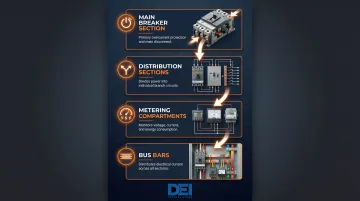
How these components are rated and assembled determines whether a switchboard meets the safety thresholds required for commercial and industrial installations — which is where UL 891 certification becomes the deciding factor.
Understanding the UL 891 Standard
UL 891 is the product safety standard for dead-front switchboards rated 1000V or less. A UL 891 listing verifies that a switchboard has been tested and certified for:
- Short-circuit withstand rating: Bus bars and supports can withstand specified fault currents without structural failure
- Temperature rise limits: Equipment operates within safe temperature thresholds at full rated current
- Electrical clearances: Adequate spacing between live parts and between live parts and ground
- Component compatibility: Integrated overcurrent devices are properly rated, mounted, and coordinated
UL 891 certification under the General Coverage Program supports designs up to 4000A in the U.S. and up to 100kA short-circuit current rating at 480V. For contractors, engineers, and facility teams, specifying UL 891-certified equipment means the switchboard has been independently verified against documented safety and performance criteria — not just self-declared compliant by a manufacturer.
Signs Your Commercial Switchboard Needs an Upgrade
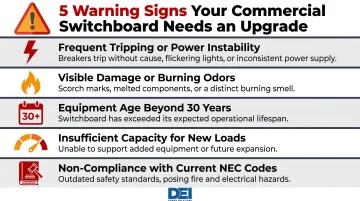
Frequent Tripping, Flickering, or Power Instability
Circuit breakers that trip repeatedly — especially when new equipment starts — or lights that flicker under load signal an overloaded or undersized switchboard. This occurs when the facility's actual electrical demand exceeds the switchboard's rated ampacity. Continued stress accelerates insulation degradation, increases connection resistance at terminals, and raises the risk of thermal runaway events where heat builds faster than the system can dissipate it.
Visible Damage, Heat, or Burning Odors
Physical deterioration is an urgent safety signal:
- Scorch marks near breakers or bus bars
- Warm or hot panel surfaces (detectable by touch or infrared scan)
- Burning smells near the switchboard enclosure
- Discoloration of wiring insulation
These symptoms indicate thermal overload or arcing conditions. Left unaddressed, they can escalate to electrical fires. NFPA reports an estimated 16,930 non-home fires annually involving electrical distribution and lighting equipment, causing 22 deaths, 210 injuries, and $718 million in property damage. Wiring and insulation were identified as the leading items first ignited.
Switchboard Age Beyond Its Useful Life
Commercial switchboards have a typical useful service life of approximately 30 years under normal conditions, according to Schneider Electric's published guidance. Equipment operating beyond this timeframe may contain:
- Degraded insulation that no longer provides adequate dielectric protection
- Obsolete breaker components no longer supported by manufacturers
- Materials like asbestos, which the EPA began banning in 1989 and fully prohibited in chrysotile form in 2024
Switchboards manufactured before the late 1980s may require hazardous material assessment and specialized abatement procedures before removal.
Insufficient Capacity for Current or Planned Power Demands
New manufacturing equipment, EV charging stations, HVAC upgrades, data center expansions, and production line additions all push electrical demand beyond a switchboard's original design capacity. "Headroom" — the difference between rated capacity and actual load — shrinks with every addition.
Operating at or near 100% capacity leaves no margin for peak loads, accelerates component wear, and increases heat stress. Proactive upgrades prevent emergency outages and the costly downtime that follows.
Non-Compliance with Current Codes or Missing Safety Protections
Code requirements tighten with each NEC cycle — and older switchboards often don't meet current standards. As of March 2026, the 2023 NEC is enforced in 25 states, the 2020 NEC in 15 states, and the 2017 NEC in 3 states. Code updates often introduce new safety requirements — such as ground fault protection of equipment (GFPE) on services rated 1000A or more (NEC 230.95), or short-circuit current rating (SCCR) field marking (NEC 408.6). Renovations, equipment additions, or facility expansions frequently trigger mandatory compliance upgrades. Missing protective features create safety and liability exposure.
Benefits of Upgrading Your Electrical Switchboard
Enhanced Safety for Personnel and Property
Modern switchboards incorporate updated protection mechanisms that older equipment lacks:
- Arc flash mitigation features that reduce arc energy exposure during fault events
- Properly rated interrupting capacities that safely clear fault currents without equipment damage
- Compliant bus configurations with documented short-circuit withstand ratings
These improvements directly reduce the risk of electrical fires, arc flash incidents, and electrocution. A Bureau of Labor Statistics study cited by IEEE found 2,287 worker deaths and 32,807 lost-time injuries from electrical shock or burns over seven years, with 38% classified as electrical burns. Modern switchboard designs address these hazards directly.
Full Compliance with Electrical Codes and Safety Standards
An upgrade ensures the facility meets the current NEC edition and applicable local amendments. Code compliance:
- Reduces insurance liability
- Satisfies inspection requirements for occupancy permits
- Becomes mandatory before facility expansions, change of use, or significant equipment additions
An inspector finding a compliance gap mid-project can stop work entirely — and the cost to retrofit a non-compliant installation almost always exceeds the cost of specifying correctly from the start.
Increased Capacity to Support Business Growth and New Loads
A correctly specified replacement switchboard provides the ampacity, number of circuit positions, and bus capacity to accommodate future growth without additional upgrades. Real-world applications include:
- Adding CNC machines or robotic cells in manufacturing plants
- Expanding server racks in data centers or colocation facilities
- Installing Level 2 or DC fast-charging stations for fleet electrification
- Integrating solar inverters or battery storage systems
Building in capacity upfront costs less than sequential upgrades and avoids repeated outages.
Improved Power Quality and Energy Efficiency
Modern switchboards with integrated metering and power monitoring help facilities:
- Identify energy waste from unbalanced loads or inefficient equipment
- Correct power factor issues that increase utility demand charges
- Track consumption patterns to optimize operational schedules
In one common scenario, an unbalanced three-phase panel running at 15–20% load imbalance can push demand charges up by hundreds of dollars monthly — costs that disappear once loads are properly distributed across a new switchboard.
Reduced Downtime and Lower Long-Term Maintenance Costs
Deferring a switchboard upgrade carries hidden costs:
- Emergency repairs during unplanned outages
- Damage to downstream equipment from voltage sag or transient events
- Productivity losses when production lines or critical systems go offline
FM Global reports that equipment failure accounts for nearly one-third of all combined property losses, and equipment flagged as "at risk" is 10 times more likely to break down. A properly specified, newly manufactured switchboard maintained per NFPA 70B guidelines delivers predictable performance and reliability.
How Is a Switchboard Upgrade Done? Step-by-Step
Step 1: Electrical Load Assessment and Audit
A licensed electrician or electrical engineer conducts a comprehensive audit of the existing system:
- Measures actual loads on all circuits using power meters or data loggers
- Reviews as-built drawings (if available) and verifies current circuit assignments
- Calculates future demand based on planned equipment additions or operational changes
- Identifies code compliance gaps and safety hazards
Accurate load data is the foundation of a well-specified replacement. Underestimating demand results in an undersized switchboard; overestimating inflates costs unnecessarily.
Step 2: Engineering Design and Equipment Specification
Based on the load assessment, the engineer specifies the replacement switchboard:
- Main breaker ampacity (e.g., 1200A, 2000A, 4000A)
- Number and type of distribution breakers (single-pole, two-pole, three-pole)
- Bus rating and material (copper or aluminum)
- Voltage configuration (120/240V, 208Y/120V, 480Y/277V, etc.)
- Metering and monitoring requirements
- Enclosure type (NEMA 1 for indoor, NEMA 3R for outdoor weather-resistant installations)
Custom configurations are common in industrial, healthcare, and high-availability environments. DEI Power, a UL 891-certified and Siemens-approved OEM based in Ontario, California, provides custom builds tailored to single-line diagrams, non-standard pole counts, and site-specific requirements across those sectors.
Step 3: Permits, Code Review, and Procurement
The project team:
- Pulls electrical permits with the local Authority Having Jurisdiction (AHJ)
- Submits equipment specifications and drawings for code review
- Coordinates equipment procurement
Standard switchboard lead times average approximately 30 weeks, with expedited options reducing delivery to 10–15 weeks. Manufacturers with in-house production and stocked inventory — like DEI Power — can cut that significantly. Most DEI Power orders ship within 4–6 weeks, with nationwide delivery in 3–5 business days, because there are no third-party suppliers in the chain.
Step 4: Disconnection of Old Equipment and Installation of New Switchboard
Once equipment is on-site and permits are in hand, the physical work begins. Installation requires a planned outage window and must be performed by licensed electricians:
- Coordinate the outage schedule to minimize operational disruption
- De-energize the system per OSHA 1910.147 lockout/tagout procedures and NFPA 70E safe work practices
- Remove the old switchboard (including hazardous material abatement if pre-1989 equipment contains asbestos)
- Install the new switchboard per manufacturer instructions and NEC requirements
- Terminate feeders and branch circuits, torque all connections to specification
- Label all circuits clearly with durable, compliant markings
Torque specs and circuit labeling are frequent sources of post-installation issues — getting both right the first time avoids costly return visits.
Step 5: Testing, Inspection, and Documentation
Post-installation work includes:
- Functional testing of all breakers and protective devices
- Infrared thermography to verify connection integrity and identify hot spots
- AHJ inspection and sign-off
- Delivery of as-built documentation, including single-line diagrams, panel schedules, and test reports
Proper documentation supports future maintenance, satisfies insurance requirements, and is often mandatory for facility compliance audits. NEC 408.6 requires field marking of available fault current, short-circuit current rating, and calculation date on all switchboards in commercial and industrial occupancies.
What to Look for When Sourcing a Replacement Switchboard
Key Certifications and Standards Compliance
Any replacement switchboard for commercial or industrial use must carry UL 891 listing and comply with applicable NEMA and NEC requirements. UL 891 certification verifies that the switchboard has been tested for safe construction, interrupting ratings, short-circuit withstand capability, temperature rise, electrical clearances, and proper component integration. This reduces risk for the project team by ensuring the equipment meets documented safety criteria.
Configuration Specifications: Voltage, Ampacity, and Environment
Engineers and contractors must define several specification variables before procurement:
| Specification | Typical Options | Selection Criteria |
|---|---|---|
| System Voltage | 120/240V, 208Y/120V, 277/480V, 480Y/277V | Matches facility service voltage |
| Main Breaker Ampacity | 400A, 600A, 800A, 1000A, 1200A, 1600A, 2000A, 2500A, 3000A, 4000A | Based on calculated load plus future growth |
| Bus Material | Copper (58 MS/m conductivity) or Aluminum (37 MS/m conductivity) | Copper offers higher conductivity; aluminum requires larger cross-sections but costs less |
| Enclosure Type | NEMA 1 (indoor), NEMA 3R (outdoor weather-resistant), NEMA 4 (watertight), NEMA 12 (industrial dust/oil) | Matches installation environment |
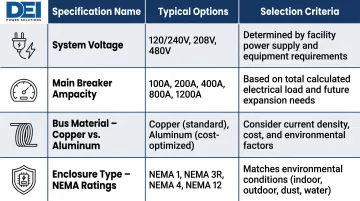
NEMA 1 enclosures are standard for indoor electrical rooms. NEMA 3R suits outdoor pad-mounted installations. NEMA 12 is specified for manufacturing facilities with airborne particulates or oil mist.
Manufacturer Capabilities: Custom Builds, Lead Times, and Support
Once specs are locked, the manufacturer you choose determines whether the project stays on schedule. When evaluating manufacturers, consider:
- Can they build to customer-supplied single-line diagrams and handle non-standard configurations?
- Do they offer pre-procurement specification review to catch errors before they become change orders?
- What are realistic delivery timelines for standard versus custom equipment?
DEI Power, a UL 891-certified Siemens OEM manufacturing in Ontario, California, addresses all three. Their engineering team reviews installer drawings, confirms termination requirements, and delivers finalized submittals with each order — shortening lead times and reducing field adjustments for time-sensitive projects.
For federally funded projects, verify that the manufacturer provides BABA (Build America, Buy America) compliance documentation. BABA requires manufactured products to be made in the U.S. with greater than 55% domestic component cost.
Switchboard Upgrade Costs and Timeline
What Drives the Cost of a Commercial Switchboard Upgrade
Several factors determine the final cost of a commercial switchboard upgrade. Key drivers include:
- Ampacity rating: Equipment at 4000A costs significantly more than 800A due to larger bus bars, enclosures, and breakers
- Breaker count: Each additional distribution breaker increases both material and labor costs
- Enclosure and bus material: NEMA 3R/4 enclosures run higher than NEMA 1; copper bus bars cost more than aluminum but deliver better conductivity
- Custom engineering: Non-standard configurations, integrated metering, or specialty enclosures add engineering and fabrication scope
- Permit and inspection fees: These vary by jurisdiction and project complexity
- Labor complexity: Tight access, existing infrastructure conflicts, and limited outage windows all increase installation hours
- Infrastructure modifications: Upgrading feeders, conduit, or grounding to match new equipment capacity adds significant scope
Hazardous material abatement for pre-1989 switchboards containing asbestos can add unplanned costs if not identified early in the assessment phase.
How Long Does a Switchboard Upgrade Take?
Project timelines break into two phases — procurement and installation — and the longer one is almost always procurement.
Procurement: Standard equipment from distributors typically requires 10–30 weeks. Custom-built switchboards from domestic manufacturers can ship within 4–6 weeks, with delivery nationwide in 3–5 business days.
Installation: Duration depends on switchboard size, outage window availability, and site conditions. Typical commercial upgrades require 1–3 days of on-site work covering removal, installation, termination, and testing. Complex industrial projects with multiple sections or integrated automation may require 1–2 weeks.
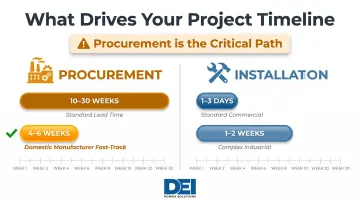
Because procurement dominates the critical path, locking in specifications and placing orders early is one of the most effective ways to protect the schedule.
How to Reduce Cost and Schedule Risk
Contractors and facility teams can control costs and avoid delays by:
- Completing the load assessment and design early — accurate specifications reduce change orders and rework
- Specifying equipment precisely to avoid clarification cycles that stall fabrication
- Sourcing from domestic, vertically integrated manufacturers with short build cycles to reduce lead times and shipping risk
- Planning the outage window well in advance to avoid premium emergency labor rates
- Including a hazmat contingency if the existing switchboard predates 1989 — budget for asbestos assessment and removal before work begins
DEI Power's engineering team provides specification review before production, confirming code compliance, system configuration, and project alignment to reduce costly field revisions.
Frequently Asked Questions
What are the basics of a switchboard?
A switchboard is a power distribution assembly that receives electricity from the utility feed and routes it to branch circuits via circuit breakers or fusible switches. It acts as a facility's electrical control center — providing overcurrent protection and the ability to isolate individual circuits without a facility-wide outage.
What are the benefits of using a switchboard?
Switchboards provide centralized power distribution, overload and fault protection for downstream circuits, and the ability to isolate individual circuits for maintenance without facility-wide outages. They also support future load growth through scalable configurations and circuit positions.
How is an upgrade of an electrical switchboard done?
A switchboard upgrade follows five steps:
- Electrical load assessment and audit
- Engineering design and equipment specification
- Permitting and procurement
- Licensed installation during a planned outage
- Post-installation testing with AHJ inspection
All work must be performed by licensed electricians per OSHA and NFPA 70E requirements.
How much to upgrade an electrical switchboard?
Commercial switchboard upgrade costs vary widely based on ampacity (400A–4000A), number of circuits, custom configuration requirements, enclosure type, labor complexity, and permit fees. Projects typically range from $15,000 to $75,000+ depending on scope. Request a detailed quote based on your specific load assessment.
How long does a switchboard upgrade take?
Installation typically takes 1–3 days for standard commercial projects, but the overall timeline is usually driven by equipment procurement, which can run 10–30 weeks with many suppliers. Manufacturers like DEI Power offer 4–6 week lead times on custom builds, which can cut total project duration considerably.