Introduction
Approximately 30,000 arc flash incidents occur annually in the U.S., resulting in 7,000 burn injuries and 2,000 burn center admissions. Data center electrical panels operate at higher power densities than ever before, which raises the operational stakes considerably: arc flash events can reach temperatures of 35,000°F, unplanned downtime costs frequently exceed $250,000 per incident, and OSHA issued 2,443 Lockout/Tagout citations in FY2024 alone.
Those numbers reflect a consistent pattern. Electrical panel work in data centers is inherently high-risk — not because panels are poorly designed, but because uptime pressure, energized work requirements, and undertrained operators create conditions where safety shortcuts become dangerously common.
The consequences extend further than most teams realize:
- Panel failures account for 36% of the largest global data center outages
- Fatal burns can occur at distances greater than 10 feet from the arc source
- Energized work without proper PPE or procedures is a leading cause of preventable fatalities
Key Takeaways
- Arc flash hazards require arc-rated PPE matched to incident energy levels (4–40 cal/cm²), not standard gloves
- LOTO procedures must be equipment-specific and verified with calibrated meters—generic policies fall short
- Energized panel work is only permissible under NFPA 70E when de-energization is documented as impossible to justify
- Hot-aisle heat and tight clearances add compounding risk during routine maintenance
- Ongoing monitoring, accurate labeling, and qualified personnel are non-negotiable at the panel level
Safety Guidelines for Data Center Electrical Panels
Electrical panel safety in data centers demands a discipline-specific approach. These panels concentrate high fault energy, serve live loads 24/7, and are accessed under intense time pressure. The primary risk categories—arc flash, electric shock, thermal burns, and isolation failures—each require distinct control strategies maintained throughout every phase of panel interaction, not just during pre-work checks.
General Safety Precautions
PPE Requirements: Arc flash protection demands specific equipment rated to the panel's incident energy level. According to NFPA 70E 2024, PPE categories range from 4 cal/cm² (Category 1) to 40 cal/cm² (Category 4):
- Category 1 (4 cal/cm²): Arc-rated long-sleeve shirt and pants, face shield, safety glasses, insulated gloves rated for panel voltage
- Category 2 (8 cal/cm²): Higher-rated FR clothing plus arc-rated balaclava
- Category 3 (25 cal/cm²): Full arc flash suit (jacket, pants, hood) over base layers
- Category 4 (40 cal/cm²): Maximum protection ensemble for high-energy panels
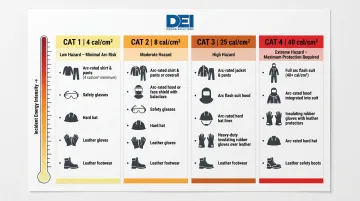
General work PPE is inadequate. Insulated gloves must match panel voltage, footwear must be non-conductive, and FR clothing must be rated to the calculated incident energy—not assumed.
Workspace Readiness: Before any panel interaction:
- Verify arc flash labels are present, legible, and current
- Confirm panel schedules are accurate and up to date
- Establish the flash protection boundary (distance where exposure equals 1.2 cal/cm² for 0.1 second)
- Ensure unauthorized personnel remain outside the restricted approach boundary
Qualified Workers Only: Only qualified electrical workers—as defined by OSHA 29 CFR 1910.332—should work on or near exposed energized parts. "Qualified" means documented training in electrical hazards, demonstrated knowledge of voltage levels and clearance distances, and skills to distinguish live parts.
Qualification is equipment-specific. A worker qualified for 480V panels may not be qualified for higher-voltage equipment in the same facility.
Safety During Installation
Site Preparation: Installation hazards begin before panels are energized:
- Confirm the installation area is clear of energized sources before positioning equipment
- Verify structural support for panel weight
- Ensure all upstream feeds are de-energized and locked out before termination work begins
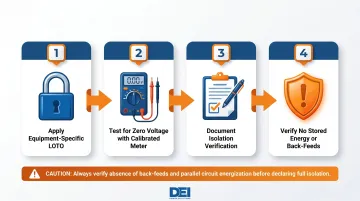
Electrical Isolation Requirements:
- Enforce LOTO using equipment-specific procedures, not generic site-wide checklists
- Test for zero voltage with a calibrated meter before touching any conductor
- Document isolation verification before proceeding
- Stored energy, back-feeds, and parallel circuits can leave panels energized even after apparent isolation
Specifying UL 891-certified switchboards—such as those manufactured by DEI Power—provides installation teams with factory-verified documentation, accurate single-line diagrams, and properly labeled panels from day one. This reduces configuration errors that contribute to installation-phase incidents.
Stop-Work Conditions: Installation must stop immediately if:
- Circuits are unlabeled or mislabeled
- Breaker schedules are missing or inaccurate
- Upstream sources cannot be confirmed as de-energized
- Personnel are not qualified for the voltage level being worked on
Safety While Using or Operating Panels
Operating Limits: Respect these non-negotiable boundaries during normal operation:
- Do not exceed rated ampacity on branch circuits
- Avoid daisy-chaining or overloading individual breakers to accommodate load growth
- Keep panel doors closed during operation except during authorized inspections
Warning Indicators: These signals require immediate action, not continued monitoring:
- Breakers that trip repeatedly and are reset without investigation
- Discoloration or heat marks on panel faces
- Unusual odors (burning insulation)
- Audible buzzing or arcing sounds
Behavioral Risks: Uptime pressure encourages familiarity that erodes caution:
- Bypassing tripped breakers without investigating root cause
- Opening panel covers during live operation without arc-rated PPE
- Allowing unqualified staff to access panel areas under the assumption that "just looking" carries no risk
Any one of these behaviors can trigger an arc flash event—resulting in severe burns, fatality, equipment destruction, and a facility-wide outage with SLA penalties to follow.
Environmental and System Safety Considerations
Temperature Impact: Data center environments directly affect panel safety. Hot-aisle temperatures can reduce insulation lifespan—per the Arrhenius rule cited in ASHRAE TC9.9 guidance, every 10°C increase in operating temperature approximately halves electrical insulation lifespan. Elevated ambient heat also impairs worker alertness and PPE comfort, increasing the likelihood of shortcuts.
Physical Clearances: Tight clearances between panel rows and server racks restrict safe working posture and egress. NEC 110.26 requires:
- Minimum 30-inch working space width
- Minimum 36-48 inches depth (depending on voltage and exposure conditions)
- Minimum 6.5-foot height clearance
- Space for at least 90-degree door opening
These clearances must be maintained even during active build-outs.
Stop-Work Environmental Conditions: Panel work must stop if:
- Cooling has failed and panel room temperatures exceed safe thresholds
- Condensation or water intrusion is present near panels
- Upstream load conditions are unknown due to recent system changes
Common Safety Mistakes to Avoid
Skipping or Shortcutting LOTO
Many data center teams rely on a single breaker trip rather than full equipment-specific LOTO procedures, assuming the load is isolated. Stored energy, back-feeds, and parallel circuits can leave panels energized even after apparent isolation. This is the most common precursor to arc flash incidents in data center environments.
LOTO violations were the #3 most-cited OSHA standard in FY2024, with 2,443 citations representing a 24% increase over the prior year.
Assuming Arc Flash Labels Are Still Accurate
Even when LOTO is followed correctly, the underlying hazard assessment may be wrong. Arc flash hazard levels change whenever upstream equipment is modified, new loads are added, or protective devices are replaced. Panels that haven't been re-analyzed after system changes may carry labels that dramatically understate true incident energy — leading to under-specified PPE.
NFPA 70E 130.5(G) requires arc flash analysis review at least every 5 years and immediately after major modifications. Outdated labels remain one of the most overlooked blind spots in active data centers.
Treating Panel Access as Routine
Outdated labels and LOTO shortcuts often share a root cause: familiarity. Uptime pressure encourages routine thinking about panel work, and routine thinking erodes caution. The consequences are severe:
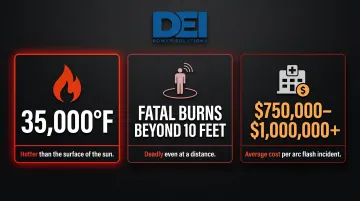
- Arc flash temperatures can reach 35,000°F — hot enough to cause fatal burns beyond 10 feet
- Incidents routinely destroy nearby equipment and trigger facility-wide outages
- Average hospitalization costs run $750,000, with serious cases exceeding $1,000,000
Conclusion
Data center electrical panel safety depends on three non-negotiable elements:
- Qualified personnel trained for the specific equipment and voltage levels in use
- Equipment-specific procedures, including LOTO and arc flash analysis
- PPE matched to actual incident energy levels — not generic defaults
Facility teams, contractors, and engineers must treat panel safety as an embedded operational standard. Review it after every system change, enforce it before every panel interaction, and never trade it off against uptime pressure.
Approximately one-third of all reported data center outages cost more than $250,000, with many exceeding $1 million. The equipment powering your facility — switchgear, distribution panels, RPPs — needs to meet the same standard of reliability your safety protocols demand. Specifying UL 891-certified, properly rated equipment from the start reduces both compliance risk and the conditions that make panel work dangerous in the first place.
Frequently Asked Questions
What precautions should be taken when handling electrical equipment in a data center?
Verify the equipment is de-energized and locked out using equipment-specific LOTO procedures with confirmed zero voltage. Wear arc-rated PPE appropriate to the panel's incident energy level per NFPA 70E. Ensure only qualified electrical workers perform or directly supervise the work.
What PPE is required when working on data center electrical panels?
Required PPE includes arc-rated face shields or hoods, FR clothing rated to the calculated incident energy (4–40 cal/cm² per NFPA 70E), voltage-rated insulated gloves, and non-conductive footwear. The exact PPE category is determined by the arc flash hazard analysis for that specific panel.
What is arc flash and why is it especially dangerous in data center panels?
Arc flash is a sudden release of electrical energy through air between conductors, producing intense heat (up to 35,000°F) and pressure waves. In data center panels with high fault current capacity, incident energy levels can cause fatal burns even with brief exposure, with severe injuries possible at distances greater than 10 feet.
What does NFPA 70E require for electrical panel work in data centers?
NFPA 70E requires an arc flash hazard analysis for each panel, PPE matched to incident energy, qualified worker designation, and LOTO compliance before energized parts are exposed. Arc flash analyses must be updated after any upstream system changes and at minimum every 5 years.
When is it acceptable to work on energized electrical panels in a data center?
Energized panel work is only permissible under NFPA 70E and OSHA 29 CFR 1910.333 when de-energization is documented as infeasible (e.g., would create greater hazard or is prohibited by equipment design). It requires an energized work permit, qualified workers, and full arc-rated PPE.
How often should data center electrical panels be inspected?
NFPA 70B 2023 mandates visual inspections every 12–60 months based on equipment condition, with infrared thermography at least annually. Arc flash analyses must be updated whenever upstream system changes occur, and at minimum every 5 years. Condition-based intervals range from every 12 months (poor condition) to every 60 months (good condition).