Many homeowners assume the panel itself drives total cost. In reality, labor accounts for 80-90% of the final bill, with permits, inspection fees, and hidden wiring work frequently pushing budgets beyond initial estimates. Facility managers face similar surprises when obsolete commercial switchboards require utility coordination, code upgrades, or extended downtime.
This guide breaks down realistic pricing tiers, the components that drive cost up or down, common budgeting mistakes, and how to estimate the right budget — whether you're a homeowner, contractor, or facility manager.
Key Takeaways
- Typical residential panel replacement: $800–$4,500 depending on amperage and scope; commercial or industrial switchboard replacement costs significantly more
- The biggest price drivers are panel amperage, labor complexity, local permit fees, and whether additional wiring or code upgrades are required
- Light commercial and low-demand facilities typically land at the lower end; high-draw systems and industrial loads should budget toward the top of the range
- Undersizing panel capacity now routinely leads to a costly second upgrade within a few years — spec the right amperage from the start
How Much Does It Cost to Replace an Electrical Panel?
Panel replacement doesn't have a fixed price — the final figure depends on a combination of equipment, labor, permits, and scope of additional work. A generic online estimate without a professional assessment routinely leads to underbudgeting — sometimes by thousands of dollars.
What goes wrong when cost is misunderstood:
- Homeowners undersize their new panel and face a repeat upgrade within years
- Facility managers ignore hidden costs like permit fees, wiring work, and inspection delays
- Commercial teams choose the wrong configuration and face code failures mid-project
Entry-Level / Basic Replacement ($800–$1,500)
A straightforward swap of an existing 100-amp residential panel with a modern circuit breaker box. Typical scope includes:
- Basic labor (4–8 hours)
- Permit fees
- Code-compliant existing wiring (no upgrades needed)
- No panel relocation
Best for smaller homes under 1,500 sq ft with modest appliance loads — no central air, no EV charger, no plans for additions.
Mid-Range / Standard Replacement ($1,500–$4,500)
Covers an upgrade to a 200-amp panel — now the residential standard. Typical scope includes:
- Updated service cable if needed
- AFCI/GFCI breakers per current NEC code
- Labor (8–12 hours) and permit/inspection fees
- Fuse box-to-breaker conversion where applicable
200-amp is the recognized sweet spot for future-proofing. Best for most modern homes with central HVAC, multiple high-draw appliances, or plans for EV charging, home additions, or smart home systems.
High-End / Commercial-Grade Replacement ($4,500 and above)
Covers 400-amp residential panels, commercial switchboards, and custom power distribution equipment for multi-circuit industrial loads. Costs scale based on:
- Bus capacity and total circuit count
- Specialty breakers (molded case, draw-out types)
- Panel relocation and utility coordination
- Voltage class and facility size
Commercial electrical service upgrades range from $8,000–$25,000, while industrial 400-amp installations typically start at $15,000–$30,000. Large-scale projects regularly exceed $50,000.
Best for large luxury homes, commercial buildings, healthcare facilities, data centers, and industrial plants — anywhere a capacity shortage or code failure could halt operations or trigger costly shutdowns.
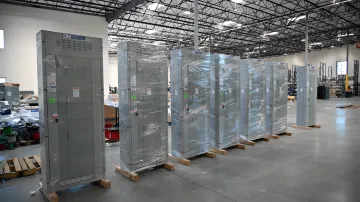
For commercial and industrial applications, pre-assembled switchgear — such as UL 891-certified switchboards from DEI Power — can reduce field labor time and minimize schedule risk by arriving ready to install with accurate documentation and Siemens components.
Key Factors That Affect the Cost of an Electrical Panel Replacement
Pricing depends on a mix of technical, regulatory, and site-specific variables. Understanding each one helps you evaluate quotes accurately and avoid being caught off-guard mid-project.
Panel Type, Configuration, and Amperage
Amperage is the single biggest pricing lever:
| Amperage | Installed Cost Range | Panel Hardware Only | Best For |
|---|---|---|---|
| 100A | $800–$1,500 | $100–$220 | Basic residential needs, small homes |
| 150A | $1,300–$1,750 | $150–$275 | Growing households, planned additions |
| 200A | $1,300–$3,000 | $250–$380 | Modern residential standard, EV charging |
| 300A | $1,800–$3,800 | $350–$545 | Large homes, multiple high-draw systems |
| 400A (residential) | $2,000–$4,000 | $500+ | Luxury homes, workshops, multi-zone HVAC |
| 400A (industrial) | $15,000–$30,000 | $2,000–$15,000 | Commercial buildings, industrial plants |
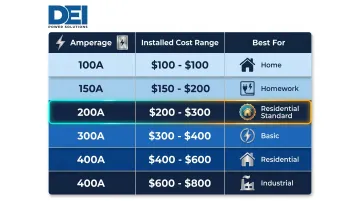
Sources: HomeAdvisor, This Old House, Delta Wye Electric
Panel brand and component quality add another layer to hardware costs. Common residential brands include:
- Square D (Schneider Electric): approximately $111
- Siemens: approximately $256
- Eaton: approximately $301
- GE: approximately $1,180
For commercial switchboards, brand and component sourcing matter even more. DEI Power, as an approved Siemens OEM, builds UL 891-certified switchboards with genuine Siemens components — a specification that keeps projects compliant and reduces field adjustments and long-term maintenance costs.
Labor and Installation Complexity
Labor typically accounts for the largest share of the total bill. According to BLS data, the median electrician wage is $29.98/hr, but residential charge-out rates range from $50–$150/hr.
Typical labor hours by job type:
- Standard residential swap (same location, same amperage): 4–8 hours
- Complex residential (with rewiring, service upgrade, or relocation): 20–30 hours
- Commercial switchboard installation: 1–3 days depending on site conditions
Several site-specific factors can extend those hours:
- Panel location and accessibility
- Whether power needs to be cut and coordinated with the utility
- Condition of existing infrastructure
- Required code upgrades or modifications
For commercial projects, pre-assembled and pre-tested switchgear reduces field labor time significantly. DEI Power's vertically integrated manufacturing process produces switchboards that arrive documented and ready to install, which cuts installation hours and schedule risk on large jobs.
Wiring Condition and Code Compliance Requirements
During a panel replacement, electricians assess connected wiring. In older homes, it's common to find cloth-insulated wiring, undersized service cables, or missing grounding that must be brought up to current NEC standards before a new panel can be installed — this can add thousands to the project scope.
Modern NEC requirements (updated every 3 years) now mandate two types of specialty protection that directly affect breaker costs:
AFCI Protection — NEC Section 210.12:
- Required for 15A and 20A, 120V branch circuits in dwelling units
- Covers kitchens, family rooms, dining rooms, living rooms, bedrooms, hallways, laundry areas, and similar spaces
- AFCI breakers cost $35–$60 each vs. $5–$40 for standard breakers
- A 20-circuit panel requiring all AFCI breakers could add $600–$1,200 in breaker costs
Both arc-fault and ground-fault protection are now baseline expectations for code-compliant work, not optional upgrades.
GFCI Protection — NEC Section 210.8:
- Required in bathrooms, garages, outdoors, crawl spaces, basements, kitchens, laundry areas, and near sinks
- GFCI breakers cost $35–$100 each
Permits, Inspections, and Utility Coordination
Panel replacement almost universally requires a permit. Fees range from $50 to $300+ for residential projects depending on municipality. Industrial permits can reach $2,000–$8,000.
The permit triggers a mandatory inspection by a local official to verify NEC and local code compliance. Skipping this step creates real exposure: unpermitted work may lead to insurance claim denial, policy cancellation, or mandatory disclosure at resale.
Utility coordination adds a separate scheduling variable. The service line must be disconnected before work begins, and reconnection depends on utility availability — not the contractor's schedule. On commercial jobs especially, plan for this lead time early.
Full Cost Breakdown: What You're Actually Paying For
The panel price tag is just one line item. Total project cost includes several distinct categories — understanding each one helps avoid sticker shock and budget more accurately.
Equipment and panel cost:
- Residential panels: $100–$650 depending on amperage and brand
- Commercial switchboards and switchgear assemblies: several thousand to tens of thousands depending on configuration, amperage rating, and bus specifications
- For commercial projects, pre-assembled switchboards like those from DEI Power (400A–4000A, UL 891-certified) arrive factory-configured, which can reduce equipment lead time and simplify procurement
Labor :
- Residential: $1,000–$3,000+
- Commercial: scales with scope and team size
- Labor covers removal of the old panel, installation and wiring of the new one, circuit labeling, and testing
- For commercial projects, pre-assembled switchgear can reduce field labor time and minimize schedule risk by arriving ready to install with wiring diagrams and labeling complete
Permits and inspections :
- Residential: $50–$300
- Commercial: may require multiple inspections and code-authority sign-offs
- Always confirm this is included in your quote
Hidden and additional costs :
- Panel relocation: $800–$4,000
- Drywall repair: $1.50–$3.00/sq ft
- Full home rewiring: averages $7,000 total
- Subpanel installation: $400–$1,800
- Meter box replacement: $200–$800 (unit); $1,800–$3,500 (installed)
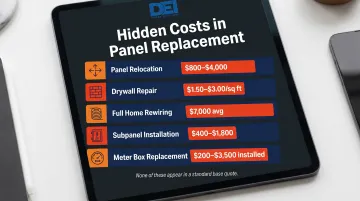
None of these appear in a standard base quote. Panel relocation and meter box replacement are the two most common surprises — ask your contractor to itemize every scope item before signing, and confirm whether permits and inspections are included or billed separately.
Low-Cost vs. High-Cost Panel Replacement — What's the Difference?
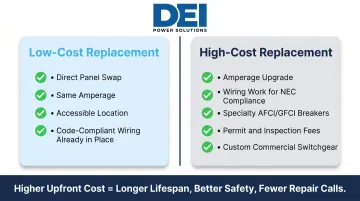
A lower-cost panel replacement typically means a direct swap of an existing panel with minimal scope changes — same amperage, accessible location, code-compliant wiring already in place. It gets the job done but may not account for future load growth or safety upgrades.
A higher-cost replacement usually reflects several compounding factors:
- Amperage upgrades to support higher load demand
- Additional wiring work required to meet current NEC code
- Specialty breakers and arc-fault protection devices
- Permit and inspection fees
- In commercial settings, custom switchgear built to exact voltage, circuit count, and bus rating specifications
The higher upfront investment typically results in a longer panel lifespan, better safety performance, and fewer unplanned repair calls.
Long-Term Cost Reality
A budget panel replacement that ignores future load needs often costs more over a 5–10 year window than doing it right the first time. Upgrading from 100A to 200A costs $1,300–$2,500. Install a 100A panel today and need to upgrade in five years, and you'll pay for labor, permits, and inspections twice, essentially doubling your total expense.
Insurance and Fire Risk
Obsolete panel brands like Federal Pacific Electric (FPE), Zinsco, and Pushmatic are flagged by insurers for good reason. FPE breakers may fail to trip over 25% of the time, and electrical malfunctions caused approximately 44,880 home fires in the U.S. in 2022, resulting in 470 deaths and $1.5 billion in property damage.
Insurers may deny coverage, refuse renewal, increase premiums, or exclude damage tied to obsolete panels. Upgrading to a modern, code-compliant panel is often required to maintain or secure coverage.
For industrial applications, properly sized electrical service upgrades can reduce energy consumption by 10–20%, with a typical payback period of 2–4 years.
What Most People Miss When Budgeting for a Panel Replacement
Three overlooked factors routinely blow panel replacement budgets:
- The hardware is rarely the biggest line item. Labor, permits, and code-compliance work frequently exceed equipment cost. Always request a fully itemized quote before approving any scope.
- Undersizing for future load. EV chargers, heat pumps, server rooms, and added circuits routinely push homeowners and facility managers into a second upgrade within five years. Plan at least one capacity step beyond current demand.
- Hidden scope triggers. Wiring condition, panel location, utility scheduling, and NEC code requirements can all expand a project mid-job. A licensed professional doing a full on-site assessment before you sign anything is the most reliable way to surface these issues early.
For commercial and industrial projects, the stakes are higher. Undersized bus ratings, incorrect voltage class, or missing metering sections can trigger costly change orders once work is underway. DEI Power's engineering team offers specification review and submittal support to catch configuration gaps before manufacturing begins, helping contractors and facility teams avoid mid-project surprises on large-scale distribution upgrades.
Frequently Asked Questions
How much does it cost to upgrade an electrical panel from 100 amp to 200 amp?
This upgrade typically costs between $1,300–$2,500, covering the new panel, updated service cable, and labor. It's the most common upgrade for homes preparing for modern appliance loads or future EV charging.
How long does it take to replace a 200-amp breaker box?
A standard 200-amp panel replacement takes 4–8 hours for a straightforward swap. It can extend to 20+ hours if wiring needs updating or the panel must be relocated. Power is off throughout the installation.
Is replacing an electrical panel worth it?
In most cases, yes. A properly sized panel improves safety, accommodates modern electrical loads, may reduce insurance premiums, and increases property value. For commercial and industrial facilities, it also protects uptime and supports code compliance.
Will homeowners insurance cover electrical panel replacement?
Insurance typically covers panel damage caused by a covered event (like a fire or storm) but not general wear, aging, or capacity upgrades. Some insurers may require a panel upgrade as a condition of coverage for outdated panels like FPE or Zinsco — check with your provider.
How much do electricians charge to install a transfer switch for a generator?
Transfer switch installation typically costs $400–$1,600 for a manual switch and $1,500–$5,000+ for an automatic transfer switch (ATS). The panel must have adequate capacity — this is often planned alongside a panel upgrade for full compatibility.