Introduction
Low voltage switchgear is the component that controls, protects, and distributes power across a facility — and in data centers, hospitals, industrial plants, and commercial buildings, getting it right is not optional. It appears on project documents as a line item, but its real value is rarely articulated beyond checkbox compliance.
The difference between properly specified switchgear and an inadequate substitute shows up immediately: how quickly faults are isolated, whether maintenance can happen without shutting down production, and whether the system passes inspection on the first attempt.
According to an ABB survey of 3,600 senior decision-makers, 83% agree unplanned downtime costs a minimum of $10,000 per hour, with 76% estimating hourly costs up to $500,000. For data centers specifically, the Ponemon Institute found average outage costs of $740,357 per event — with UPS failure as the leading root cause.
This article explains what low voltage switchgear actually does, the measurable operational outcomes it enables, the consequences of underspecifying it, and how to ensure you're getting full value from your investment.
Key Takeaways
- Low voltage switchgear manages power distribution at voltages up to 1,000V AC through protective devices, circuit breakers, and control systems
- Core benefits: fault isolation, uptime protection, safe maintenance access, energy visibility, and regulatory compliance
- Underspecified equipment causes cascading failures: damaged gear, project delays, failed inspections, and costly rework
- UL-certified, code-compliant equipment eliminates change orders and field substitutions
- Quality switchgear pays off over time: less downtime, longer equipment life, and room to scale
What Is Low Voltage Switchgear?
Low voltage switchgear is a metal-enclosed assembly of protective and control devices designed to manage power distribution at voltages up to 1,000V AC. Per IEEE C37.20.1-2015, the standard for metal-enclosed low-voltage power circuit breaker switchgear, these assemblies include:
- Draw-out or stationary power circuit breakers
- Busbars for power distribution
- Protective relays and fuses
- Control panels and instrumentation
- Metering equipment
Switchgear sits on the secondary (low-voltage) side of a transformer and routes power to downstream loads including motor control centers, switchboards, and branch circuits. You'll find it in heavy industrial facilities, utility substations, data centers, healthcare campuses, manufacturing plants, and large commercial buildings — wherever protected, reliable power distribution is non-negotiable.
Why It Matters Beyond Moving Electricity
Low voltage switchgear shapes how your facility responds to faults, handles maintenance, and grows over time. Specifically, it determines:
- Whether a fault in one section shuts down an entire facility or gets isolated in seconds
- Whether maintenance can happen without production stopping
- Whether the system can scale without complete replacement
A well-specified switchgear assembly can contain a fault to a single section in under 15 minutes. A poorly specified one can take an entire facility offline for hours.
Key Benefits of Low Voltage Switchgear
Each benefit below maps to outcomes that engineers, contractors, and facility teams track directly: uptime, safety incidents, inspection results, maintenance costs, and project schedules. These advantages only materialize when switchgear is properly specified, certified to applicable standards (such as UL 891 or UL 1558), and correctly integrated into the system design.
Enhanced Safety and Fault Protection
The primary function of LV switchgear is to detect and isolate electrical faults — overcurrents, short circuits, and ground faults — before they cascade into equipment damage, fires, or personnel injuries. This is achieved through circuit breakers, protective relays, and arc-flash mitigation features working together.
How It Works in Practice:
When a fault occurs downstream, a properly coordinated switchgear system trips only the breaker nearest to the fault (selective coordination), leaving the rest of the facility powered. In hospitals or data centers, a contained trip means the difference between a minor disruption and a full facility shutdown.
The Real Cost of Unprotected Faults:
Arc flash events are among the most dangerous electrical incidents. ESFI data shows an average of 150 workplace electrical fatalities per year (2011–2024), with 74% occurring in non-electrical occupations. Non-fatal electrical injuries rose 59% in 2023–2024 versus 2021–2022 (5,180 versus 3,260 cases).
Modern LV switchgear incorporates arc-flash mitigation technologies:
- Arc-resistant construction per IEEE C37.20.7
- Zone selective interlocking
- High-speed arc quenching (sub-4 millisecond response per Eaton's arc quenching technology)
Facilities without proper fault protection face equipment replacement costs, regulatory investigations, liability exposure, and extended downtime — each one a measurable line item that certified switchgear directly reduces.
KPIs Impacted:
- Safety incident rates
- Arc flash incident energy levels
- Fault isolation speed (cycles to clear)
- Equipment replacement frequency
- OSHA compliance record
When This Advantage Matters Most:
Fault protection is most critical in environments with high-density loads, complex electrical networks, or where personnel regularly work near energized equipment — industrial plants, data centers, and healthcare facilities where even partial system failure has downstream consequences.
Operational Reliability and Reduced Downtime
Fault protection prevents incidents — but operational design determines how quickly a facility recovers when conditions change. LV switchgear with draw-out or compartmentalized construction allows individual breakers or sections to be serviced, tested, or replaced while the rest of the system stays energized, separating it from simpler fixed-mounted configurations.
How Selective Coordination Extends Reliability:
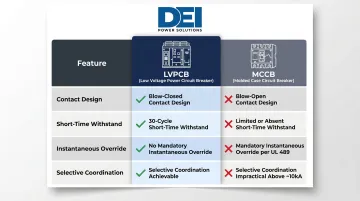
Selective coordination ensures only the faulted circuit trips rather than an entire upstream section. LV power circuit breakers (LVPCBs) can be programmed with short-time delay settings — withstanding fault current for up to 30 cycles — to give downstream devices time to clear faults first. Molded case circuit breakers (MCCBs) cannot do this due to mandatory instantaneous override per UL 489.
| Feature | LVPCB | MCCB |
|---|---|---|
| Contact design | Blow-closed | Blow-open |
| Short-time withstand | 30 cycles | Limited/absent |
| Instantaneous override | Not required | Mandatory |
| Selective coordination | Achievable | Impractical above ~10kA |
Downtime Has a Dollar Figure:
The ABB survey cited earlier found that 44% of facilities experience equipment-related interruptions at least monthly, with 14% reporting stoppages every week. For 24/7 operations, even a two-hour outage can cost hundreds of thousands of dollars. Modular compartmentalization limits fault propagation: if an arcing fault develops inside a compartmentalized section, barriers prevent it from spreading to adjacent breaker cells, dramatically reducing repair scope and time.
KPIs Impacted:
- Mean time between failures (MTBF)
- Mean time to repair (MTTR)
- System uptime percentage
- Planned versus unplanned maintenance ratio
- Production hours lost to electrical faults
When This Advantage Matters Most:
Reliability and serviceability advantages are highest in 24/7 operations — hyperscale data centers, continuous process manufacturing, hospital power systems — where downtime threatens revenue, production schedules, or patient safety.
Code Compliance, Certification, and Long-Term Serviceability
LV switchgear in the U.S. is governed by standards including ANSI/IEEE C37.20.1 and UL 1558 for metal-enclosed power circuit breaker switchgear, and UL 891 for switchboards. These certifications define short-circuit withstand ratings, insulation requirements, busbar bracing, and arc-flash safety features that determine whether equipment actually performs as rated under fault conditions — not just on a spec sheet.
How Certified Equipment Streamlines the Project Lifecycle:
- Inspections pass on first attempt
- AHJ (Authority Having Jurisdiction) approvals happen faster
- Specifying listed equipment eliminates ambiguity in bid documents
- Contractors avoid field substitutions and change orders
DEI Power's UL 891 certified switchboards, manufactured domestically in Ontario, California, are built specifically to eliminate these project friction points — from bid qualification through final inspection.
Why Certification Matters Long-Term:
UL-listed equipment has documented short-circuit withstand ratings that allow engineers to properly coordinate protection devices across the system. Without this, downstream breakers may be under-rated for available fault current, creating a latent safety hazard that isn't discovered until a fault event occurs.
Additionally, BABA (Buy America Build America) compliance — required on many federal, utility, and infrastructure projects — mandates that manufactured products contain greater than 65% domestic component cost (increasing to 75% by 2029). Equipment that isn't domestically manufactured can disqualify a bid or trigger costly substitutions mid-project.
KPIs Impacted:
- Inspection pass rate
- Change order frequency
- Bid qualification rate (BABA-required projects)
- Warranty claim rate
- Total cost of ownership over system lifecycle
When Compliance Advantages Matter Most:
Government-funded infrastructure projects, utility substation builds, and large commercial projects in jurisdictions with strict electrical inspection regimes — where non-compliance isn't just a cost issue but a project-stopping risk.
What Happens When Low Voltage Switchgear Is Ignored or Underspecified
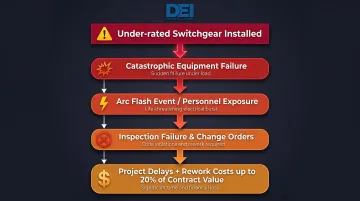
The most common failure mode is specifying switchgear under-rated for available fault current. When equipment can't interrupt a fault safely, the consequences compound fast:
- Catastrophic failure of the switchgear itself
- Potential arc flash events and personnel exposure
- Extended downtime while equipment is assessed or replaced
- Full replacement of gear that was never rated for the job
Project-Side Consequences
Those equipment failures don't stay contained to the mechanical room. Non-listed or improperly specified switchgear routinely fails inspection, triggering change orders, schedule delays, and rework costs. Construction Executive research found that direct rework costs can reach up to 20% of contract value, with indirect costs running up to 6x that amount due to schedule delays and consequential damages.
The Compounding Maintenance Problem
Fixed-mounted, non-compartmentalized equipment that lacks draw-out capability forces full de-energization for any maintenance or breaker replacement. In continuous operations, that means scheduled outages, lost production time, and compounding operational risk — every time routine maintenance is required.
How to Get the Most Value from Low Voltage Switchgear
Value starts at the specification stage. Switchgear delivers full value only when it is:
- Rated for the actual available fault current at the point of installation (confirmed through a coordination study)
- Certified to the applicable standard for the application
- Configured to match the facility's load requirements and future expansion plans
Generic specifications that don't account for site-specific conditions are the root cause of most field substitutions and change orders. Working with a supplier that provides in-house engineering support — like DEI Power — helps contractors and facility teams lock in the correct specification before equipment is built, reducing costly change orders downstream.
Maintenance Intervals Under NFPA 70B
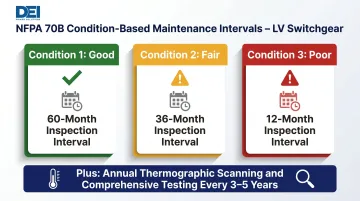
Draw-out circuit breakers should be tested and inspected on a scheduled basis. NFPA 70B, which transitioned to a mandatory standard in January 2023, establishes condition-based maintenance intervals:
| Equipment Condition | Inspection Interval |
|---|---|
| Condition 1 (good) | 60 months |
| Condition 2 (fair) | 36 months |
| Condition 3 (poor) | 12 months |
Beyond scheduled inspections, plan for thermographic scanning at least once a year. Comprehensive testing — covering insulation resistance, circuit breaker operation, and relay calibration — typically runs on a 3–5 year cycle or per manufacturer guidelines.
Planning Ahead for Expansion
Modular switchgear designs allow additional circuits or capacity to be added without replacing the entire assembly. This future-proofing only works if the original specification accounts for headroom in bus ratings and physical space for expansion.
Conclusion
Low voltage switchgear earns its value through control, protection, and continuity. It determines how quickly faults are isolated, whether maintenance can happen without shutdowns, and whether the system holds up to regulatory scrutiny from commissioning.
Specified and certified correctly, switchgear reduces incident frequency, lowers long-term maintenance costs, and keeps projects on schedule. Underspecification doesn't stay cheap — those gaps surface as unplanned outages, failed inspections, and emergency replacements.
Switchgear selection shapes the reliability and compliance of the entire distribution system for its full operational life. Contractors, engineers, and facility teams who treat it as a procurement afterthought tend to revisit that decision at the worst possible time. Starting with equipment that's UL 891 certified, correctly rated, and ready to ship — like the pre-configured assemblies DEI Power builds in Ontario, California — removes much of that risk before the project breaks ground.
Frequently Asked Questions
What are the benefits of using low voltage switchgear?
Low voltage switchgear delivers fault protection, operational reliability, safe access to energized systems, energy monitoring, and code compliance. Together, these capabilities directly affect uptime, safety records, and project approval timelines.
What is the life expectancy of low voltage switchgear?
High-quality, properly maintained LV switchgear operates reliably for 20-30 years, per ABB documentation. Lifespan depends on installation environment, maintenance frequency, and whether components such as circuit breakers are serviced or replaced on schedule per NFPA 70B guidelines.
What is low voltage protection?
Low voltage protection refers to the system of devices — circuit breakers, protective relays, and fuses — within LV switchgear that detect abnormal electrical conditions (overcurrents, short circuits, ground faults) and isolate the affected circuit to prevent damage to equipment and risk to personnel.
What is the difference between LVP and LVR?
LVP (Low Voltage Protection) trips a device when voltage drops below a threshold, preventing automatic motor restart. LVR (Low Voltage Release) allows automatic restart once voltage is restored. The distinction is critical in motor protection — unattended restart after a power interruption can cause injury.
What is the difference between low voltage switchgear and a switchboard?
Switchgear (UL 1558 / IEEE C37.20.1) uses draw-out power circuit breakers, full compartmentalization, and a 30-cycle short-time withstand rating, making it suited for heavy industrial and critical power applications. Switchboards (UL 891) use fixed-mounted molded case breakers with simpler construction, a smaller footprint, and lower cost, suited for commercial and light industrial distribution.
How often should low voltage switchgear be inspected or maintained?
NFPA 70B recommends annual visual inspections and thermographic scanning, with comprehensive testing (insulation resistance, circuit breaker operation, relay calibration) on a 3-5 year cycle or per manufacturer guidelines. Any system modification or fault event should trigger an immediate inspection before re-energization.