Introduction
Electrical switchgear shortages are now stalling projects nationwide and forcing contractors, engineers, and facility teams to rethink how they procure critical power distribution equipment. Switchgear that once shipped in weeks now takes months—or even years—creating cascading delays across data centers, healthcare facilities, industrial plants, and utility infrastructure projects. Medium-voltage switchgear lead times currently sit at 40-80 weeks, more than double pre-pandemic averages, while large low-voltage switchboards lag at 35-62 weeks compared to the 20-30 weeks once considered standard.
Those delays have real consequences. Projects that still treat switchgear as a routine, late-stage procurement item are absorbing the full force of the shortage: collapsed commissioning windows, extended temporary power arrangements, and budget overruns running into six or seven figures.
The root causes—surging demand from data centers and grid modernization, copper price volatility, and ongoing regulatory transitions—are well-documented. What's less clear for many project teams is how to respond before the delays hit.
Key Takeaways
- Switchgear lead times have ballooned to 40–80 weeks industry-wide, up from 24–34 weeks pre-COVID
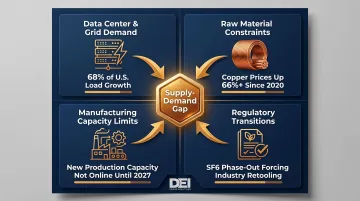
- The shortage stems from four converging pressures: data center demand, grid modernization, copper supply constraints, and SF6 regulatory transitions
- Projects that treat switchgear as a late-stage procurement item face schedule collapse, compliance risk, and major cost overruns
- Engage manufacturers early, source from domestic suppliers, and build price contingencies into budgets before shortages hit your schedule
- Treat switchgear as a critical-path procurement item from day one — not an afterthought
What's Driving the Electrical Switchgear Shortage?
The current switchgear shortage isn't caused by a single event—it's the result of multiple structural pressures converging simultaneously on both the demand and supply sides of the market. Each driver compounds the others, which is why lead times keep stretching even as manufacturers announce new capacity.
Surging Demand from Data Centers and Grid Modernization
Hyperscale and AI-driven data centers are absorbing enormous volumes of low-voltage and medium-voltage switchgear, reshaping equipment allocation priorities. Data centers are projected to account for 68% of all U.S. load growth through 2030, with the electrical equipment market for these facilities expected to grow from approximately $20 billion in 2026 to $65 billion by 2030. Manufacturers are actively prioritizing these large-volume, repeat customers over smaller commercial projects, leaving one-off buyers competing for shrinking production slots.
Data centers aren't the only pressure point. Grid modernization efforts—renewable energy integration, EV charging infrastructure, and aging infrastructure replacement—are adding a second wave of demand on top of data center growth. The Infrastructure Investment and Jobs Act allocated $65 billion for energy and power infrastructure programs, with $27.65 billion specifically designated for grid resilience and reliability projects.
This sustained public-sector investment ensures demand will remain elevated for years, independent of any single sector's growth cycle.
Raw Material Constraints
Switchgear production depends heavily on copper, and copper prices rose over 66% from 2020 to 2023, with an additional ~10% increase since early 2024. EVs, renewable energy systems, and power distribution all compete for the same copper supply, creating sustained upward price pressure across every segment at once. Key supply indicators reinforce the squeeze:
- Domestic mine production fell 6% in 2024, following an 8% drop in 2023
- U.S. manufacturers increased imports by 13% to compensate for falling domestic output
- Copper demand from grid and EV buildout shows no sign of softening through 2030
Specialized electrical steel used in switchgear cores and related grid components also faces concentration risk. Cleveland-Cliffs is the only domestic producer of grain-oriented electrical steel (GOES) in North America, creating single-source vulnerability. Any disruption to their Butler, Pennsylvania facility or trade restrictions on imported GOES would directly impact power equipment manufacturing capacity.
Manufacturing Capacity Limitations
OEM manufacturers are allocating limited factory capacity to large data center frameworks over one-off commercial projects. For smaller buyers, this translates to practical procurement friction:
- Selective quoting — many RFQs go unanswered or receive partial responses
- Shrinking bid validity periods (some as short as 24-48 hours)
- Increased deposit requirements before production slots are secured
New capacity is coming, but not soon. Schneider Electric announced $700 million in U.S. manufacturing investment through 2027, while Eaton announced a $30 million medium-voltage switchgear factory in Nebraska with production starting in the first half of 2027. These investments represent meaningful additions, but they leave a multi-year gap between today's demand and available supply.
The lack of a robust domestic supplier ecosystem in the U.S.—compared to Europe, where local supply chains support shorter lead times—means American projects face structurally longer delays and import dependency. The U.S. government has identified manufacturing supply chains for grid equipment as "dangerously limited," citing financing risks, regulatory delays, and insufficient domestic production capacity.
Regulatory and Technology Transitions
The SF6 ban and shift toward eco-friendly switchgear alternatives are requiring manufacturers to retool, requalify, and redesign product lines, creating a temporary capacity pinch during the technology transition. California began phasing out SF6 in gas-insulated switchgear in 2025; New York follows in 2027, forcing OEMs to simultaneously serve existing demand while developing and scaling SF6-free product lines like ABB's AirPlus alternative insulation technology.
R&D investment in smart switchgear and digital monitoring capabilities is adding cost and engineering complexity, keeping prices elevated even as supply gradually improves. The Producer Price Index for switchgear rose nearly 50% between 2020 and 2024, reflecting both raw material costs and these technology transitions.
What Happens When Projects Ignore the Shortage?
When project teams treat switchgear as a routine, late-stage procurement item rather than a critical-path risk, the damage compounds fast. Commissioning windows collapse. Temporary power arrangements drag on for months. Redesign pressure builds, and cost certainty disappears — all tracing back to a procurement decision that came too late.
The ripple effects reach well beyond individual projects:
- Building permits stall or get denied when utilities can't energize new connections
- Housing, school, and healthcare construction gets pushed back by months
- Grid outage recovery slows where spare equipment isn't available
- Data center project cancellations jumped to 25 in 2025, up from just 6 in 2024, with equipment delays cited as a primary driver
Warning Signs You're Already in Trouble
These early indicators signal that your project is at risk of a switchgear-driven delay and require immediate escalation in procurement strategy:
- You are receiving selective quotes or no quotes at all from manufacturers—a sign that your project's size or timeline does not fit current production priorities
- Your project schedule still shows switchgear procurement starting at or after the design-complete milestone, rather than during early design—meaning lead time assumptions are well out of date
- You are being asked to accept non-standard configurations or substitute equipment due to availability—substitutions made under schedule pressure routinely create code compliance and field adjustment problems that follow the project through closeout
How to Reduce Switchgear Supply Chain Risk
Reducing switchgear supply chain risk isn't about eliminating uncertainty entirely. It's about taking deliberate procurement actions early enough to protect schedule control, cost certainty, and code compliance.
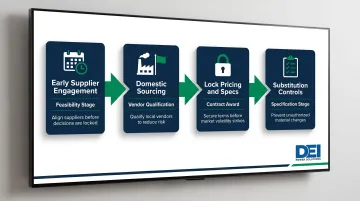
Treat Switchgear as a Critical Path Item from Day One
Engage switchgear manufacturers during early design — before design freeze — and build realistic lead time assumptions into the master project schedule from the start. Getting into the production queue early prevents the reactive substitution pressure that creates compliance risk.
Key advantages of early engagement:
- Locks in engineering specifications before backlog worsens
- Gives manufacturers time to provide submittal packages during design development
- Enables smoother permitting and approval processes
When: At the feasibility stage — not at permit issuance or construction start.
Source from Domestic Manufacturers with Faster Fulfillment
Prioritize domestic, vertically integrated switchgear manufacturers who control their own production schedules — not those subject to import lead times, port delays, or overseas supply chain disruptions. DEI Power, for example, manufactures UL 891-certified switchboards in-house at its 50,000 sq. ft. Ontario, California facility, with BABA-compliant domestic production for federally funded projects.
The fulfillment difference is significant. In-stock units ship within one business day, and built-to-order configurations typically complete within 4–6 weeks — far faster than the 40–80 week backlogs reported across major OEMs industry-wide. Domestic in-house manufacturing also gives project teams clearer visibility into actual production timelines, reducing schedule risk compared to relying on overseas suppliers.
When: At vendor qualification — make domestic sourcing capability and lead time guarantees part of your supplier evaluation criteria.
Lock in Pricing and Specifications Early to Hedge Against Material Volatility
Request firm pricing commitments and locking deposits as early as possible. Copper is trading at $5.92 per pound as of May 2026 — up 24.75% year-over-year — and those swings translate directly into switchgear price changes.
Projects that leave specifications and pricing open until late in design absorb the full impact of commodity increases. Early commitments cap that exposure before it hits your budget.
When: At contract award or design development. On longer-duration projects, revisit contingency assumptions quarterly.
Avoid Reactive Equipment Substitutions
Establish a clear specification hierarchy and a formal approval process for any substitution requests before procurement begins. Require that substitutes meet the same UL listing, voltage rating, and integration requirements as the originally specified equipment.
Rushed substitutions — accepting whatever is available rather than what was engineered for the application — introduce non-compliant configurations and create long-term reliability risk in critical infrastructure. The field adjustment costs alone can exceed the savings from substituting.
When: At project specification stage. Include substitution approval requirements in subcontractor and vendor agreements before work begins.
Long-Term Procurement Strategies to Stay Ahead
Build switchgear procurement into standard project planning templates with defined lead time buffers. Current lead time benchmarks across equipment types include:
- Medium-voltage switchgear: 26-32 weeks (improved availability); 40-80 weeks for 15KV with breakers
- Large low-voltage switchboards (1,200A+): 35-62 weeks, versus 20-30 weeks pre-COVID
Update these planning assumptions at least annually.
Establish preferred vendor relationships with domestic manufacturers who can offer framework agreements, priority production access, or pre-engineered standard configurations—reducing the engineering and quoting cycle time on future projects. Manufacturers with in-house production and stocked inventory — such as DEI Power, which builds UL 891-certified low-voltage switchboards from its Ontario, California facility — can deliver schedule certainty that traditional OEM distribution channels cannot match during periods of constrained capacity.
Internal alignment is just as important as supplier relationships. Train procurement, engineering, and project management teams on current lead time realities so schedule assumptions reflect today's market — not pre-2020 norms. After any project that hits switchgear-related delays, document what happened and share it across teams so the same scheduling errors don't repeat on the next job.
Conclusion
The electrical switchgear shortage has identifiable, structural causes — and it will not resolve quickly. Projects that continue to treat switchgear as a routine late-procurement item will face avoidable delays, cost overruns, and compliance risk.
The convergence of data center demand, federal infrastructure investment, raw material constraints, and regulatory transitions has created a supply-demand gap that will persist through at least 2027, regardless of new domestic capacity additions already underway.
Proactive procurement is the most effective and lowest-cost defense available. That means: early supplier engagement, domestic sourcing, locked specifications, and lead time planning that reflects today's reality — not pre-shortage norms. The projects that hold schedule are the ones that treat switchgear as strategic infrastructure from the start, not a commodity to be sourced at the eleventh hour.
DEI Power manufactures UL 891-certified low-voltage switchgear domestically at its Ontario, California facility, with in-stock inventory and lead times that are a fraction of the industry average. If your project timeline is tight, that's a meaningful difference.
Frequently Asked Questions
Is there a shortage of switchgear?
Yes. Surging demand from data centers and grid modernization—combined with constrained manufacturing capacity—has pushed lead times well above pre-COVID norms across most product categories. The shortage is expected to persist for several more years, even as new domestic manufacturing capacity comes online.
What are the challenges in procurement?
The most common obstacles buyers face:
- Lead times running 2-3x pre-COVID levels across most switchgear categories
- Selective quoting from manufacturers who favor large repeat buyers over smaller projects
- Copper price volatility (up 66%+ since 2020) driving unpredictable pricing
- Reduced bid validity windows and higher deposit requirements on confirmed orders
What is the life expectancy of a switchgear?
Electrical switchgear typically lasts 25-40 years, though well-maintained systems can exceed 40 years. Replacement becomes necessary when equipment is past the 30-40 year mark, carries obsolete components, or no longer meets current safety standards. Given today's extended lead times, proactive replacement planning is critical.
How long are switchgear lead times right now?
It depends on product type. 15KV switchgear with breakers now runs 40-80 weeks versus 24-34 weeks pre-COVID, and large low-voltage switchboards over 1,200A require 35-62 weeks compared to 20-30 weeks historically. Only commodity-grade low-voltage equipment has returned to near-normal lead times of 6-10 weeks.
What is causing the electrical switchgear shortage?
Four main drivers create the shortage: data center and grid modernization demand surge (data centers represent 68% of projected U.S. load growth through 2030), copper and raw material constraints (copper prices up 66%+ since 2020), limited domestic manufacturing capacity with new facilities not coming online until 2027, and technology transitions driven by SF6 regulatory phase-outs requiring manufacturers to retool production lines.
How can I reduce switchgear lead times for my project?
Engage manufacturers before design freeze to secure production slots early—well ahead of the construction documents stage. Domestic suppliers with in-house manufacturing, like DEI Power, offer significantly shorter lead times: in-stock configurations ship within days, while built-to-order units typically deliver in 4-6 weeks. Avoid treating switchgear as a late-stage procurement item.