Introduction
Projects are stalled. Budgets are blown. Critical infrastructure sits idle — not because of poor planning, but because the switchboard needed to power it hasn't arrived. Across North America, contractors, engineers, and facility teams are discovering that switchboard procurement has become a high-stakes gamble, where delays of 12 to 18 months and limited supplier options are now the baseline expectation.
These aren't temporary disruptions. The supply chain for commercial and industrial switchboards faces sustained pressure from surging demand, raw material volatility, component scarcity, and a market dominated by a handful of large OEMs. Labor shortages and compliance complexity compound the problem — leaving even experienced project teams unable to secure reliable equipment on schedule.
What follows breaks down why procurement has become this difficult, what's driving the supply and competitive pressures, and what buyers should demand from their suppliers to keep projects on track.
TLDR:
- Switchboard demand is surging due to data center expansion, grid modernization, and renewable energy projects
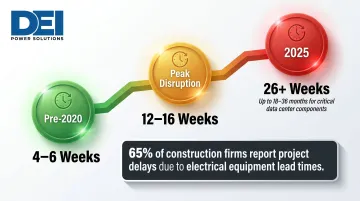
- Lead times have stretched from 4-6 weeks pre-2020 to 26+ weeks today — driven by component scarcity and raw material volatility
- Market concentration among a few large OEMs limits buyer options and leverage
- Vertically integrated domestic manufacturers can offer faster builds and more predictable timelines
Why Switchboard Demand Is Surging
Multiple demand drivers are converging simultaneously, creating mounting pressure on switchboard manufacturers. The global low-voltage switchgear market reached $32.97 billion in 2025 and is projected to grow to $45.61 billion by 2030 — a compound annual growth rate of 7.1%.
The biggest single driver is data centers. The IEA projects that global data center electricity demand will more than double by 2030 to approximately 945 TWh, slightly more than Japan's entire electricity consumption. AI infrastructure is accelerating this trend, with electricity demand from AI-optimized data centers projected to more than quadruple by 2030.
Data centers are only part of the picture. Grid modernization initiatives are driving significant procurement activity. The U.S. DOE announced approximately $1.9 billion in funding through the SPARK program to accelerate grid upgrades, part of the $10.5 billion total competitive funding provided over five years through the Grid Resilience and Innovation Partnerships (GRIP) Program under the Bipartisan Infrastructure Law.
Additional demand is coming from:
- Renewable energy projects requiring large switchgear installations for solar and wind integration
- Increased commercial construction activity as office, healthcare, and industrial facilities expand
- Electrification of transportation infrastructure, including EV charging networks
- Manufacturing reshoring initiatives bringing production capacity back to North America
Wood Mackenzie projects the US data center electrical equipment market will surge from $20 billion to $65 billion between 2025 and 2030. Data centers captured under 2% of the total US electrical equipment market in 2020; they are projected to capture up to 40% by 2030 under accelerated scenarios.
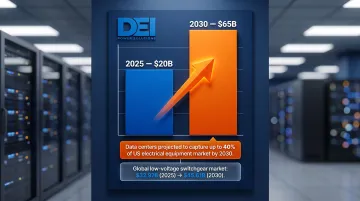
Federal infrastructure investment, renewable energy mandates, and ongoing electrification mean demand will remain elevated for years — keeping sustained pressure on manufacturers and their supply chains.
The Supply Chain Challenges Disrupting Switchboard Manufacturing
Raw Material Volatility
Switchboard manufacturing depends on three critical commodities: copper, aluminum, and steel. All three are subject to significant price volatility and supply disruption driven by geopolitical tensions, mining output fluctuations, and export restrictions.
COMEX copper reached a record high of $5.02 per pound in May 2024. Compared to January 2020 levels of approximately $2.50-$2.80 per pound, this represented a nearly 100% increase at the 2024 peak. Copper prices remained elevated through 2025, surging 18% since January 2025.
Aluminum followed a similar trajectory. It hit a record high of roughly $3,840 per metric ton in March 2022, driven by geopolitical disruption following the invasion of Ukraine. While prices moderated somewhat through 2023, they remain well above historical baselines.
The impact on electrical equipment pricing has been severe. Electrical panels are up an average of 22% in 2025. Circuit breakers, panels, and switchgear registered a 3% price gain in Q2 2023 alone, with manufacturers announcing additional increases of 4% to 7% through Q3 2023. Tariffs on copper, steel, and aluminum have added up to 25% to raw material costs, pushing overall manufacturing expenses up 12-19%.
When material shortages hit, manufacturers face three equally problematic options:
- Delay production until material becomes available, pushing schedules back
- Absorb cost increases and squeeze margins to hold pricing
- Substitute materials and risk product quality or compliance issues
Each choice creates risk for buyers — schedule delays, unexpected cost escalation, or potential field failures.
Component Scarcity and Third-Party Dependency
Switchboards aren't simple assemblies. They rely on a range of specialized components sourced from third-party vendors: circuit breakers, busbars, relays, surge protection devices, metering equipment, and control devices. When any single component is delayed or unavailable, the entire assembly is held up.
This dependency on external suppliers creates a single-point-of-failure risk. Manufacturers with no control over their component supply chain are especially vulnerable. They depend entirely on their vendors' production schedules, inventory levels, and prioritization decisions.
The numbers tell the story. Historically, switchboard lead times ran four to six weeks. During recent peak disruption periods, lead times extended to 12-16 weeks, a 200-300% increase from pre-2020 baselines. As of 2025, low-voltage switchgear lead times have doubled again to over 26 weeks, with some manufacturers reporting 18-36 months for critical data center electrical components.
Those delays hit construction projects directly. 65% of construction firms report projects delayed specifically because of supply chain challenges, with "extreme lead times for electrical equipment such as transformers and switchgear" cited most often. An additional 22% of firms report projects were canceled, postponed, or scaled back due to lengthening or uncertain completion times.
Labor Shortages in Skilled Manufacturing
Assembling complex switchboard equipment requires skilled labor — electrical assemblers, engineers, QA technicians, and manufacturing specialists who understand electrical codes, component integration, and safety testing. The industry is facing a well-documented shortage of these workers.
The manufacturing skills gap in the U.S. could result in 2.1 million unfilled jobs by 2030, according to research by Deloitte and The Manufacturing Institute. The cost of those unfilled positions could total $1 trillion in 2030 alone.
Several factors compound the problem:
- Retirement of experienced workers without enough trained replacements
- Pandemic-era disruptions that drove 1.4 million manufacturing job losses
- Declining interest in manufacturing careers among younger workers
- Competition from other industries for the same technical talent
By the end of 2020, the industry had recouped 63% of lost jobs — leaving 570,000 positions still unfilled. Manufacturers reported finding talent was 36% harder in 2021 than in 2018.
This labor constraint limits how quickly manufacturers can scale production to meet surging demand, even when raw materials and components are available. It also increases quality risk when less experienced workers are rushed through training to fill gaps.
Logistics and Transportation Disruptions
Even a completed switchboard can miss a project deadline due to third-party freight delays, poor tracking, and lack of coordination between manufacturer and project team. Suppliers who outsource logistics lose visibility and control over delivery timelines.
Contractors end up with vague delivery windows that prove unreliable — equipment arrives weeks late with no advance warning, schedules slip, and costs escalate. When that happens, there's rarely clear accountability: the manufacturer, freight broker, and carrier each point to factors outside their control.
The Competitive Landscape: Few Players, Big Consequences
The North American commercial-grade switchboard and switchgear market is dominated by a small number of large OEM manufacturers: Eaton, Schneider Electric (Square D), Siemens, and ABB/GE Industrial Solutions. These companies maintain dominant positions through advanced product portfolios, established distribution networks, and strong brand recognition.
This market concentration creates a problem for buyers. When any one of these manufacturers experiences labor issues, supply constraints, or capacity bottlenecks, the disruption spreads across the entire market. Buyers have few alternatives. They can't easily switch suppliers mid-project because specifications, approvals, and compatibility lock them in.
That dynamic plays out in three consistent ways:
- Popular configurations face extended backlogs as manufacturers prioritize large national accounts
- Buyers have little negotiation power on price, schedule, or customization
- When delays occur, large OEMs typically issue generic updates with no meaningful recourse
OEM-authorized manufacturers and smaller specialty switchboard producers can fill some of the gap. Approved OEM fabricators — companies certified by Eaton, Siemens, or Schneider to build equipment using their components and designs — can offer faster builds and more flexibility than ordering direct from the OEM. But buyers must vet them carefully for certifications, quality control, and engineering capability.
DEI Power operates as a UL 891-certified, Siemens-approved OEM with a vertically integrated manufacturing facility in Ontario, California. This positioning allows the company to deliver switchboards with shorter lead times than large OEMs while maintaining the same component quality and compliance standards.
Custom-built switchgear typically ships in 4–6 weeks versus 16+ weeks at major manufacturers. In-stock configurations ship in 3–5 business days.
Tariffs and trade policy add another competitive dimension. Low-voltage switchgear assemblies (HTS 8537.10.9030) carry a 2.7% general duty rate plus a 25% Section 301 tariff on China-origin goods — a combined 27.7% cost premium on imported equipment. Domestic manufacturers gain a pricing advantage when those tariffs rise, but only if they have the capacity and certifications to absorb increased demand.
Buyers comparing domestic versus foreign-sourced switchboards should factor in tariff costs alongside lead time implications and compliance requirements for federally funded projects.
Compliance and Certification Pressures Adding Complexity
UL 891 Certification
UL 891 is the safety standard for low-voltage, dead-front switchboards rated at 1000V or less. The standard covers general-purpose switchboards, fusible switchboards, commercial metering switchboards, and integrated facility systems, with short-circuit withstand ratings typically ranging from 10,000 to 200,000 amperes.
When a switchboard fails inspection in the field due to lack of certification or non-compliant construction, the consequences are severe: costly rework, project delays, and potential liability. Not all manufacturers maintain current certifications or invest in continuous compliance. Buyers who don't verify certifications upfront take on significant risk.
The standard requires:
- Dead-front construction to protect against accidental contact with live parts
- Proper sizing, spacing, and support for bus bars (copper or aluminum)
- Grounding and bonding with a clear fault current path
- All internal components must be UL-listed or recognized
- Durable labels indicating voltage, amperage, short-circuit ratings, and wiring diagrams
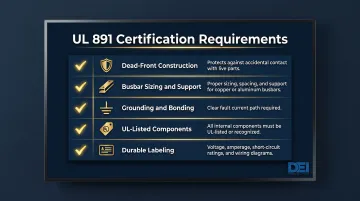
Authorities Having Jurisdiction (AHJs) typically require NRTL listing before approving installations. Using non-listed equipment voids warranties, increases legal and financial liability, and creates safety hazards including arc flash and electrocution risk.
BABA Compliance
Build America Buy America (BABA) compliance has become a critical procurement factor for federally funded infrastructure, utility, and public construction projects. Enacted as part of the Infrastructure Investment and Jobs Act on November 15, 2021, BABA requires that iron, steel, manufactured products, and construction materials used in covered infrastructure projects be produced in the United States.
For switchboards, classified as "manufactured products," compliance hinges on two conditions:
- The product must be manufactured in the United States
- The cost of domestic components must exceed 55% of the total component cost
Foreign-sourced or non-compliant switchboards cannot be used on BABA-qualifying projects, shrinking the pool of viable suppliers and raising the value of domestic manufacturing credentials. Buyers can request waivers for public interest, nonavailability, or unreasonable cost — but obtaining them adds time and uncertainty to procurement.
ESG and Sustainability
BABA addresses where products are made — but a separate layer of compliance pressure is building around how they're made. ESG and sustainability requirements are working their way into procurement and supply chain decisions.
The SEC adopted climate disclosure rules in March 2024 requiring large public companies to report material climate risks and Scope 1 and Scope 2 emissions. The rule is currently stayed pending legal challenges, but the regulatory trajectory is set. Manufacturers should expect increasing pressure to demonstrate responsible sourcing, carbon footprint transparency, and supply chain due diligence alongside standard product compliance.
How Smart Manufacturers Are Responding — and What Buyers Should Demand
Vertical Integration Eliminates Bottlenecks
Manufacturers who control their own component inventory, assembly process, and logistics eliminate the third-party bottlenecks that cause most delays. That's the core advantage of vertical integration.
Made-to-order manufacturers, by contrast, depend on external suppliers at every stage — raw material procurement, component sourcing, subassembly fabrication, final assembly, and shipping.
Buyers should ask suppliers directly: Do you manufacture in-house, or do you outsource production? Do you maintain component inventory, or do you order parts after receiving customer orders? Who controls your logistics — you or a third-party freight broker?
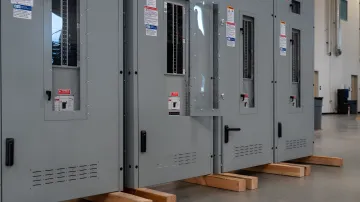
DEI Power's in-house manufacturing model at its 50,000 sq. ft. Ontario, California facility is a direct response to these vulnerabilities. By controlling the entire process from component procurement through final testing and delivery, the company can quote realistic lead times and adjust production schedules without depending on external vendors.
Demand Forecasting and Inventory Management
Smart manufacturers use demand forecasting and inventory management strategies to reduce the impact of supplier delays. These include:
- Maintain safety stock of long-lead-time items like circuit breakers and busbars
- Use Kanban-triggered reordering to prevent stockouts before they affect production
- Negotiate standing orders with suppliers to lock in capacity and pricing
Manufacturers who maintain pre-built inventory of the most commonly specified configurations can ship same-day or next-day for urgent projects. Those who build everything to order face longer lead times and higher exposure to component delays.
Transparency and Engineering Support
Buyers should demand transparency upfront: documented lead times, clear configuration guidance, and direct communication between their engineering team and the manufacturer's engineers.
The "sales-to-engineering gap" is a common failure mode. A salesperson takes an order without fully understanding technical requirements. Errors only surface late in production when they're expensive to fix. The result: schedule delays, costly change orders, and production stoppages.
DEI Power structures its process to prevent this gap. Engineering support is available from the initial inquiry stage, with specification reviews conducted before production begins to ensure proper system configuration and code compliance. Catching misconfigurations before production starts is far less expensive than correcting them in the field.
Pre-Purchasing Strategy
Contractors and project managers can protect their schedules by placing switchboard orders early — ideally at the design or preconstruction phase — rather than waiting until permits are issued or site work begins. Pre-purchasing locks in lead times before a project's schedule becomes dependent on equipment that hasn't been ordered yet.
This requires coordination between the design team, contractor, and manufacturer to finalize specifications early. The payoff is schedule certainty and protection against lead time inflation when demand surges.
What a Trustworthy Switchboard Partner Looks Like
When evaluating suppliers, buyers should verify:
- UL 891 certification that is current and maintained through ongoing audits
- Domestic manufacturing with BABA compliance capability for federally funded projects
- Engineering support available from initial inquiry — not just sales reps reading from spec sheets
- Realistic lead time commitments backed by in-house production control
- Delivery visibility from order confirmation through final shipment, with proactive updates
Frequently Asked Questions
What is causing switchboard lead times to be so long right now?
Several pressures have converged at once: surging demand from data centers and infrastructure projects, raw material shortages, component scarcity, and manufacturing capacity concentrated among a handful of large OEMs. Together, these have pushed lead times from a historical norm of 4–6 weeks to 26+ weeks or more in 2025.
How do tariffs and trade policy affect switchboard pricing and availability?
Tariffs on imported electrical equipment and raw materials — copper and steel in particular — can add up to 27.7% to the total cost of China-origin switchgear. Domestic manufacturers with in-house production, proper certifications, and stable component inventory are better positioned to absorb that pressure without passing it fully to buyers.
What is UL 891 certification and why does it matter?
UL 891 is the safety standard for low-voltage switchboards, confirming that the equipment meets defined performance and safety requirements including dead-front construction, proper grounding, and component listing. Purchasing a non-certified switchboard risks field inspection failures, project delays, and compliance liability.
What does BABA compliance mean for switchboard procurement?
Buy America Build America (BABA) requirements mandate that products used on federally funded infrastructure projects be manufactured domestically with at least 55% domestic content. Switchboards that don't meet this standard cannot be used on qualifying projects — projects awarded under IIJA funding or federal grants are most likely to trigger this requirement.
How can contractors protect their projects from switchboard supply chain delays?
Order at preconstruction — not after permit — and choose a manufacturer with in-house production and component inventory rather than one that depends entirely on third-party suppliers. Both steps reduce exposure to the delays that hit hardest mid-project.
How do I evaluate whether a switchboard manufacturer is reliable?
Start with these four checks:
- Verify UL 891 certification documentation
- Confirm whether manufacturing is in-house or outsourced to third parties
- Ask about current lead times and the specific factors driving them
- Confirm direct engineering support — not just a sales contact — is available
Request BABA compliance documentation separately if your project is federally funded.