Introduction
A 1200 amp switchboard is high-stakes equipment. An incorrectly planned electrical room means failed inspections, costly rework, and dangerous conditions for anyone maintaining the gear. The voltage level, physical size, and ampacity of the equipment all directly influence how much space you must provide, how many exits are required, and what safety features must be in place before the first breaker closes.
NEC Article 110.26 governs working space for all electrical equipment likely to be serviced while energized. For 1200A switchboards, the code triggers elevated requirements — specific depth conditions, mandatory dual-access rules, and dedicated space protections that go beyond what applies to smaller panels.
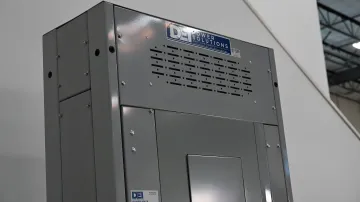
The physical dimensions of the switchboard itself directly affect how working space must be planned. DEI Power's UL 891-certified units (14″ D × 30″ W × 90″ H) come with accurate dimensional documentation, giving contractors and engineers a reliable starting point for code-compliant layout planning.
This guide covers every dimension requirement from depth to height, the critical two-entrance rule, OSHA alignment, and the 80%/83% loading consideration — so you can plan a compliant room before the equipment ever ships.
TLDR: Key Working Space Requirements for 1200A Switchboards
- Depth: 3 feet (Condition 1), 3.5 feet (Condition 2), or 4 feet (Condition 3) minimum per NEC 110.26(A)(1) for systems up to 600V to ground
- Width: 30 inches or the full width of the switchboard, whichever is greater NEC 110.26(A)(2)
- Height: 6 feet 6 inches or equipment height, whichever is greater; floor must be level and flat per 2023 NEC updates
- Dual Access: Required when switchboard is 1200A or more AND wider than 6 feet; each entrance must be 24″ W × 6.5′ H NEC 110.26(C)(2)
- Clear Space: No storage permitted in working space at any time; permanent lighting required (not solely auto-controlled)
NEC 110.26 at a Glance: Why 1200 Amp Switchboards Trigger Stricter Rules
Scope and Triggers
NEC 110.26 applies to all electrical equipment likely to require examination, adjustment, servicing, or maintenance while energized. This explicitly includes switchboards, switchgear, panelboards, motor control centers, and service equipment. OSHA 1910.303, which mirrors NEC 110.26 requirements for general industry, states: "Working space for equipment operating at 1000 volts, nominal, or less to ground and likely to require examination, adjustment, servicing, or maintenance while energized shall comply with 110.26(A)(1) through (A)(4)."
While all equipment covered by 110.26 must meet minimum depth, width, and height requirements, the 1200A threshold activates two additional mandatory provisions:
- 110.26(C)(2) — Large equipment access: Two entrances required for switchboards 1200A or larger exceeding 6 feet in width
- 110.26(C)(3) — Panic hardware: Doors within 25 feet of equipment rated 800A and above must have listed panic hardware
Why Physical Dimensions Matter
The physical dimensions of the switchboard — its width, depth, and footprint — directly affect how working space must be planned. For example, a standard DEI Power 1200A switchboard measures 14″ D × 30″ W × 90″ H. At 30 inches wide (2.5 feet), this unit falls well under the 6-foot width threshold that triggers dual-entrance requirements.
Larger lineups or multiple grouped service disconnects can push past that 6-foot threshold, which changes the room layout, door placement, and egress requirements — all of which need to be resolved before construction drawings are finalized.
2023 NEC Updates
These dimensional thresholds don't exist in isolation — the 2023 NEC also tightened the access and egress language that surrounds them. Two additions affect how working space is designed around any covered equipment:
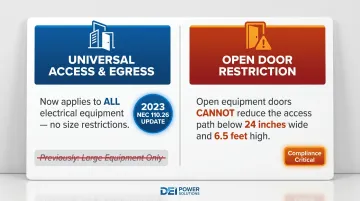
- Universal access and egress language now applies to all equipment, not just large equipment
- Open equipment doors must not restrict the working space access path to less than 24 inches wide and 6.5 feet high at any time — a provision previously limited to large equipment
Working Space Depth for 1200 Amp Switchboards: Understanding the Three Conditions
Working space depth is measured from the front of the enclosure (not from the live parts) and is governed by Table 110.26(A)(1), which defines three conditions based on what is opposite the switchboard across the working space.
The Three Conditions Defined
Condition 1: No live or grounded parts on the opposite side
- 0–150V to ground: 3 feet minimum
- 151–600V to ground: 3 feet minimum
- Concrete, brick, and tile walls are considered grounded surfaces and do not qualify as Condition 1
Condition 2: Exposed live parts on the switchboard side and grounded parts (such as a block or concrete wall) on the opposite side
- 0–150V to ground: 3 feet minimum
- 151–600V to ground: 3 feet 6 inches minimum
- This is the most common scenario in electrical rooms where equipment backs up to a masonry wall
Condition 3: Exposed live parts on both sides of the working space (for example, face-to-face switchboards across an aisle)
- 0–150V to ground: 3 feet minimum
- 151–600V to ground: 4 feet minimum
- Exception (2020 NEC): Condition 2 clearance allowed between dead-front switchboards in supervised, qualified-only installations with written no-simultaneous-open-door procedures
Voltage to Ground: A Critical Distinction
Voltage to ground is not the same as phase-to-phase voltage. A standard 480V three-phase wye system measures approximately 277V to ground, placing it squarely in the 151–600V to ground category — not the lower ≤150V tier. That single distinction shifts the required depth in Conditions 2 and 3.
For a 1200A, 480V switchboard:
- Condition 1 requires 3 feet
- Condition 2 requires 3.5 feet (most common)
- Condition 3 requires 4 feet
2023 NEC addition — level floor requirement: NEC 110.26(A)(6) now requires the floor or platform within the working space to be kept clear and as level and flat as practical for the full required depth and width. Facilities with sloped or uneven floors near electrical rooms should verify compliance before installation.
Depth Requirements by Condition and Voltage
| Condition | Opposite Side | 0–150V to Ground | 151–600V to Ground |
|---|---|---|---|
| 1 | No live or grounded parts | 3 feet | 3 feet |
| 2 | Grounded parts (concrete, brick, tile wall) | 3 feet | 3.5 feet |
| 3 | Exposed live parts on both sides | 3 feet | 4 feet |
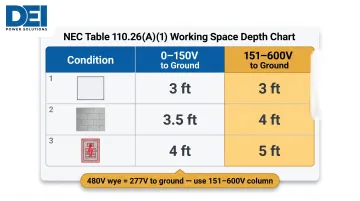
Note: A 480V wye system = 277V to ground, so use the 151–600V row.
Width, Height, and Other Dimensional Requirements
Width [NEC 110.26(A)(2)]
The working space must be at least 30 inches wide — but never narrower than the equipment itself. That 30-inch measurement can be taken left-to-right, right-to-left, or centered on the equipment, and it may overlap the working space of adjacent equipment.
DEI Power's 1200A switchboard lineup configurations that exceed 30 inches require working space equal to the full equipment width — plan accordingly for wider multi-section assemblies.
Height [NEC 110.26(A)(3)]
The working space must extend from the floor to a minimum of 6 feet 6 inches, or to the height of the equipment itself, whichever is greater. DEI Power's standard 1200A switchboard stands 90 inches tall (7.5 feet), so the working space height must extend the full 90 inches.
Critical detail: Raceways, cables, wireways, and support structures — including concrete pads — associated with the switchboard cannot extend more than 6 inches beyond the front face of the switchboard within this working space.
Illumination [NEC 110.26(D)]
Working spaces for switchboards must have permanent lighting. At least some of that lighting must operate without automatic control — occupancy sensors alone do not satisfy this requirement.
Two compliance points inspectors frequently flag:
- Occupancy-sensor-only lighting fails NEC 110.26(D) — at least one circuit must remain energized without automatic control
- OSHA 29 CFR 1910.303(g)(1)(v) carries parallel regulatory text, so the requirement applies under both codes
Both issues are easy to miss during fit-out and difficult to correct after installation is complete.
Access and Egress: When Two Entrances Are Required for 1200 Amp Switchboards
The Core Rule: NEC 110.26(C)(2)
When electrical equipment is rated 1200 amps or more AND is more than 6 feet wide and contains overcurrent, switching, or control devices, there must be one entrance/egress of at least 24 inches wide and 6 feet 6 inches high at each end of the working space.
Critical: "More than 6 feet wide" means exactly 6 feet wide does not trigger this rule. A DEI Power 1200A switchboard at 30 inches wide (2.5 feet) would not trigger dual-entrance requirements based on width alone.
Extension to Grouped Service Disconnects (2020 NEC)
The 2020 NEC extended this rule beyond a single piece of equipment: it now also applies when multiple service disconnecting means installed under 230.71(B) have a combined ampere rating of 1200A or more and a combined width of more than 6 feet.
Example: Six 200A service disconnects mounted side-by-side totaling 1200A and more than 6 feet wide would trigger dual-entrance requirements.
Safety Rationale
Two entrances exist so that a worker cannot be trapped behind arcing or energized equipment during a fault or arc flash event, and so emergency personnel can reach an injured worker. ESFI data covering 2011–2024 recorded 2,070 workplace electrical fatalities, with 26 specifically attributed to arc flash events — a direct argument for unimpeded egress.
The 2023 NEC reinforced this safety priority by extending the open-door impeding prohibition universally. If any simultaneously opened equipment door reduces the access path to less than 24 inches wide and 6.5 feet high, that configuration is non-compliant.
Two Exceptions That Permit a Single Entrance
Both NEC exceptions allow a single entrance when the layout provides adequate escape routes by other means:
- Unobstructed egress — The working space provides a continuous, unobstructed path of egress travel at all times.
- Doubled working space depth — The depth is at least twice the minimum required by Table 110.26(A)(1), and the entrance edge is no closer to the equipment than the minimum clearance distance.
Example: If Condition 2 requires 3.5 feet, doubling it to 7 feet allows a single entrance — provided that entrance sits at least 3.5 feet from the switchboard.
Personnel Doors: NEC 110.26(C)(3)
Where the switchboard is rated 800A or more and contains overcurrent, switching, or control devices, any personnel door located within 25 feet of the nearest edge of the working space must:
- Swing in the direction of egress
- Be equipped with listed panic hardware or listed fire exit hardware
This is a common finding during inspections. DEI Power's engineering team can provide accurate switchboard width and amperage documentation to help contractors and engineers confirm at the design stage whether a single or dual entrance is required.
Dedicated Space vs. Working Space: What's the Difference?
Dedicated Equipment Space [NEC 110.26(E)]
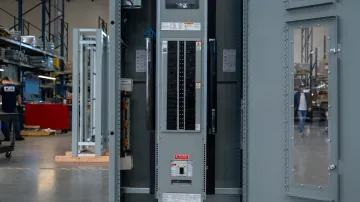
In addition to working space in front of the switchboard, NEC 110.26(E) requires dedicated equipment space — a protected zone equal to the full width and depth (footprint) of the switchboard extending from the floor up to 6 feet above the equipment or to the structural ceiling, whichever is lower.
No foreign systems may be installed within this dedicated space:
- No piping
- No ducts
- No HVAC equipment
- No structural supports
One major exception: Fire sprinkler systems may be located within the dedicated space, provided that any equipment above the switchboard that could leak has secondary drip protection in place.
Working Space vs. Dedicated Space: Two Separate Requirements
- Working space = the clear area in front of the equipment where a worker stands
- Dedicated space = the protected footprint above the equipment
Both must be satisfied simultaneously. For a practical example, a 30-inch-wide switchboard requires:
- 30-inch minimum working space width in front
- 30-inch footprint width above, extending from the floor to 6 feet above the equipment (or to the structural ceiling if lower)
The No-Storage Rule [NEC 110.26(B)]
The working space must be kept clear at all times and cannot be used for storage of any kind. This is one of the most frequently cited violations during inspections.
Facilities commonly mark the floor with painted outlines or tape to enforce this. No exceptions apply — not for temporary storage, not for equipment staged between tasks.
OSHA Clearance Standards and the 80%/83% Loading Rule
OSHA Mirrors NEC Working Space Requirements
OSHA 29 CFR 1910.303(g)(1) mirrors the NEC 110.26 working space requirements for general industry:
- Same three-condition depth table
- Same 30-inch width minimum
- Same 6.5-foot height minimum
- Same dedicated space rules
Key difference: NEC governs installation compliance (enforced by AHJs at the time of installation), while OSHA governs employer obligations for ongoing workplace safety (enforced through workplace inspections). NEC and OSHA enforcement overlap in commercial environments, meaning a 1200A switchboard installation must satisfy both sets of requirements.
The 80%/83% Continuous Load Rule
NEC 110.26 governs physical working space — but loading compliance determines whether that space stays safe after installation. An overloaded 1200A switchboard creates conditions that push workers back into the working space more often and under higher risk.
Standard 80% Rule
Under NEC 210.20 and 230.42, continuous loads (operating 3 hours or more) must not exceed 80% of the switchboard's overcurrent device rating. The code expresses this as 125% of the continuous load — the inverse of the same calculation.
100%-Rated Equipment (the "83% Rule")
Some equipment is listed and rated for 100% of their breaker rating. The colloquial "83% rule" refers to the fact that 100%-rated equipment allows the full continuous rating — effectively equal to 83% of the next standard size up. An ABB circuit breaker ratings technical paper details the code exception and UL test basis for 100%-rated assemblies.
Why Overloading Matters for Working Space Safety
Exceeding a 1200A switchboard's loading limits creates cascading problems that put workers directly at risk inside the working space:
- Thermal stress accelerates insulation breakdown and component failure
- Nuisance tripping forces repeated energized access for troubleshooting
- Shortened equipment life increases the frequency of maintenance events
- Elevated arc flash risk during each unplanned entry
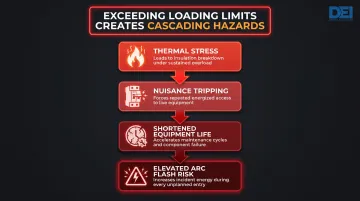
Meeting both the NEC loading limits and the physical clearance requirements is what keeps the working space safe in practice — not just on the inspection checklist.
Frequently Asked Questions
What does NEC Article 110.26 require for working space in front of a 1200 amp switchboard?
NEC 110.26 sets six core requirements for working space around a 1200A switchboard:
- Depth per Table 110.26(A)(1) conditions (3–4 feet for ≤600V systems)
- Width of 30 inches or equipment width, whichever is greater
- Height of 6.5 feet or equipment height, whichever is greater
- Clear, unobstructed access and egress paths
- Permanent lighting not solely controlled by automatic means
- No storage within the working space at any time
How much working clearance is required in front of a 1200 amp, 480V switchboard?
A 480V wye system operates at approximately 277V to ground, placing it in the ≤600V to ground category. Condition 1 requires 3 feet, Condition 2 requires 3 feet 6 inches, and Condition 3 requires 4 feet — with the specific condition determined by what is directly opposite the front of the switchboard (wall type or adjacent equipment).
How many access openings are required for working space around a 1200 amp switchboard wider than 6 feet?
Two entrances/egress points are required — each at least 24 inches wide and 6 feet 6 inches tall, one at each end of the working space — unless an exception applies (unobstructed egress path or doubled working depth), in which case a single entrance is permitted.
What are OSHA requirements for clearance around a 1200 amp switchboard?
OSHA 29 CFR 1910.303(g)(1) applies the same working space depth, width, and height minimums as NEC 110.26 for general industry. The distinction is that OSHA compliance is an ongoing employer obligation enforced through workplace inspections, not just at the time of installation.
What is the 80%/83% rule for electrical panels and switchboards?
Under NEC 210.20, continuous loads (3 hours or more) must not exceed 80% of a standard breaker's rating. Equipment rated for 100% continuous duty can carry the full load — the "83% rule" refers to the fact that running a 100%-rated breaker at full capacity is roughly 83% of the next standard size up, giving you more usable capacity without upsizing the overcurrent device.
What are the requirements for a 1200 amp electrical room?
A compliant 1200A electrical room must meet these minimums:
- Working space depth of 3–4 feet per Table 110.26(A)(1) conditions
- 30-inch minimum width (or equipment width, whichever is greater)
- 6.5-foot height clearance throughout the working space
- Two access points if the switchboard exceeds 6 feet wide
- Dedicated overhead space free of piping, ducts, or foreign systems
- Permanent lighting and no storage within the working space
Planning a 1200A switchboard installation? Contact DEI Power at (866) 773-8050 or sales@deipower.com to discuss UL 891-certified switchboards with full dimensional drawings for code-compliant room layouts. All units are manufactured in Ontario, California, and ship nationwide with free delivery in 3–5 business days.