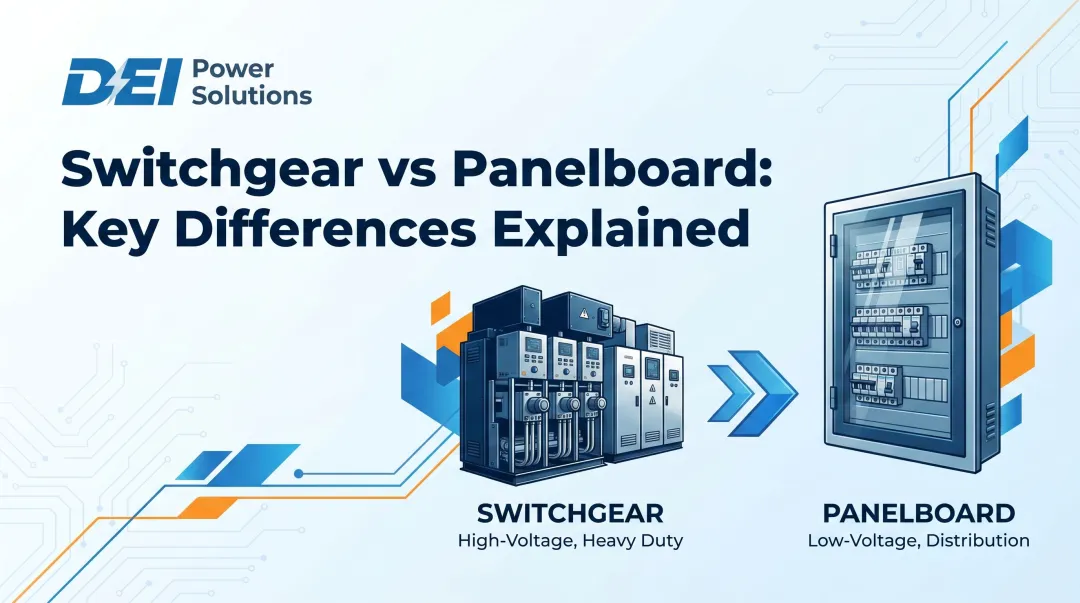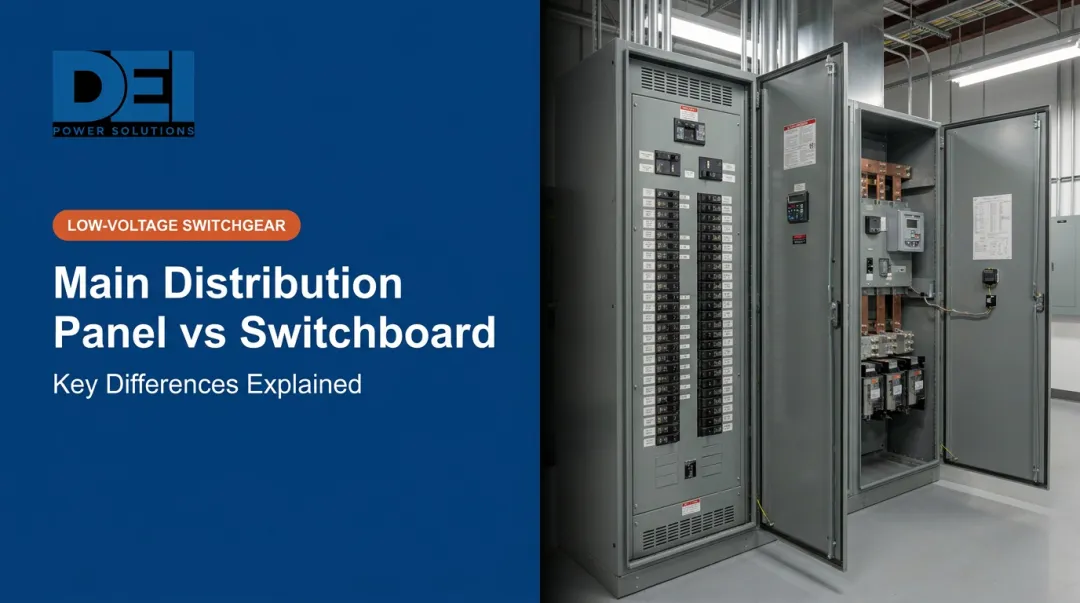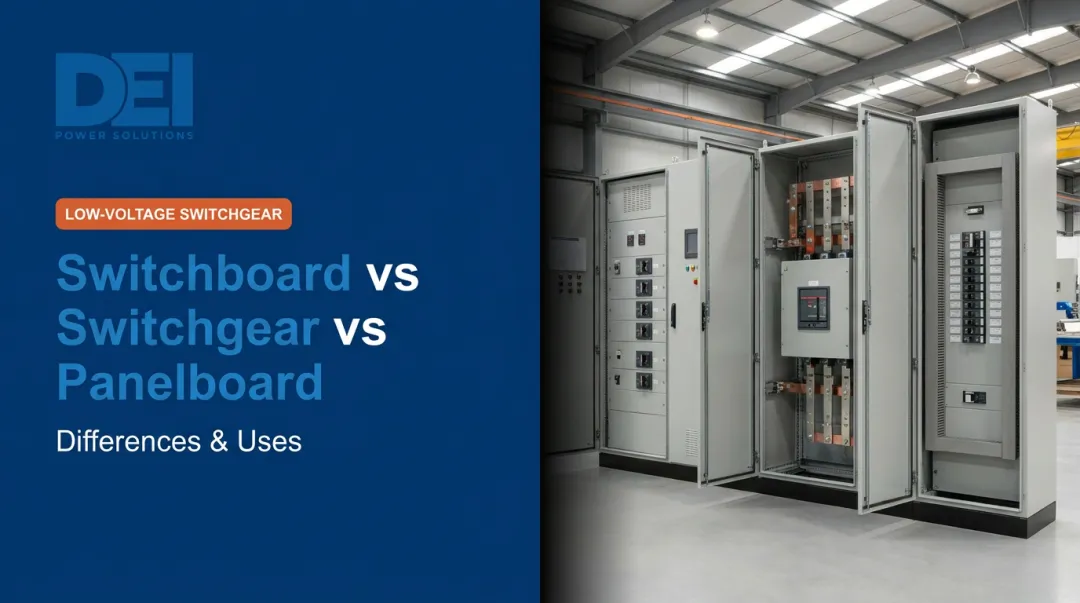
The two equipment types differ in ways that matter: fault current withstand ratings, breaker serviceability, voltage class, NEC compliance requirements, and total installed cost. Picking the wrong one at the specification stage can compromise facility uptime, safety, and your project timeline.
This article cuts through the confusion with clear definitions, a side-by-side comparison, and a practical decision framework built for contractors, engineers, and facility teams.
Key Takeaways
- An MDP receives utility power and distributes it into feeder circuits — designed for standard low-voltage applications up to 600V
- Switchgear is a fully enclosed assembly with draw-out breakers, rated for higher fault currents and voltage ranges up to 38kV
- Key differentiators: fault withstand rating (3 cycles vs. 30 cycles), breaker type (bolt-on vs. draw-out), and serviceability
- Choose an MDP when loads are predictable, voltage is standard, and scheduled maintenance windows are acceptable
- Switchgear fits facilities that require continuous uptime, high fault protection, or medium-voltage distribution
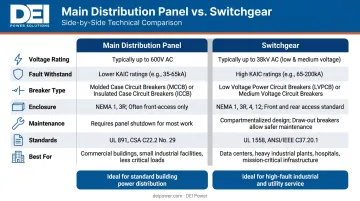
Main Distribution Panel vs. Switchgear: Quick Comparison
Use this table to compare both options across the factors that matter most to your project.
| Factor | Main Distribution Panel | Switchgear |
|---|---|---|
| Voltage Rating | Up to 600V AC | Low voltage up to 1,000V; medium voltage up to 38kV |
| Current Rating | Up to 5,000A (NEMA PB 2 allows up to 6,000A) | Up to 6,000A (LV); up to 4,000A (MV metal-clad) |
| Fault Withstand | ~3 cycles | ~30 cycles |
| Breaker Type | Bolt-on (fixed mounted) | Draw-out (removable without shutdown) |
| Enclosure | Open or semi-enclosed; front/rear access | Fully enclosed on all sides and top per UL 1558 / IEEE C37.20.1 |
| Maintenance | Partial or full shutdown required | Individual breakers serviceable without de-energizing adjacent circuits |
| Primary Standards | UL 891, NEMA PB 2, NEC Article 408 | UL 1558, IEEE C37.20.1, NEMA SG 5, NEC Article 408 |
| Capital Cost | Lower | Higher |
| Best For | Standard commercial/light industrial | Critical facilities, high fault current, medium voltage |
What Is a Main Distribution Panel?
"Main distribution panel" is a field term, not a formal NEC equipment category. In practice, it refers to the primary panelboard or switchboard where utility power enters a facility and gets subdivided into individual feeder circuits. NEC Article 408 defines the two closest formal categories:
- Panelboard — a single panel or group of panel units with buses and overcurrent devices, installed in or against a wall, accessible from the front only
- Switchboard — a larger, floor-mounted assembly accessible from both front and rear, not designed for cabinet installation
Most equipment labeled "MDP" in commercial and industrial settings is technically a switchboard under Article 408 — typically governed by UL 891 and NEMA PB 2 (which covers deadfront distribution switchboards rated 600V or less).
How an MDP Is Built
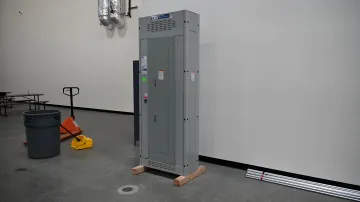
The typical MDP contains busbars, bolt-on or plug-in circuit breakers, and a main disconnect, all housed in a floor-mounted or wall-mounted enclosure. It is not fully enclosed on all sides the way switchgear is — the NEC's full sheet-metal enclosure language belongs to switchgear specifically.
Each breaker protects an individual feeder or branch circuit, making the MDP the first point of distribution for everything downstream: sub-panels, lighting circuits, HVAC, and process loads.
Where MDPs Are the Right Choice
MDPs are the standard choice across a wide range of projects:
- Commercial office buildings and retail centers
- Educational campuses
- Healthcare facilities (non-critical distribution boards)
- Mid-size industrial facilities with predictable load profiles
- Any project where scheduled maintenance windows are operationally acceptable
MDPs are widely available, faster to procure in standard configurations, and familiar to most electricians — which reduces installation time and keeps labor costs down.
The main tradeoff is maintenance access. Because MDPs use bolt-on breakers on a shared bus without compartmentalization, servicing typically requires a partial or full shutdown. For 24/7 operations, that constraint matters.
What Is Switchgear?
NEC Article 408 defines switchgear precisely: an assembly completely enclosed on all sides and top with sheet metal (except for ventilating openings and inspection windows), containing primary power circuit switching and interrupting devices, with buses, connections, and access by doors or removable covers.
That full enclosure is a code-defined distinction from switchboards and panelboards — and it drives every practical difference in how switchgear performs.
The Draw-Out Breaker Advantage
Each breaker in a switchgear assembly occupies its own isolated compartment. Per IEEE C37.20.1-2015, breakers can be stationary or draw-out — and in practice, draw-out configurations are what make switchgear the preferred choice for mission-critical applications.
A draw-out breaker can be moved to a test or disconnect position, or fully withdrawn for service, without de-energizing the rest of the gear. In practice, that changes how maintenance gets done:
- Faults can be isolated to a single compartment
- Breakers can be replaced without shutting down adjacent circuits
- Maintenance windows shrink from full-facility outages to targeted, localized work
Fault Current Performance
Engineering guidance from Eaton and technical literature from Consulting-Specifying Engineer both state that switchboards carry approximately a 3-cycle short-time withstand rating, while switchgear is associated with 30-cycle withstand. That difference is significant in high-fault-current environments where a fault needs to be contained long enough for upstream protective devices to operate selectively.
Voltage Range and Standards
Low-voltage switchgear (UL 1558, IEEE C37.20.1) covers applications up to 1,000V AC. Medium-voltage metal-clad switchgear — a separate category under IEEE C37.20.2 — extends from 4.76kV to 38kV, with main bus continuous current ratings up to 4,000A.
The applicable standards:
- Low-voltage switchgear: UL 1558, IEEE C37.20.1, NEMA SG 5
- Medium-voltage switchgear: IEEE C37.20.2
- Both: NEC Article 408
DEI Power manufactures UL 891-certified switchboards at their 50,000 sq. ft. facility in Ontario, California, with assemblies from 400A to 4,000A built to these code requirements for commercial, industrial, and utility applications.
Where Switchgear Is Required
According to Consulting-Specifying Engineer, switchgear is used more often than switchboards in critical facilities such as hospitals and data centers, where power continuity is a priority. Other environments where switchgear is the appropriate or required solution:
- Utility substations and infrastructure
- Hyperscale and enterprise data centers
- Large industrial and manufacturing plants
- Hospitals and healthcare systems with critical uptime requirements
- Large commercial campuses where unplanned outage costs are significant
ITIC's 2024 Hourly Cost of Downtime report found that hourly downtime exceeds $300,000 for 90% of mid-size and large enterprises, with 41% reporting costs of $1 million or more per hour. At that exposure, the capital premium for switchgear over a switchboard is rarely the deciding factor — availability is.
Which One Do You Need?
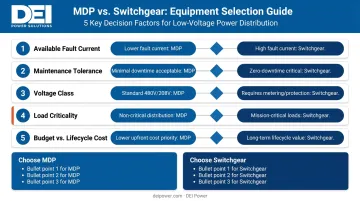
The decision comes down to five factors. Work through them in order:
- Available fault current — Does the short-circuit current at the point of interconnection exceed what a switchboard can withstand?
- Maintenance tolerance — Can the facility accept a scheduled shutdown for breaker servicing, or does uptime require zero-interruption maintenance?
- Voltage class — Is the utility service at low voltage (600V or less) or medium voltage (above 1kV)?
- Criticality of loads — What is the operational and financial cost of an unplanned outage?
- Budget vs. lifecycle cost — Does the lower capital cost of an MDP justify the potential operational risk?
Choose an MDP When:
- The facility is served at low voltage (600V or less)
- Load profiles are standard and well-defined
- Scheduled maintenance windows are operationally acceptable
- The project budget prioritizes capital cost and the fault current levels are within switchboard SCCR limits
Choose Switchgear When:
- The facility serves critical loads (hospitals, data centers, industrial production lines)
- The utility service is at medium voltage
- Available fault current is high and 30-cycle withstand is required
- The engineering specification requires draw-out breaker capability or selective coordination
- Unplanned downtime carries significant financial or safety consequences
The Gray Zone
Some projects could technically use either. When that's the case, two questions usually resolve it: What is the facility's growth trajectory? And what does an unplanned outage actually cost?
Switchgear is more modular, meaning additional circuits or capacity can be added without a full shutdown. If the facility is likely to expand, or if downtime carries real cost, the lifecycle math favors switchgear from the outset.
Once switchgear is the right call, sourcing speed becomes the next practical concern. DEI Power manufactures UL 891-certified low-voltage switchgear from their Ontario, California facility, with standard configurations shipping within 1–5 business days and custom builds completed within 4–6 weeks. Reach a switchgear specialist at (866) 773-8050 to discuss your project requirements.
Conclusion
Selecting between an MDP and switchgear comes down to three technical realities: fault withstand capability, voltage rating, and how the equipment fits the facility's maintenance requirements. Get those aligned, and the right choice becomes straightforward.
Getting this right at the specification stage prevents change orders, compliance failures, and operational disruptions. Mismatches caught after installation are far more costly — in time, budget, and schedule credibility — than the upfront work of specifying correctly. If you're weighing options for a current project, DEI Power's engineering team can help confirm the right configuration before you commit.
Frequently Asked Questions
What is the difference between switchgear and a distribution panel?
A main distribution panel distributes power through bolt-on breakers in an open or semi-enclosed assembly, with a fault withstand rating of approximately 3 cycles. Switchgear is fully enclosed, compartmentalized, and uses draw-out breakers rated for approximately 30 cycles — and covers a broader voltage range including medium voltage up to 38kV.
What is the difference between an MCC and switchgear?
A Motor Control Center (MCC) is purpose-built to start, stop, and protect electric motors using starters and drives. Switchgear is a power distribution and protection assembly that feeds circuits and loads broadly. Both are often installed in the same facility but serve distinct roles in the power distribution hierarchy.
What NEC article covers main distribution panels and switchgear?
Both are covered under NEC Article 408 (Switchboards, Switchgear, and Panelboards), which was expanded in the 2014 NEC to include switchgear. UL 891 applies to switchboards; UL 1558 and IEEE C37.20.1 apply to low-voltage switchgear.
Can a main distribution panel be upgraded to switchgear later?
Rarely without significant redesign. Upgrading typically requires new gear, new breakers, and potentially rerouted conductors — the scope is comparable to a full replacement. When critical uptime or growth is anticipated, specifying switchgear from the outset is more cost-effective.
Which is more expensive: a main distribution panel or switchgear?
Switchgear carries a higher upfront cost due to compartmentalized construction, draw-out breakers, and stricter UL/ANSI compliance testing. In mission-critical applications, the lifecycle cost advantage from reduced downtime risk, modular maintenance, and longer service life typically justifies the premium.
What current and voltage ratings apply to each type?
MDPs (as switchboards) are typically rated up to 600V AC and up to 5,000A, with NEMA PB 2 allowing up to 6,000A. Low-voltage switchgear handles up to 1,000V and up to 6,000A; medium-voltage switchgear covers 4.76kV to 38kV — making switchgear the only viable option for medium-voltage service entrances.