Introduction
Data centers operate around the clock, and a single power disruption can trigger outages costing hundreds of thousands—or even millions—of dollars. According to the Uptime Institute's 2025 Annual Outage Analysis, 54% of significant outages exceeded $100,000, with 20% crossing the $1 million mark. Power-related failures remain the leading cause, accounting for 54% of all impactful outages. That puts switchgear at the core of any serious data center power strategy.
TLDR:
- Switchgear controls, protects, and isolates electrical power in data centers using circuit breakers, relays, and busbars
- It prevents costly downtime by detecting faults and isolating affected circuits automatically
- Low-voltage (up to 1,000V) and medium-voltage (1kV–69kV) types serve different facility scales
- UL 1558 switchgear offers 30-cycle fault withstand versus 3-cycle for UL 891 switchboards
- Domestic manufacturing and Buy America Build America (BABA) compliance reduce lead times and qualify equipment for federal and public infrastructure projects
What Is Data Center Switchgear?
Data center switchgear is the collection of electrical devices—including circuit breakers, disconnect switches, protective relays, and busbars—used to control, protect, and isolate electrical power within a data center's power distribution system. According to ANSI/IEEE C37.100-1981, switchgear is defined as "switching devices and their combination with associated control, measuring, protective, and regulating equipment, used for controlling, protecting, and isolating electrical equipment."
Switchgear acts as the command layer of a data center's electrical infrastructure. It receives power from the utility feed or on-site transformers and manages how that power is routed, switched, and protected before it reaches servers, cooling systems, and other critical loads.
Unlike a simple power distribution panel, switchgear actively monitors current flow, detects fault conditions (like overloads or short circuits), and can automatically interrupt power to protect downstream equipment.
Where Switchgear Lives in Your Data Center
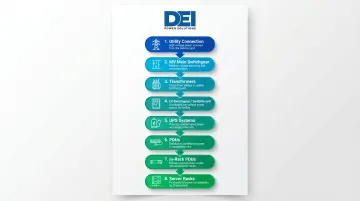
Switchgear is typically installed in dedicated electrical rooms or switchgear rooms, often fed from a utility transformer or on-site generator. It's positioned upstream of UPS systems, PDUs, and individual rack circuits. In the data center power chain, the flow typically follows this sequence:
- Utility Connection
- MV Main Switchgear
- Transformers
- LV Switchgear/Switchboard
- UPS Systems
- PDUs
- In-Rack PDUs
- Server Racks
Why Switchgear Is Critical for Modern Data Centers
Modern hyperscale and enterprise data centers are handling heavier loads than ever. AI workloads, high-density computing, and always-on uptime requirements mean power infrastructure must be engineered with precision and redundancy. Because switchgear sits at the top of the distribution chain, it's where fault isolation and load protection are enforced before problems cascade downstream.
The financial stakes are real. Average outage costs reach $740,357 per incident according to a widely cited Ponemon Institute study, and UPS system failures alone account for 25% of unplanned outages. The switchgear layer is your first line of defense against those six- and seven-figure losses.
How Does Switchgear Work in a Data Center?
Data center switchgear manages power at every handoff point in the distribution chain — controlling flow, isolating faults, and enabling maintenance without taking down critical loads.
The Power Chain Flow
Utility power enters the facility through a main switchgear assembly, where voltage is stepped down (if medium voltage) and distributed to sub-distribution switchboards, UPS systems, and eventually individual PDUs and server racks. Switchgear controls and protects every handoff point in this chain, ensuring that power flows safely and reliably from source to load.
Fault Protection Function
When a fault—such as a short circuit, overload, or ground fault—is detected by protective relays within the switchgear, circuit breakers trip automatically to isolate the affected circuit. This prevents damage from cascading to the rest of the system.
Low-voltage switchgear governed by IEEE C37.20.1 includes three core protective components:
- Power circuit breakers for fault isolation and system protection
- Protective relays that detect electrical faults in real time
- Instrument transformers for metering and relay inputs
Isolation and Switching Function
Switchgear allows operators to safely de-energize a section of the power system for maintenance or emergency response without shutting down the entire facility. Tier III/IV data centers require this for concurrent maintainability. Drawout circuit breakers in UL 1558 switchgear enable technicians to remove and service breakers without de-energizing adjacent equipment.
Automatic Transfer Switches (ATS) Integration
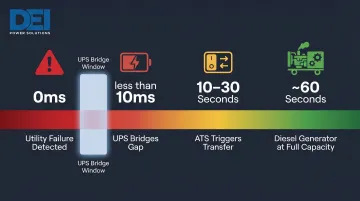
When the primary utility feed fails, the ATS triggers an automatic transfer to backup generators or battery systems. Mechanical ATS devices typically achieve failover in 10–30 seconds, while diesel generators ramp to full capacity in approximately 60 seconds. UPS systems bridge the gap between utility loss and generator availability with response times typically lower than 10 milliseconds. This integration is what enables near-zero-downtime failover in mission-critical data centers.
Real-Time Monitoring and Intelligent Control
Modern switchgear systems include smart metering, digital relays, and remote communication interfaces using protocols like IEC 61850 and Modbus. These interfaces allow operators to monitor power quality, load levels, and breaker status from a centralized DCIM or SCADA platform.
Key IEC 61850 communication services include:
- GOOSE messaging handles time-critical protection events at the microsecond level — for example, tripping a breaker the instant a fault is detected
- Sampled Values (SV) stream real-time digitized current and voltage data continuously to monitoring systems
- MMS (Manufacturing Message Specification) handles supervisory commands from SCADA or DCIM platforms
IEC 61850 can reduce physical wiring in switchgear by up to 80% by replacing copper bundles with fiber optic cables. The result is a leaner, more responsive distribution system that operators can monitor and control from a single platform.
Types of Data Center Switchgear
The right switchgear type depends on where in the power chain it operates — specifically the incoming voltage level and the facility's total load capacity. Two primary categories define most data center deployments: low-voltage and medium-voltage.
Low-Voltage (LV) Switchgear
LV switchgear operates at up to 1,000V AC (expanded from the prior 600V threshold under NEC 2014) and is the most common type found in commercial and enterprise data centers. It distributes power at the final stage to individual circuits, PDUs, UPS systems, and critical loads.
UL 891-certified switchboards fall within this category and must meet strict safety standards for data center use. DEI Power manufactures UL 891-certified LV switchboards from 400A to 4000A using Siemens components, assembled domestically for hyperscale and enterprise data center applications.
Medium-Voltage (MV) Switchgear
MV switchgear handles voltages between 1kV and 69kV, typically receiving power directly from the utility grid or large on-site generation systems and stepping it down via transformers before distribution. Common MV application ratings include 5kV, 15kV, 27kV, and 38kV, with service voltages commonly at 12.47kV, 13.2kV, 13.8kV, and 14.4kV.
This equipment is common in large hyperscale facilities and campus-style data centers with multiple buildings or significant on-site generation.
Campuses requiring more than 100MW typically deploy on-site high-voltage substations with MV switchgear at 11kV, 22kV, or 33kV. Dual-source configurations for each data hall are standard practice to eliminate single points of failure.
Form Factor Sub-Types
| Type | Standard | Key Features | Typical Use |
|---|---|---|---|
| Metal-Clad | IEEE C37.20.2 | Drawout circuit breakers; separate metal compartments for incoming bus, outgoing bus, instrumentation, and breaker | MV distribution in large/hyperscale data centers |
| Metal-Enclosed | IEEE C37.20.3 | Devices in common compartments; no mandatory separate barriers | General MV applications |
| Gas-Insulated (GIS) | IEEE C37.122 | Uses SF₆ for higher dielectric strength; compact sealed-tank design | Space-constrained installations |
Arc-resistant switchgear designs are particularly important for data center safety:
- Type 1: Arc resistant at front only (standard personnel protection)
- Type 2: Arc resistant around entire perimeter (enhanced protection, common in data centers)
- Suffix B: Protection maintained with control compartment doors open
- Suffix C: Isolation between adjacent compartments to prevent fault propagation
Key Components of Data Center Switchgear
Switchgear assemblies are built from several interdependent components — each with a defined job in fault protection, isolation, and monitoring.
Core Internal Components:
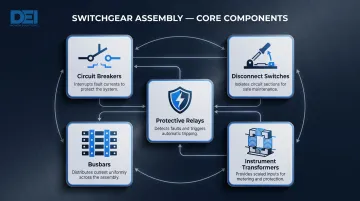
- Circuit Breakers interrupt fault current. Low-Voltage Power Circuit Breakers (LVPCB) in UL 1558 switchgear are 100% rated and drawout-mounted, so adjacent equipment stays energized during service
- Disconnect Switches isolate individual circuits safely for maintenance or emergency shutdowns
- Protective Relays monitor voltage, current, and frequency — tripping breakers when faults are detected. Under IEC 61850, logical node PTOC standardizes overcurrent protection across all compliant vendors
- Busbars are copper or aluminum conductors that carry current between components. They must meet Class 105 temperature ratings and be mechanically braced to handle short-circuit forces
- Instrument Transformers: Current Transformers (CTs) and Potential Transformers (PTs) safely measure high currents and voltages for metering and protection
Enclosure and Compartmentalization Design
Enclosure design directly affects arc flash safety, particularly in data centers where technicians routinely work near energized switchgear rooms. Arc-resistant designs redirect blast energy away from personnel rather than outward toward workers.
The risk is real: according to ESFI analysis of BLS/OSHA data, an estimated 5–10 arc flash events occur every day in the U.S., with more than 1,800 workers hospitalized annually from severe arc flash burns. IEEE C37.20.7 defines type-testing requirements for internal arcing faults, verifying that enclosures can withstand rapid pressure rises and mechanical stresses.
Metering, Communications, and Control Hardware
Modern switchgear assemblies integrate digital relays, power meters, and network interfaces that enable the switchgear to report operational data upstream to building management systems or DCIM platforms. IEC 61850 Merging Units digitize instantaneous values from CTs/VTs over the process bus using the Sampled Values protocol, enabling real-time monitoring and faster protection coordination.
Switchgear vs. Switchboard in a Data Center
Switchgear and switchboards are not interchangeable — and choosing the wrong one for the wrong location creates real reliability and code-compliance problems.
Core Functional Distinction
Switchboards primarily distribute power—accepting input from a source and splitting it across multiple output circuits. Switchgear controls, monitors, and protects power. It offers active fault detection, selective coordination, and the ability to interrupt faults with precision, which a basic switchboard cannot do.
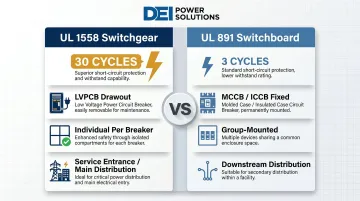
| Feature | UL 1558 Switchgear | UL 891 Switchboard |
|---|---|---|
| Short-circuit withstand rating | 30 cycles | 3 cycles |
| Breaker type | LVPCB, 100% rated, drawout-mounted | MCCB or ICCB, typically fixed-mounted |
| Compartmentalization | Individual compartments per breaker | Group-mounted components |
| Primary application | Primary service entrance, generator tie, main distribution | Downstream distribution: data centers, commercial, industrial |
The 30-cycle versus 3-cycle withstand difference matters in practice: UL 1558 switchgear can sustain fault current for 10 times longer, allowing for selective coordination of protective devices.
Where Each Device Fits in the Power Chain
Switchgear is typically upstream, handling the main service entrance, generator tie, and primary distribution. Switchboards and panelboards appear downstream, distributing power to specific loads like CRAC units, PDUs, and lighting circuits.
Where Intelligent Switchboards Fall Short
Modern switchboards equipped with intelligent circuit breakers can offer some protection functionality, but they still lack the full selective coordination, arc-flash mitigation, and draw-out serviceability that true switchgear provides. At the primary service entrance and generator-tie level of a data center, UL 1558 switchgear is the appropriate choice. UL 891 switchboards remain well-suited for downstream distribution — handling loads like PDUs, CRAC units, and branch circuits where the application requirements align with their ratings.
Selective Coordination Requirements
Selective coordination is mandatory under NEC for the following system types:
- Emergency systems (Article 700.27)
- Legally required standby systems (Article 701.18)
- Critical operations power systems / COPS (Article 708.54)
- Healthcare essential electrical systems (Article 517.26)
Selective coordination ensures that in a fault event, only the overcurrent protective device nearest to the fault opens, leaving the remainder of the system energized and functional.
How to Choose the Right Switchgear for Your Data Center
Selecting the right switchgear requires balancing technical requirements, compliance needs, and project schedule constraints.
Determine Voltage Class Requirements
Start by determining voltage class requirements based on utility delivery voltage and whether on-site generation (diesel generators, natural gas, renewables) is part of the design. This dictates whether LV or MV switchgear (or both) is needed. Hyperscale facilities typically deploy both: MV switchgear receives utility power at 11kV–33kV and distributes it to transformers, which step down to LV for final distribution to UPS systems and racks.
UL Certification and Compliance
For low-voltage applications, the key standards are:
- UL 891 — covers switchboards
- UL 1558 — covers low-voltage switchgear
- IEEE C37.20.1 — engineering design and performance standard for metal-enclosed LV switchgear
Specifying certified, code-compliant equipment protects your project from inspection failures and insurance complications.
DEI Power's custom switchgear is UL 891-certified and manufactured domestically with BABA compliance. This makes it a strong fit for government, utility, and mission-critical data center projects where sourcing documentation and schedule certainty matter. Under the Build America, Buy America Act (effective May 14, 2022), manufactured products must include at least 55% domestic components by cost for federally funded infrastructure projects.
Lead Time and Manufacturability
Data center construction schedules are unforgiving. Switchgear lead times from overseas or large-catalog suppliers stretched to 40–60 weeks in 2024–2025, while power transformer lead times crossed 120 weeks according to NERC. These delays can cascade through the 1,500–5,000 BOM line items typical of a hyperscale facility.
Look for manufacturers with in-house fabrication, engineering support, and domestic assembly. This reduces schedule risk and keeps last-minute specification changes from triggering costly delays.
DEI Power's in-house manufacturing process at its 50,000 sq. ft. Ontario, California facility allows most orders to ship within 3–5 business days for standard configurations and 4–6 weeks for custom assemblies, with engineering support available throughout the design and procurement process.
Frequently Asked Questions
What is a switchgear in a data center?
Data center switchgear is the electrical infrastructure used to control, protect, and distribute power from the utility or generator to the facility's critical loads. It includes circuit breakers, protective relays, and disconnect devices all housed in a single assembly.
What does a switchgear do in a data center?
Switchgear performs three primary functions: distributing electrical power to multiple circuits, protecting equipment from fault conditions (overloads, short circuits, ground faults), and allowing safe isolation of circuits for maintenance. Together, these functions keep power flowing reliably while giving operators control over every distribution path.
What is the difference between switchgear and switchboard in data center?
Switchboards distribute power to multiple circuits but offer limited fault protection. Switchgear actively controls, monitors, and protects power flow with intelligent fault interruption and selective coordination — and carries a higher fault withstand rating, making it the appropriate choice at the primary distribution level in most data centers.
What is a switchboard in a data center?
A switchboard is a downstream power distribution device that accepts power from a source and routes it to multiple circuits or panels. It is simpler and less protective than switchgear, typically used for secondary distribution to specific equipment loads like CRAC units, lighting, and localized PDUs.
What are the electrical equipment in a data center?
Primary power infrastructure components include utility transformers, switchgear, UPS systems, automatic transfer switches (ATS), generators, switchboards/PDUs, and busway. Switchgear serves as the central control and protection layer connecting the utility supply to all downstream equipment.
Do data centers have their own substations?
Large hyperscale and enterprise data centers often include on-site substations with medium-voltage switchgear and transformers to receive utility power at transmission or distribution voltage (138kV, 230kV, or 345kV) — facilities exceeding 100MW typically require this setup. Smaller data centers rely on utility-provided service at lower voltages.