Key Takeaways
- Switchgear handles primary distribution (400A–4000A, low-voltage); panelboards serve branch circuits (up to 1,200A) — know which you need before specifying
- UL 891 certification is mandatory for low-voltage switchboards in new commercial and industrial projects
- Top 2026 options: DEI Power, Siemens, Schneider Electric, Eaton, and ABB — each suited to different voltage levels and project scopes
- Key selection factors: ampacity rating, UL/NEC compliance, short-circuit withstand rating, lead time, and engineering support
- USA-manufactured gear with in-house fulfillment cuts the 8–20+ week lead times typical of imported equipment
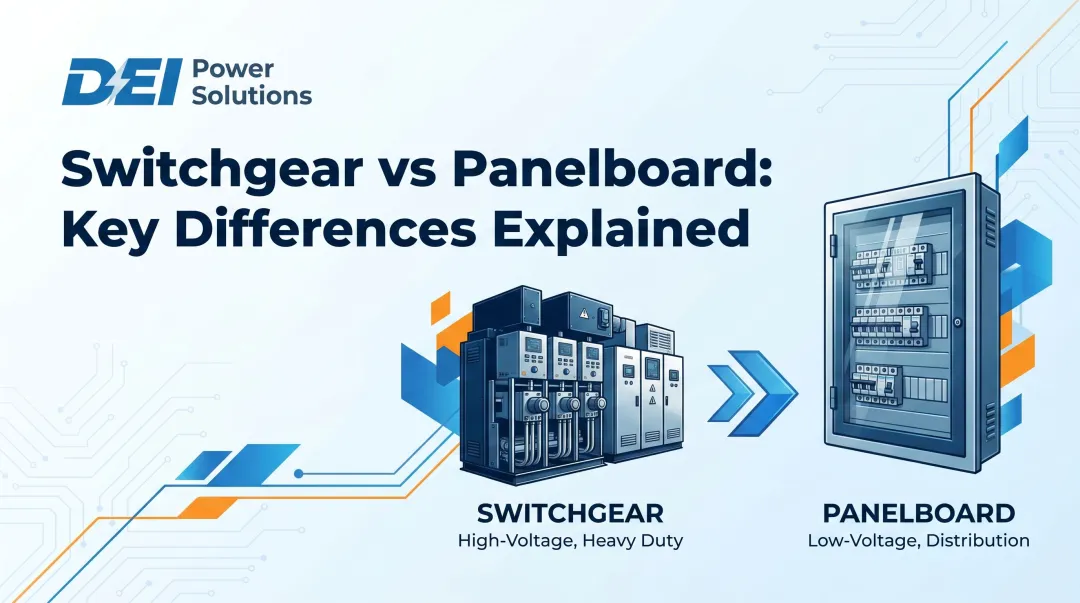
Switchgear vs. Panelboards: Understanding the Difference for New Installs
These three equipment types serve distinct roles in a distribution system. Choosing the wrong one adds cost, delays inspections, and creates field problems that are expensive to fix.
| Equipment Type | Mounting | Access | Current Range | Key Feature |
|---|---|---|---|---|
| Panelboard (NEC Art. 408) | Wall-mounted | Front only | Up to 1,200A | Branch circuit distribution in commercial spaces |
| Switchboard | Floor-mounted | Front & rear | 1,200A–5,000A | Main distribution point for larger facilities |
| Switchgear | Floor-mounted (enclosed) | Front & rear | Up to 6,000A / 38kV | Draw-out breakers allow live maintenance without full de-energization |
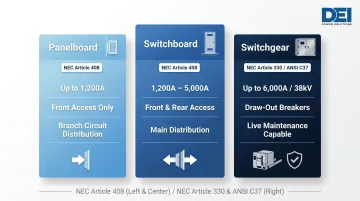
What drives the choice on a new install:
- Load size — Larger facilities with higher current demands require switchboards or switchgear
- Fault current level — NEC 408.6 requires equipment with short-circuit ratings not less than available fault current
- Maintenance capability — Projects requiring live maintenance need draw-out breaker functionality
- Floor space — Panelboards save space; switchgear requires dedicated electrical rooms
- Utility service entry requirements — Utility specifications often dictate equipment type
For example, a hospital emergency power panel handling 400A of branch circuits uses a panelboard, while a data center's primary distribution feeding 3,000A across multiple racks requires switchgear with draw-out breakers for uninterrupted maintenance.
The five product lines reviewed below cover voltage range, certifications, customization, lead times, and field performance — the factors that matter most when specifying equipment for a new build.
Top Switchgear & Panelboard Options for New Electrical Installs 2026
Each option below is evaluated on UL certification, voltage and ampacity coverage, engineering support, lead times, and field performance across commercial, industrial, and utility new-build applications. Use the specs and standout factors to match each product to your project requirements.
DEI Power Custom UL 891 Switchboards
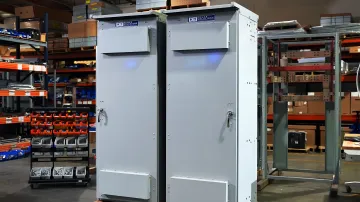
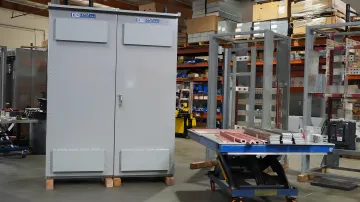
DEI Power is a USA-based manufacturer with 10+ years building UL 891-certified low-voltage switchboards for commercial, industrial, utility, and data center applications from their 50,000 sq. ft. facility in Ontario, California. As an approved Siemens OEM, their switchboards integrate genuine Siemens components and are precision-engineered to project-specific specs.
Key advantages:
- Ships most in-stock configurations within 1 business day; custom builds avoid the 8–20+ week delays common with imported gear
- Every board built to exact voltage, layout, and ampacity requirements — no forced standard configurations
- BABA-compliant construction supports federally funded and infrastructure projects
- Free nationwide shipping with 3–5 day delivery for time-sensitive installs
| Specification | Details |
|--------------|---------|
| Voltage Range | 120/240V, 208Y/120V, 240/120V, 480V, 480Y/277V, 600V, 415/240V |
| Ampacity Range | 400A to 4000A (standard configurations include 600A, 800A, 1200A, 1600A, 2000A, 2500A, 3000A, 4000A) |
| Certification | UL 891 certified; Approved Siemens OEM; BABA compliant; USA manufactured |
| Enclosures | NEMA 1 (indoor), NEMA 3R (outdoor weather-resistant) |
| Best For | New commercial builds, data centers, industrial plants, utility infrastructure, healthcare facilities, time-sensitive projects |
Siemens Sentron Panelboards & Switchboards
Siemens' Sentron series covers panelboards and switchboards for commercial and industrial new construction across the U.S. The lineup is specified for its broad breaker compatibility and native support for smart monitoring and building management integrations.
Why engineers specify it:
- Modular design supports flexible configuration across varied load profiles
- Broad breaker compatibility includes arc-fault and ground-fault protection
- Digital-ready variants support energy monitoring and BMS integration via SEM3 embedded metering and Modbus-to-BACnet gateways
| Product Line | Voltage | Max Bus Ampacity | SCCR | UL Listing |
|---|---|---|---|---|
| SMP Switchboard | 240V, 480V, 600V AC | 1,200A | 50kA (65kA optional) | UL 891 |
| FCI Switchboard | 240V, 480V, 600V AC | 2,000A | 50–200kA | UL 891 |
| FCII Switchboard | 240V, 480V, 600V AC | 5,000A (6,000A optional) | 50–200kA | UL 891 |
Best For: Commercial buildings, industrial facilities, smart building integration
Schneider Electric / Square D Switchboards & Panelboards
Schneider Electric's Square D line covers panelboard and switchboard applications from light commercial to heavy industrial through the NQ, I-Line, and QED series. Availability through electrical distributors nationwide makes it a practical default spec for many general contractors.
Notable capabilities:
- Available through electrical distributors nationwide — reduces sourcing risk on tight schedules
- Broad ecosystem of compatible breakers, surge protection, and metering accessories
- Square D Energy Center integrates solar, EV charging, battery, and generator into a single platform
- Standard preconfigured designs ship in as short as four weeks
| Product Line | Voltage | Max Ampacity | SCCR | Key Features |
|---|---|---|---|---|
| NQ Panelboards | 240V, 208Y/277V, 480Y/277V | 800A | 65kA fully rated; 200kA series rated | UL 67 listed; NEMA 1, 2, 3R, 4, 4X, 5, 12 |
| QED-2 Switchboards | 600V AC | 5,000A | Up to 200kA | UL 891; front-accessible |
| QED-6 Switchboards | 600V AC | 6,000A | 100kAIR at 635V | UL 891; fully withdrawable draw-out construction |
Best For: New commercial construction, multi-tenant facilities, campuses, renewable energy-integrated builds
Eaton Pow-R-Line & Magnum DS Switchgear
Eaton offers a broad portfolio spanning panelboards (Pow-R-Line series) through low-voltage switchgear (Magnum DS series), making them a scalable option for projects requiring both secondary distribution and primary switchgear in a single-supplier specification.
Standout factors:
- Arc-flash mitigation via Arcflash Reduction Maintenance System (ARMS), Zone Selective Interlocking, and Arc Quenching Device
- PXR trip units deliver 0.5% current accuracy; PXM meters support Modbus, BACnet, and HTTP cloud push
- Industrial enclosures rated for demanding environments
- Single-source procurement simplifies spec compliance and project coordination
- USA manufacturing in Sumter, SC reduces lead times
| Product Line | Voltage | Max Ampacity | SCCR | UL Listing |
|---|---|---|---|---|
| Pow-R-Line Panelboards (PRL1a/2a) | 240V AC, 480Y/277V AC, 125/250V DC | 600A | 65kA fully rated; 200kA series rated | UL 67, UL 50 |
| PRLX Switchboards | 240V, 480V, 600V AC; 250V DC | 6,000A | 65kA standard; 200kA with approved mains | UL 891 |
| Magnum DS Switchgear | Up to 600V | 10,000A continuous bus; 6,000A breakers | Up to 200kA | UL 1558, UL 891, UL 1066 |
Best For: Industrial plants, manufacturing, large commercial campuses requiring scalable distribution
ABB MNS / SACE Low-Voltage Switchgear
ABB's low-voltage switchgear lineup — including the MNS series and SACE circuit breaker platforms — targets large industrial and infrastructure new-build applications where high fault current ratings, draw-out breaker capability, and modular bus architecture are required.
Standout factors:
- Short-circuit withstand up to 100kA at 480V (ANSI) and 250kA peak (IEC)
- 25mm-grid modular architecture with withdrawable, plug-in, and fixed units — future expansion doesn't require full lineup replacement
- Dual IEC and UL certification suits cross-border specifications and multi-site rollouts
- Tool-free withdrawable units exchange in under one minute
| Product Line | Voltage | Max Bus Ampacity | SCCR | Certification |
|---|---|---|---|---|
| MNS-SG (ANSI/UL) | 480V, 600V | 5,000A | 100kA at 480V; 85kA at 600V | UL 1558, ANSI C37.20.1, ANSI C37.20.7 |
| MNS System (IEC) | Up to 690V AC, 750V DC | 6,300A | 100kA short-time; 250kA peak | IEC 61439-1/-2; IEC 61641 arc fault |
Best For: Large industrial plants, data centers, utility infrastructure, multi-site or international project specifications
How to Choose the Right Switchgear or Panelboard for Your Project
The most common mistake is selecting gear based on brand familiarity alone. Always verify that ampacity rating, short-circuit withstand rating, and voltage class match your calculated load and utility fault current. Oversizing wastes budget; undersizing creates code violations and safety risk.
UL Certification Is Non-Negotiable
NEC 110.2 requires all equipment be "approved" by the AHJ, who relies on UL listings. Verify the correct listing for your equipment type:
- UL 67 — Panelboards (up to 1,200A)
- UL 891 — Low-voltage switchboards (1,000V or less)
- UL 1558 — Low-voltage power circuit breaker switchgear
Inspectors will require listing documentation for final sign-off. Missing the correct UL mark will halt a project.
Lead Time Is a Critical Selection Factor
RMI reports that lead times for grid hardware remain elevated compared to pre-2021 baselines. Imported or nationally distributed gear can carry 8-20+ week lead times. USA manufacturers with in-house production — like DEI Power, which ships in-stock configurations in 3-5 business days from Ontario, California — cut that risk significantly.
For time-sensitive projects, prioritize suppliers with:
- Domestic manufacturing facilities
- In-stock inventory of common configurations
- In-house manufacturing from build to ship
Match Equipment Type to Application Fit
Once lead time and supplier fit are confirmed, match the equipment class to the application:
- Panelboards — Branch circuit distribution in most commercial spaces (up to 1,200A)
- Switchboards — Larger service entrances or main distribution points (1,200A–6,000A) where more circuit capacity and floor-mounted installation are needed
- Switchgear — Projects requiring draw-out maintenance capability, high short-circuit ratings, or continuous uptime (data centers, hospitals, utilities)
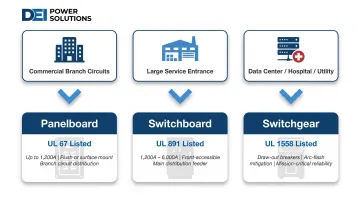
Hospital Emergency Panel: A 400A branch circuit panel uses a UL 67-listed panelboard with NEMA 1 enclosure.
Data Center Primary Distribution: A 3,000A feed across multiple racks requires UL 1558-listed switchgear with draw-out breakers and arc-flash mitigation.
Supplier Engineering Support Matters
On new installs, configuration errors caught before fabrication are far less costly than field corrections. Look for suppliers who offer:
- Clear documentation and accurate configuration guidance
- In-house engineering review before production
- Load calculation verification
- Documentation support for AHJ submittal
Conclusion
Choosing the right switchgear or panelboard for a 2026 installation is, at its core, a risk management decision — one that affects project timelines, code compliance, and long-term operational reliability. With data center and grid infrastructure investment at record levels, supply chain constraints persist, making lead times, engineering support, and manufacturing origin as critical as product specifications.
When evaluating suppliers, go beyond voltage and ampacity ratings. The right partner should meet these criteria:
- Delivers on schedule with transparent lead times
- Offers custom configurations for non-standard specs and layouts
- Supports AHJ approval processes with proper documentation
- Manufactures domestically with traceable, code-compliant components
For projects requiring UL 891-certified, USA-manufactured switchboards built to exact specs and shipped in days — not weeks — contact DEI Power at (866) 773-8050 or sales@deipower.com for a quote and engineering consultation.
Frequently Asked Questions
What is the difference between a switchgear panel and a breaker panel?
A breaker panel (panelboard or load center) distributes power to branch circuits from a wall-mounted enclosure rated up to 1,200A. Switchgear is a larger, fully enclosed primary distribution system with higher current ratings (up to 6,000A), draw-out breakers, and the ability to isolate sections for maintenance without a full shutdown.
What are the different types of switchgear panels?
For low-voltage new installs, the main categories are:
- Metal-enclosed switchgear: Fixed or removable components, less compartmentalization, suited for low-voltage distribution
- Low-voltage switchboards: Floor-mounted, high-ampacity main distribution (1,200A–5,000A), UL 891 listed
- Panelboards: Wall-mounted branch circuit distribution up to 1,200A, UL 67 listed
Metal-clad switchgear (draw-out breakers, medium-voltage) is a separate class used in utility and industrial primary distribution. Selection depends on voltage class, fault current level, and maintenance requirements.
What is industrial switchgear?
Industrial switchgear is heavy-duty primary distribution equipment used in manufacturing plants, utilities, and process facilities. It's rated for high fault currents and designed for environments where sections must be isolated for maintenance without shutting down the full system — keeping operations running in facilities where downtime isn't an option.
What is UL 891 certification and why does it matter for new installs?
UL 891 is the UL standard for dead-front switchboards, confirming equipment meets safety, performance, and construction requirements for low-voltage power distribution (1,000V or less). AHJs and inspectors typically require UL 891 listing for switchboards used in commercial and industrial new construction.
How do I choose between a switchboard and a panelboard for my project?
Panelboards suit secondary branch circuit distribution in most commercial builds (up to 1,200A, wall-mounted, front-access only). Switchboards are appropriate for larger service entrances or main distribution points (1,200A–5,000A) where more circuit capacity, higher ampacity, and floor-mounted installation with front-and-rear access are needed.
What certifications should I look for when buying switchgear for a new electrical installation?
Key certifications include UL 891 (low-voltage switchboards), UL 1558 (low-voltage switchgear), UL 67 (panelboards), NEMA ratings for enclosure protection (Type 1, 3R, 4, 4X, 12), and NEC compliance. Projects using federal or public funding may also require BABA (Buy America Build America) compliance.