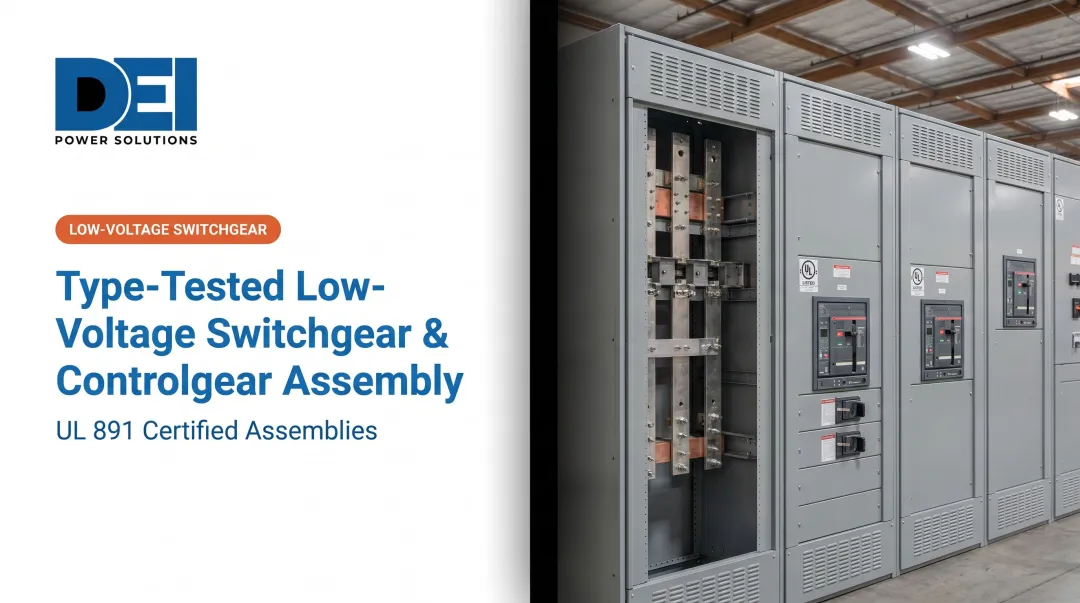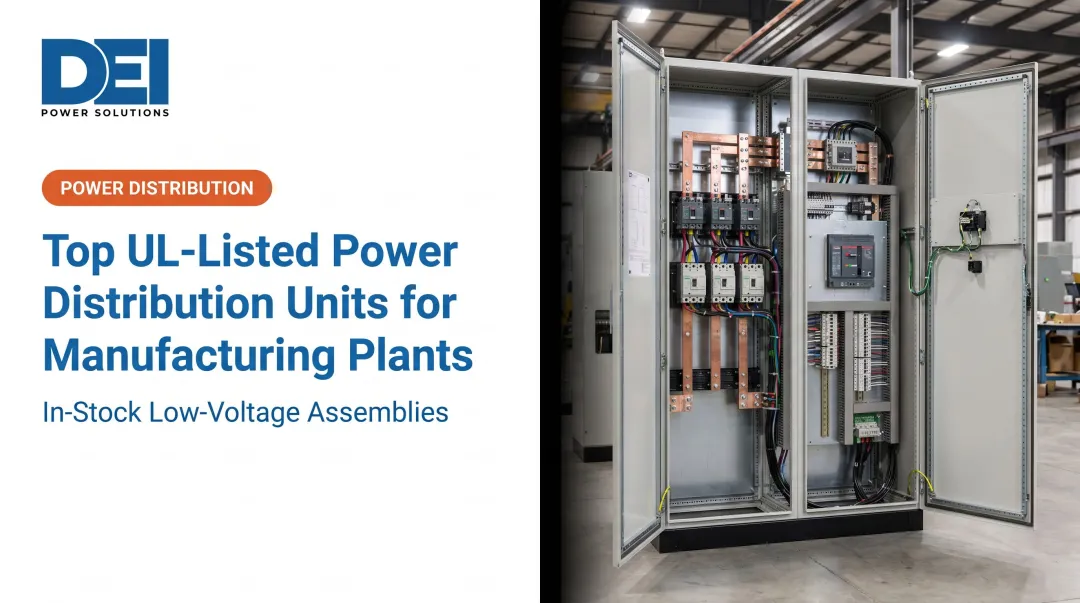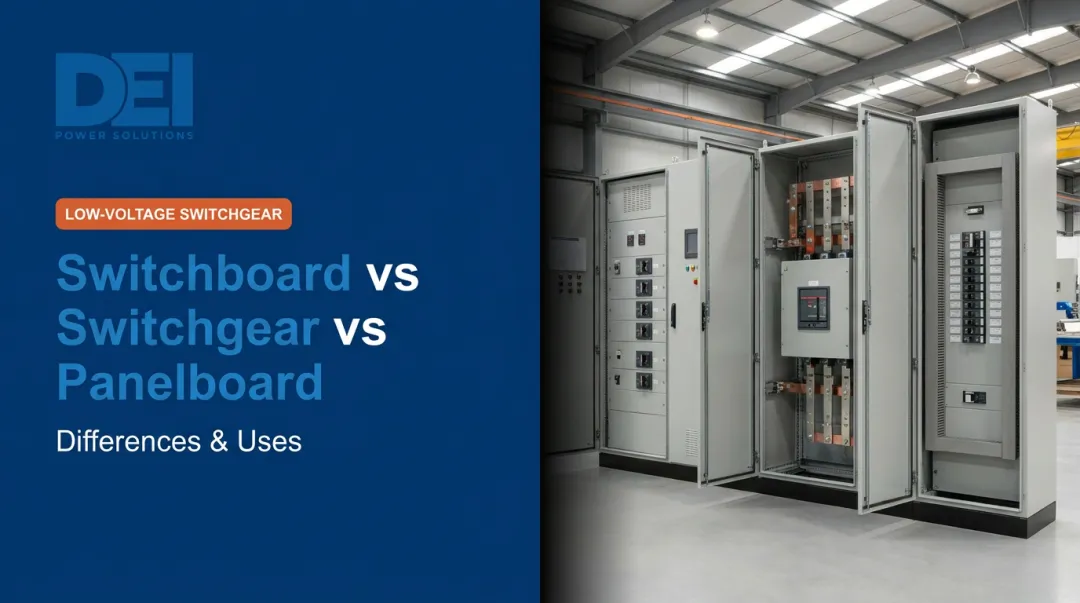
In electrical distribution, "Equipment Group 400A" refers to the amperage rating tier for low-voltage switchboard assemblies — specifically, switchgear rated to handle 400 amperes of continuous current. The 400A designation marks the entry point of the heavy-duty switchgear range, covering the configurations most commonly specified for mid-size commercial buildings, light industrial facilities, and branch distribution panels.
This guide covers what 400A switchgear includes, how it compares to higher-ampacity equipment groups, which applications it fits best, and how to order a code-compliant assembly from DEI Power.
TLDR:
- 400A is the minimum ampacity tier for UL 891-certified low-voltage switchgear — one step above standard panelboards
- A 400A switchboard includes a main breaker or main lugs, branch circuit positions, metering provisions, and copper bus bars rated to 480V or 208V/120V systems
- DEI Power manufactures 400A assemblies with Siemens components, UL 891 certification, and BABA-compliant construction at its Ontario, California facility
- In-stock 400A units ship in 3-5 business days with free shipping nationwide
- For loads approaching or exceeding 320A continuous, or projects with significant expansion plans, stepping up to 600A-800A or higher is the right call
What Is a 400A Switchgear Assembly?
In low-voltage power distribution, 400A identifies the main bus rating of a switchboard assembly — the maximum continuous current the equipment is built to carry. At this capacity tier, the gear steps beyond a standard residential or light-commercial panelboard into purpose-built, engineered distribution equipment designed for sustained, high-demand operation.
A 400A assembly is not a single fixed product. It defines a capacity tier within which manufacturers configure assemblies to specific project requirements. Bus material, interrupt ratings, breaker types, and enclosure construction all vary based on application. What remains constant is the continuous current rating — 400 amperes — and the requirement for UL 891 certification, which governs the construction and safety testing of low-voltage switchboards in commercial and industrial use.
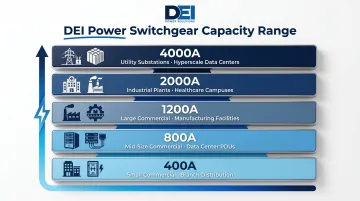
How 400A fits within the broader switchgear range:
DEI Power manufactures UL 891-certified switchboards from 400A through 4000A. The 400A group serves projects where load requirements don't demand larger gear but still require a certified, engineered assembly — not a standard panelboard. Typical applications include:
- Secondary distribution in commercial office or retail buildings
- Power feeds to mechanical rooms and HVAC equipment
- Substation output panels in light industrial settings
- Tenant metering and distribution in multi-unit facilities
Understanding where 400A sits in the capacity range helps engineers and contractors specify the right equipment from the start. Undersizing creates compliance and safety problems; oversizing adds unnecessary cost. Getting the ampacity tier right is the first decision in any switchgear specification.
400A Switchgear Specifications and Configuration
In electrical distribution, 400A switchgear marks the entry point for serious commercial and industrial power capacity. It is the minimum rating that most commercial construction specs require, and it is where the conversation shifts from residential panelboards to purpose-built, UL 891-certified switchboards designed for continuous, high-demand loads.
DEI Power's 400A switchgear lineup is built with Siemens components, manufactured in-house at its Ontario, California facility, and certified to UL 891 — the governing standard for low-voltage switchboards used in commercial, industrial, and utility applications.
What a 400A Switchgear Configuration Includes
A standard 400A switchgear assembly from DEI Power is a pre-configured, code-compliant unit ready for immediate deployment. Core components include:
Electrical Ratings and Bus Configuration:
- 400A continuous current rating
- 208V, 480V, or 600V voltage configurations (specify at order)
- Copper bus bars with tin-plated connections
- Interrupting capacity rated to project specification
- UL 891 listed and labeled
Enclosure and Construction:
- NEMA 1 (indoor) standard; NEMA 3R available for outdoor or weatherproof applications
- Steel construction with powder-coat finish
- Front-accessible for single-wall installation
- Modular design for future expansion
Protective Devices and Distribution:
- Main breaker or main lug configurations available
- Branch circuit breaker positions sized to project load schedules
- Optional ground fault protection, surge protective devices (SPDs), and metering
Documentation and Compliance:
- UL 891 certification documentation included
- Single-line diagrams, nameplate data, and as-built drawings
- BABA (Buy America Build America) compliant — manufactured in the USA
400A vs. Higher-Ampacity Equipment Groups: Key Differences
What "Equipment Group" Means in Switchgear
In low-voltage switchgear, an equipment group designation refers to a pre-engineered assembly configuration defined by its bus ampacity, interrupting ratings, breaker arrangement, and available options. The 400A designation identifies the main bus rating: the maximum continuous current the assembly is built to carry.
This matters because specifying the wrong ampacity group affects more than cost. It affects code compliance, upstream protection coordination, and the ability to add loads later without replacing the gear.
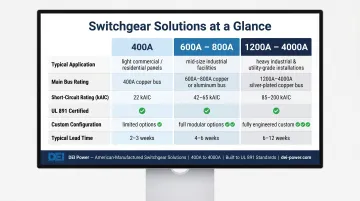
Ampacity Group Comparison
The table below compares 400A switchgear against common higher-ampacity configurations across the criteria that matter most to engineers and contractors:
| Specification | 400A Group | 600A-800A Group | 1200A-4000A Group |
|---|---|---|---|
| Typical Application | Branch distribution, smaller commercial loads | Mid-size commercial, light industrial | Data centers, industrial plants, utility substations |
| Main Bus Rating | 400A continuous | 600-800A continuous | 1200-4000A continuous |
| Short-Circuit Rating (kAIC) | Up to 65 kAIC | Up to 100 kAIC | Up to 200 kAIC |
| UL 891 Certified | Yes | Yes | Yes |
| Custom Configuration | Available | Available | Available |
| Typical Lead Time (DEI Power) | In-stock / 3-5 business days | In-stock / 3-5 business days | Custom build - contact for timeline |
When 400A Is the Right Choice
A 400A switchgear assembly fits most branch distribution applications where the connected load does not exceed roughly 160-200 kW at 480V (accounting for standard demand factors). These assemblies are commonly specified as 400A switchboards for secondary distribution in commercial and light industrial settings. Common installations include:
- Smaller commercial buildings and tenant distribution panels
- Healthcare facility branch circuits and isolated power systems
- Light manufacturing and process support loads
- Secondary distribution in larger facilities fed from higher-ampacity gear upstream
If the load schedule stays consistently below that threshold and future expansion is limited, 400A equipment delivers a right-sized, cost-efficient solution without oversizing the gear.
When to Step Up to a Higher Ampacity Group
Upgrading to 600A or above makes sense when any of the following apply:
- Connected load projections exceed 400A demand at the distribution point
- The facility has significant motor loads with high inrush current
- Future capacity additions are likely within 5-10 years
- The upstream service or transformer exceeds 400A capacity
Undersizing switchgear to save upfront cost creates a far more expensive problem: replacing the entire assembly when loads grow. Stepping up one ampacity tier is almost always cheaper than a mid-project changeout.
The Decision Point
For most branch distribution and mid-size commercial applications, 400A switchgear covers the load with room to spare. If the project scope includes heavy industrial loads, data center infrastructure, or planned expansion, a higher ampacity group is the better long-term investment.
When in doubt, DEI Power's engineering support team can review a load schedule and recommend the right ampacity before the order is placed, not after equipment arrives on the jobsite.
Applications for 400A Switchgear
Commercial Buildings and Tenant Distribution
400A switchboards are a standard specification in commercial office, retail, and multi-tenant buildings where individual tenant feeds or floor-level distribution panels fall within the 400A range. These assemblies handle secondary distribution from a higher-ampacity main switchboard, routing power to tenant spaces, lighting panels, and mechanical equipment.
In tenant improvement projects, 400A gear offers a cost-effective solution for new fit-outs that need a certified, code-compliant assembly without the footprint or cost of larger gear. DEI Power's BABA-compliant construction is an advantage on federally funded commercial projects where domestic manufacturing is required.
Light Industrial and Manufacturing
Light manufacturing facilities — machine shops, assembly operations, food processing — frequently specify 400A switchboards for subpanel feeds, dedicated equipment circuits, and power factor correction distribution. The 400A tier covers most single-production-line applications and process support loads without requiring the larger assemblies used for full-floor industrial distribution.
Healthcare Facilities
Healthcare facilities require switchgear that meets strict code compliance and documentation requirements. DEI Power's UL 891-certified 400A assemblies include full submittal packages with single-line diagrams and nameplate data, supporting the documentation requirements of hospital and clinic electrical systems. For branch distribution feeding isolated power systems or medical equipment panels, 400A is a common specification.
Data Centers and Colocation Facilities
In data center environments, 400A switchboards serve as secondary distribution equipment — feeding rows of remote power panels (RPPs) or PDU feeds from higher-ampacity main switchgear. DEI Power manufactures both UL 891 switchboards and Remote Power Panels in the 225A-1200A range, allowing data center operators to source coordinated primary and secondary distribution from a single manufacturer.
For AI compute halls and hyperscale facilities where load density is high, the 400A tier typically handles branch-level feeds rather than primary distribution, but it remains a high-volume specification for mid-tier colocation build-outs. Projects that require higher interrupting capacity or larger bus ratings can step up to DEI Power's 1200A 480V switchboard configurations.
How to Order 400A Switchgear from DEI Power
DEI Power maintains in-stock inventory of pre-configured 400A switchboard assemblies at its 50,000 sq. ft. facility in Ontario, California. In-stock units ship within 3-5 business days with free shipping nationwide — one of the shortest lead times in the domestic switchgear market.
Ordering process:
- Confirm your load schedule — verify that your calculated demand load at the distribution point is within the 400A continuous rating (and accounts for the NEC's 80% continuous load rule, which sets the effective limit at 320A for continuous loads)
- Specify voltage and configuration — 208V/120V or 277V/480V; main breaker or main lug; NEMA 1 or NEMA 3R enclosure
- Request a quote — contact DEI Power's sales team for current availability, custom configuration options, and pricing
- Submit project documentation — for custom builds, DEI Power's engineering team reviews load schedules, single-lines, and spec sheets to confirm configuration before production
Contact DEI Power:
- Phone: (866) 773-8050
- Email: sales@deipower.com
Custom configurations are available for non-standard voltage, breaker layouts, metering requirements, or enclosure types. DEI Power's in-house manufacturing means custom builds move faster than sourcing from a distributor — with direct engineering support from specification through delivery.
Frequently Asked Questions
What is a 400A switchgear assembly?
A 400A switchgear assembly is a low-voltage distribution system rated for 400 amperes of continuous current. It routes, protects, and controls power across circuits in commercial, industrial, and utility applications. DEI Power's 400A units are UL 891 certified and built with Siemens components.
What are the standard specifications for a 400A switchboard?
DEI Power's 400A switchboards are configured to the following standard specs:
- Voltage: 120/208V or 277/480V, 3-phase, 4-wire
- Interrupting rating: 65kAIC or higher (application-dependent)
- Certification: UL 891 listed
- Busbars: Copper, tin-plated
- Enclosure: NEMA 1 standard; NEMA 3R available for outdoor or wet locations
Custom configurations - including breaker layouts, metering, and voltage - are available upon request.
How does a 400A switchboard differ from a 600A or 800A unit?
The primary difference is load capacity. A 400A unit suits smaller commercial buildings, light industrial spaces, or branch distribution. A 600A or 800A unit handles heavier loads - larger facilities, data center rows, or multi-tenant buildings. DEI Power manufactures switchgear from 400A through 4000A, so the right size depends on the calculated load and future expansion plans.
What certifications does DEI Power's 400A switchgear carry?
All DEI Power switchboards are UL 891 listed and built as an approved Siemens OEM. Units are manufactured in Ontario, California with Buy America Build America (BABA)-compliant construction - a requirement for many federally funded projects.
What is the lead time for a 400A switchboard from DEI Power?
In-stock 400A units ship within 3-5 business days with free shipping included. Custom-configured assemblies vary by scope, but DEI Power's in-house manufacturing and 50,000 sq. ft. facility in Ontario, California keep lead times shorter than most competitors. Contact the sales team at (866) 773-8050 or sales@deipower.com for a project-specific timeline.
What is the difference between a switchboard and a panelboard?
A switchboard is a larger, free-standing assembly designed for high-current distribution, typically 400A and above. It is front-accessible, UL 891 certified, and built with heavier bus structures and more protective device positions than a panelboard. A panelboard is a flush or surface-mounted enclosure used for branch circuit distribution at lower ampacity levels. For commercial and industrial projects where the service or feeder exceeds 200-225A, a switchboard is the standard specification.