Introduction
Contractors and engineers specifying 480V switchboards for commercial or industrial projects often discover mid-project that ground fault protection of equipment (GFPE) is a code requirement — and that a non-compliant switchboard can trigger costly rework, failed inspections, and project delays. Construction rework costs the U.S. industry an estimated $31.3 billion annually, with design-related errors and code compliance gaps accounting for 52% of all rework causes.
Non-home electrical fires involving distribution and lighting equipment cause approximately $718 million in property damage each year, with arcing involved in 46% of fires caused by electrical failure.
On 480V systems specifically, ground faults represent 95-98% of all power system faults. Many of these low-level arcing faults flow undetected through standard overcurrent devices, burning insulation, damaging bus bars, and creating fire risk before a conventional breaker ever trips.
Understanding where the code draws the line is the first step to getting it right. This guide covers the NEC articles that govern GFPE at switchboards, the specific voltage and amperage thresholds that trigger the requirement, the recognized exceptions, and what all of this means when specifying or procuring a switchboard.
TLDR: Ground Fault Protection at Switchboards in Brief
- NEC 230.95 mandates GFPE on solidly grounded wye disconnects rated 1,000A+ where voltage exceeds 150V to ground but stays below 600V phase-to-phase.
- NEC 215.10 and 240.13 extend the same GFPE threshold to feeder and building main disconnects.
- 208Y/120V systems are exempt — voltage to ground is only 120V.
- Multiple exceptions exist including fire pumps, emergency systems, and continuous industrial processes.
What Is Ground Fault Protection of Equipment (GFPE)?
Per NFPA 70, ground fault protection of equipment is defined as "a system intended to provide protection of equipment from damaging line-to-ground fault currents by operating to cause a disconnecting means to open all ungrounded conductors of the faulted circuit."
A ground fault itself is "an unintentional, electrically conductive connection between an ungrounded conductor of an electrical circuit and the normally non-current-carrying conductors, metallic enclosures, metallic raceways, metallic equipment, or earth."
GFPE vs. GFCI: Different Devices, Different Mandates
GFPE is frequently confused with GFCI (Ground Fault Circuit Interrupter), but they serve fundamentally different purposes:
| Feature | GFCI (Class A) | GFPE |
|---|---|---|
| Purpose | Personnel protection | Equipment protection |
| Trip threshold | 4-6 milliamps | Up to 1,200A maximum |
| Time delay | No intentional delay | Up to 1 second (for faults ≥3,000A) |
| Application | Branch-circuit receptacles | Service/feeder disconnects ≥1,000A |
| UL standard | ANSI/UL 943 | UL 1053 |
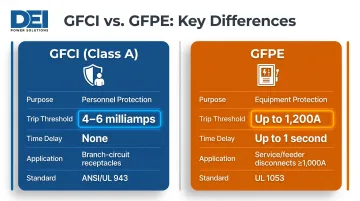
The trip threshold gap — milliamps versus hundreds of amps — reflects a completely different protection goal. Mixing them up in a specification or installation is a code violation with real consequences. That distinction matters most when you understand the specific hazard GFPE was designed to address.
The Core Hazard: Low-Level Arcing Ground Faults
On solidly grounded wye systems (277/480V), arcing ground faults may not draw enough current to trip standard overcurrent protective devices (OCPDs), yet they release enough energy to cause extensive equipment damage. Engineering standards cap tolerable exposure at 20,000 kilowatt-cycles (equivalent to 200,000 ampere-cycles at 100V arcing voltage).
The maximum available ground-fault current is approximately one-third the phase-to-phase fault current value. Standard breakers often don't respond at that level — allowing the fault to persist, build heat, and escalate before anyone intervenes.
How GFPE Works:
GFPE monitors the difference between current entering and leaving a circuit. When an imbalance exceeds the set threshold, the system triggers disconnection. Key operating parameters per NEC:
- Trip threshold: not greater than 1,200A
- Maximum time delay: 1 second for fault currents of 3,000A or greater
- Activation: opens all ungrounded conductors of the faulted circuit simultaneously
NEC Articles Governing GFPE at Switchboards
The NEC has progressively expanded GFPE requirements across five distinct application points — services (1971), feeders (2008), branch circuits (2014), and DC systems (2026). Each article targets a specific disconnect type and voltage range, so knowing which one applies to your installation determines both your compliance obligations and your equipment specifications.
NEC 230.95: Services (Primary GFPE Requirement)
GFPE shall be provided for solidly grounded wye electric services of more than 150 volts to ground but not exceeding 600 volts phase-to-phase for each service disconnect rated 1,000 amperes or more.
Performance requirements:
- Maximum pickup setting: 1,200A
- Maximum time delay: 1 second (60 cycles) for ground-fault currents of 3,000A or greater
Exception: GFPE is not required for a service disconnect for a continuous industrial process where a nonorderly shutdown will introduce additional or increased hazards.
Note: The 2026 NEC raises the phase-to-phase ceiling to 1,000V and adds DC system requirements.
NEC 215.10: Feeders
Each feeder disconnect rated 1,000A or more on qualifying systems shall have GFPE. The continuous industrial process exception applies. An additional exception permits temporary feeder conductors used for generators during repair, maintenance, or emergencies for up to 90 days.
Critical cascade rule: When GFPE is already provided at the service level, downstream feeder disconnects are generally exempt — except in healthcare facilities.
NEC 240.13: Building/Structure Main Disconnecting Means
This article covers a distinct scenario: where a building or structure has its own main disconnecting means separate from the service. GFPE shall be provided for solidly grounded wye systems of more than 150V to ground but not exceeding 1,000V phase-to-phase for each individual device used as a building or structure main disconnecting means rated 1,000A or more.
Note the 1,000V ceiling — higher than 230.95's 600V ceiling in pre-2026 editions. This extends GFPE requirements to higher-voltage low-voltage systems at building disconnects that 230.95 would not otherwise capture.
NEC 517.17: Healthcare Facilities
Where GFPE is provided at the service or main, ground fault relays must also be placed on the next level of feeders. The separation between relay time bands must be at least six cycles to achieve coordination.
Why this matters: In healthcare, an uncoordinated ground fault trip at the service level could de-energize life-safety loads. The six-cycle separation ensures that a feeder-level fault trips the feeder relay before the service relay operates, preserving power to unaffected circuits.
Section 517.17 prohibits installing additional levels of ground-fault protection on the load side of an essential electrical system transfer switch.
NEC 210.13: Branch-Circuit Disconnects
Added in the 2014 NEC, this article extends GFPE requirements to each branch-circuit disconnect rated 1,000A or more on qualifying systems (exceeding 150V to ground but not exceeding 1,000V phase-to-phase). The continuous industrial process exception applies.
The Three Conditions That Trigger GFPE at a Switchboard
All three conditions must be simultaneously true for GFPE to be required. If any one condition is not met, the requirement does not apply.
Condition 1: System Type — Solidly Grounded Wye
GFPE applies only to solidly grounded wye (Y) systems. Delta systems — whether grounded or ungrounded — do not trigger the requirement. Resistance- or impedance-grounded systems are also exempt.
The most common qualifying system in commercial and industrial switchboard applications is the 277/480V, 3-phase, 4-wire wye system.
Condition 2: Voltage to Ground — More Than 150V
The voltage threshold is measured to ground, not phase-to-phase. This is one of the most common sources of misapplication in the field.
Voltage-to-ground values by system:
- 208Y/120V system: 120V to ground — does NOT exceed 150V threshold, so GFPE is not required
- 277/480V system: 277V to ground — EXCEEDS 150V threshold, so GFPE is required (if other conditions are met)
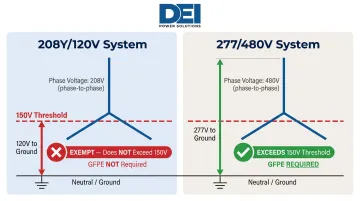
This is why GFPE is effectively a 480V switchboard issue.
Condition 3: Disconnect Rating — 1,000A or More
The 1,000A threshold applies to the rating of the disconnect, not the actual load current. A switchboard with a main breaker rated at 1,000A or more on a qualifying system requires GFPE regardless of its actual loading.
Design strategy — the Six-Disconnect Rule: NEC 230.71 permits a service to be split into six or fewer disconnects grouped together. A 4,000A service can be split into five 800A switches. Each disconnect stays below the 1,000A threshold, avoiding the GFPE requirement entirely.
Important caveat: While this approach is code-compliant, it eliminates GFPE protection for the entire service. Given that 95-98% of power system faults are line-to-ground, this design choice trades first-cost savings for long-term fire risk. NEC 240.13 may still require GFPE at downstream building disconnects rated 1,000A or more — so the exposure isn't always eliminated, just shifted.
When Ground Fault Protection Is NOT Required: Key Exceptions
NFPA 70 includes specific carve-outs where GFPE would introduce more risk than it prevents. Applying GFPE where an exception exists is just as much a compliance error as omitting it where it's required.
Exception: Continuous Industrial Processes
NEC 230.95 Exception states: "The ground-fault protection requirements of this section shall not apply to a service disconnect for a continuous industrial process where a nonorderly shutdown will introduce additional or increased hazards."
Examples: Chemical processing, smelting operations, and steel mills where an unexpected power interruption could create a more dangerous condition than the ground fault itself.
Document the engineering judgment supporting this exception — inspectors will ask for it.
Exception: System Types Outside the Qualifying Voltage Band
Exempt system types:
- 208Y/120V systems — 120V to ground is below 150V threshold
- All single-phase services including 240/120V
- All delta systems (grounded, ungrounded, or corner-grounded)
- Resistance- or impedance-grounded systems
Exception: Fire Pumps, Emergency Systems, and Legally Required Standby
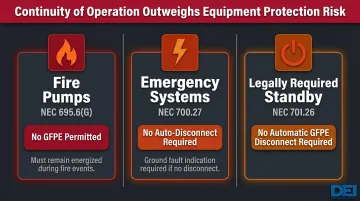
These systems share a common rationale: continuity of operation during an emergency outweighs the risk of equipment damage from an uncleared ground fault.
| Code Reference | System | GFPE Requirement |
|---|---|---|
| NEC 695.6(G) | Fire pump power circuits | No GFPE permitted — must remain energized during fire events |
| NEC 700.27 | Emergency system alternate sources | No automatic disconnect required; ground fault indication required if no auto-disconnect |
| NEC 701.26 | Legally required standby alternate sources | No automatic GFPE disconnect required |
Exception: Downstream Feeders When Service Already Has GFPE
Once GFPE is provided at the service level, downstream feeder disconnects on the same system are generally not required to duplicate the protection — except in healthcare facilities per Article 517.17, where selective coordination across levels is mandatory.
Understanding where GFPE is not required is as important as knowing where it is — both sides of that equation affect your switchboard configuration and code compliance.
Implementing GFPE in Your Switchboard Specification
Two Primary Implementation Approaches
Method 1: Integral GFPE Built into Main Circuit Breaker
The trip unit within the breaker accepts inputs from internal sensors (residual sensing) or external zero-sequence CTs and initiates a trip directly. Factory-integrated GFPE delivers better accuracy, coordination, and UL listing compliance than field-assembled alternatives.
Method 2: External Ground Fault Relay + CT + Shunt-Trip Assembly
A separate ground fault relay monitors a current transformer installed on the neutral-to-ground bond or around all phase and neutral conductors. When the relay detects a fault exceeding the pickup setting, it signals a shunt-trip mechanism on the main disconnect to open. This method is typical for fused switches or older breaker installations.
Three Sensing Methods
- Residual sensing: Individual CTs on each phase and neutral; relay sums currents and identifies residual as ground fault current
- Zero-sequence sensing: All conductors pass through a single CT window; the CT directly measures net imbalance
- Ground-return (source) sensing: A CT on the neutral-to-ground bond senses actual ground current returning to the source
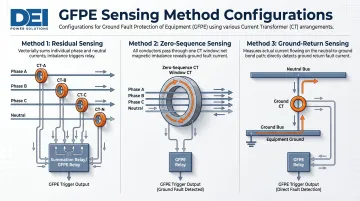
What Specifiers Need to Provide
When ordering a switchboard with GFPE, provide:
- Pickup current setting (typically approximately 10% of main disconnect rating; code maximum is 1,200A)
- Time-delay setting (code maximum is 1 second for faults ≥3,000A; settings should coordinate with downstream devices)
- Neutral monitoring configuration (whether neutral CT is required; neutral grounding location)
- Coordination requirements with upstream or downstream protection
- 4-pole vs. 3-pole ATS coordination (if generators are present: separately derived sources require 4-pole ATS to switch neutral)
DEI Power's UL 891-certified switchboards ship with GFPE settings factory-configured to project specifications. In-house engineering support handles the coordination analysis before the board leaves their Ontario, California facility, which means fewer field adjustments and fewer change orders on commissioning day.
NEC 230.95(C): Performance Testing Requirement
Once specification decisions are finalized, the next obligation is mandatory acceptance testing before the system goes live.
Exact NEC text: "GFPE testing shall be conducted by a qualified person using primary current injection, in accordance with instructions that are provided with the equipment. A written record of this testing shall be made and shall be available to the authority having jurisdiction."
Key implementation points:
- Push-to-test buttons do NOT satisfy the 230.95(C) requirement because they only test a portion of the system components
- Avoid secondary injection for acceptance testing — it does not verify CT installation and wiring
- Primary current injection is the only effective method — it verifies the relay/trip unit, control power, wiring, and external CT, including both trip and non-trip tests to confirm CT polarity
- Complete testing before energizing the system
- Most AHJs require a third-party electrical testing company to conduct and document the work
Specifiers should confirm that the switchboard manufacturer provides documentation supporting commissioning and testing procedures.
Frequently Asked Questions
When must the service equipment be provided with ground fault protection?
Service equipment must have GFPE when the main disconnect is rated 1,000A or more, the system is a solidly grounded wye, and the voltage to ground exceeds 150V but does not exceed 600V phase-to-phase — as required by NEC Article 230.95.
What is the NEC code for ground fault protection?
The key NEC articles are 230.95 (services), 215.10 (feeders), 240.13 (building main disconnects), 210.13 (branch-circuit disconnects), and 517.17 (healthcare facilities).
What is the difference between GFCI and GFPE?
GFCI (Ground Fault Circuit Interrupter) protects personnel and trips at 4–6 milliamps. GFPE (Ground Fault Protection of Equipment) protects electrical equipment and operates at much higher fault current thresholds — up to 1,200A — with a built-in time delay.
Does a 208Y/120V system require ground fault protection at the switchboard?
No — a 208Y/120V system has a voltage to ground of 120V, which does not exceed the 150V threshold required to trigger GFPE under NEC 230.95 or 215.10.
What are the most common exceptions to NEC ground fault protection requirements?
The most frequently applicable exceptions are disconnects rated below 1,000A, 208Y/120V and single-phase systems, delta systems, fire pump disconnects, emergency system alternate sources, and feeders downstream of a service that already has GFPE (outside of healthcare).
How does GFPE coordinate between the service and feeder levels in a switchboard?
When both levels have GFPE, their time-current settings must be coordinated so a feeder fault trips the feeder relay before the service relay responds. NEC 517.17 requires at least six cycles of separation between relay bands — mandatory in healthcare, recommended practice elsewhere.