Introduction
When a switchboard fails inspection or gets rejected by a utility, the consequences go far beyond a minor delay. Projects grind to a halt. Rework costs escalate. Safety liability becomes very real. For engineers, contractors, and facility teams specifying or purchasing low-voltage switchboards, understanding UL 891 isn't optional—it determines whether projects stay on schedule or spiral into costly rework.
Key Takeaways
- UL 891 covers dead-front distribution switchboards rated ≤1,000 V and <200,000 A interrupting capacity
- Compliance simplifies AHJ inspections, reduces liability, and ensures operational reliability
- UL 67 covers lighter panelboards; UL 1558 governs heavy industrial switchgear with draw-out breakers
- Always specify "UL 891 listed and labeled" explicitly—not just "built to UL 891 standards"
- Verify active UL listings and request utility-specific documentation from suppliers
What Is UL 891? Definition, Scope, and Purpose
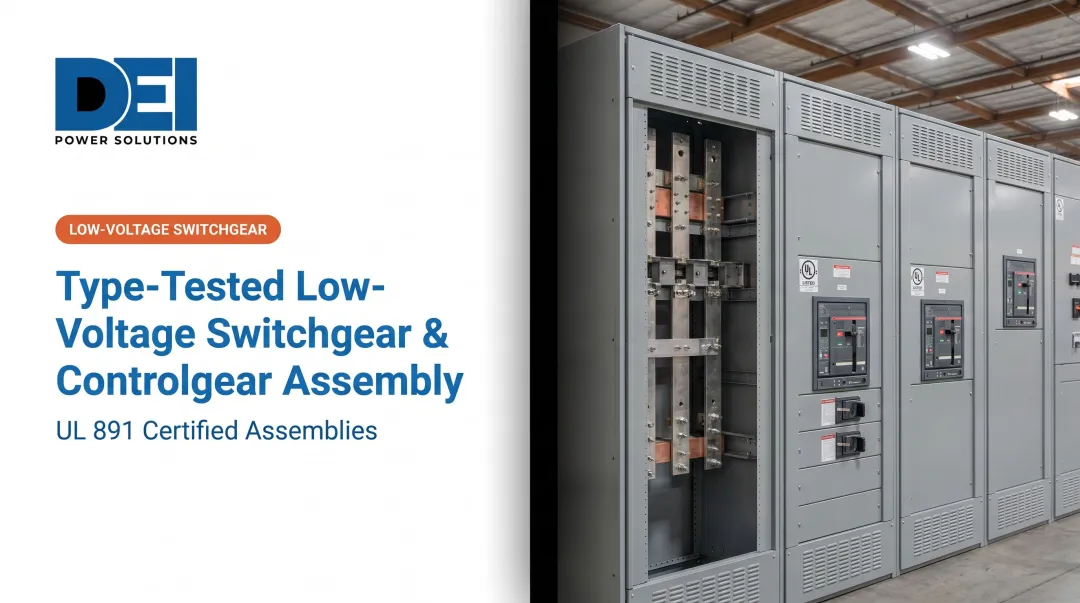
UL 891 is the Underwriters Laboratories safety standard for switchboards rated at nominal voltages of 1,000 V or less and designed for circuits with available short-circuit currents not exceeding 200,000 amperes. The standard specifically addresses dead-front switchboards—meaning no live electrical parts are exposed on the front panel, a fundamental design requirement for operator safety.
Relationship to the NEC and International Codes
UL 891 operates in parallel with NEC Article 408 (Switchboards, Switchgear, and Panelboards) and is aligned with the Canadian Electrical Code Part I, IEC 60364, and Mexican NOM-001-SEDE. This broad applicability makes UL 891 the foundation for U.S. and cross-border power distribution projects.
What UL 891 Does NOT Cover
UL 891 explicitly excludes:
- Live-front switchboards
- Switchboards with short-time current ratings
- Theater (preset/dimmer control) switchboards
- Railway control or electrification switchboards
- Assemblies intended solely for motor control centers (MCCs)
If your project involves these applications, UL 891 does not apply—different standards govern those equipment types.
Who Develops and Maintains UL 891
UL Solutions (formerly Underwriters Laboratories) develops UL 891 through a consensus process accredited in both the U.S. and Canada. The standard is copublished by UL, CSA Group, and ANCE, and is periodically updated. Always reference the current edition (Edition 12, published 2019) when writing RFQs or reviewing submittals.
Types of Assemblies UL 891 Governs
UL 891 covers a broad range of low-voltage metal-enclosed switchgear assemblies, including:
- Dead-front distribution switchboards
- Air-insulated switchgear
- Metal-clad switchgear configurations
For commercial, industrial, and utility applications—the segments where dead-front switchboards are most common—this scope covers the vast majority of low-voltage distribution needs.
What Does UL 891 Cover? Key Requirements Explained
Design Parameters and Physical Layout
UL 891 mandates minimum conductor spacing requirements to prevent arcing or short circuits. Physical layout rules govern safe access configurations—both front-access and rear-access designs—while enclosure rating requirements are tied to installation environment. For example:
- NEMA 1: Indoor dry locations
- NEMA 3R: Outdoor exposure with protection from rain, sleet, and snow
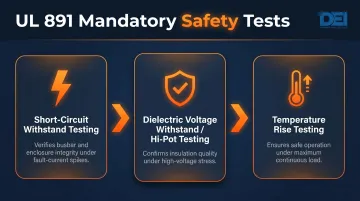
Mandatory Safety Testing
Before a switchboard can receive a UL listing label, it must pass extensive safety testing:
- Short-circuit withstand testing: Simulates fault-current spikes to verify busbar and enclosure integrity
- Dielectric voltage withstand (hi-pot) testing: Confirms insulation quality under high-voltage stress
- Temperature rise testing: Ensures safe operation under maximum continuous load conditions
Together, these tests cover the three most common failure modes a switchboard will encounter over its service life.
Construction, Materials, and Labeling Requirements
UL 891 requires every component — busbars, wires, circuit breakers, and terminals — to carry UL recognition and meet benchmarks for conductivity, insulation, and flammability. Copper and aluminum busbars must hit minimum conductivity thresholds, while insulating materials must resist both fire and mechanical stress.
Grounding and labeling requirements are equally specific:
- All exposed metal parts must be bonded and grounded to redirect fault current safely
- Nameplates must display voltage ratings, current capacity, and short-circuit ratings
- Wiring diagrams must be included on or inside the enclosure
These markings give maintenance crews and inspectors the critical information they need at a glance — reducing risk during any future servicing or modification.
Annex G: Flexibility for Custom Configurations
Annex G (the General Coverage Program) allows manufacturers to produce customized switchboard configurations—different layouts, added metering, modular builds—without requiring a full UL re-evaluation each time, as long as changes stay within pre-approved component systems and design rules. This is particularly valuable for custom or high-volume projects where standard catalog units don't fit.
Critical Technical Ratings: Voltage, Fault Current, and Enclosures
Voltage Rating Scope
UL 891 applies to switchboards operating at nominal AC voltages up to 1,000 V. In practice, 600 V is the most common working voltage in U.S. commercial and industrial installations. Always verify the specific maximum voltage for your switchboard section as defined in the standard.
SCCR vs. AIC: Understanding the Difference
Two critical ratings govern fault protection:
- SCCR (Short-Circuit Current Rating): The maximum fault current the entire switchboard assembly can safely withstand at its incoming terminals—commonly rated at 42 kA, 65 kA, or up to 200 kA for demanding sites
- AIC (Ampere Interrupting Capacity): A per-breaker rating that must meet or exceed the available fault current at each individual breaker's installed point
Complete a short-circuit study before finalizing these values in any RFQ. Without accurate fault-current data, you risk under-specifying equipment that could fail dangerously under fault conditions.
Overcurrent Protection Devices
UL 891 requires molded-case circuit breakers (MCCBs) listed to UL 489. These are typically fixed-mounted (as opposed to the draw-out design used in UL 1558 switchgear). Every breaker in a UL 891 assembly must carry its own independent UL listing; inclusion in an assembly does not substitute for individual certification.
Enclosure Type Selection and NEC Article 408 Installation Rules
NEMA enclosure types must match your installation environment:
| NEMA Type | Environment | Protection |
|---|---|---|
| Type 1 | Indoor dry | Incidental contact, falling dirt |
| Type 3R | Outdoor | Rain, sleet, snow (not dust-tight) |
| Type 4/4X | Indoor/outdoor | Dust-tight, hose-directed water; 4X adds corrosion resistance |
| Type 12 | Indoor | Circulating dust, falling dirt, dripping non-corrosive liquids |
NEC Article 408 adds site-level installation requirements beyond enclosure selection:
- Install switchboards plumb and level with adequate working clearances on all sides
- Do not place in hazardous or corrosive locations unless the enclosure is specifically rated for that environment
- Follow utility grounding and bonding requirements for all service-entrance configurations
Benefits of UL 891 Compliance for Your Project
Simplified Permitting and Inspection
Authorities Having Jurisdiction (AHJs) recognize the UL mark, and NRTL-listed equipment is their primary basis for approval. In practice, that recognition means:
- Fewer back-and-forth cycles during inspections
- Lower likelihood of last-minute design changes
- Faster project timelines with fewer delays at the permit stage
Liability and Safety Benefits
Using UL 891-listed switchboards demonstrates due diligence in meeting national safety standards. This limits exposure to:
- Code violations
- Equipment failures
- Worker safety incidents, including arc flash and electrical shock caused by non-compliant designs
NFPA data shows that electrical distribution and lighting equipment caused an estimated 430 civilian deaths and 1,070 injuries annually in residential settings alone. In non-residential buildings, electrical failures caused an estimated 23 deaths and 200 injuries annually. These figures span all electrical distribution equipment — non-compliant installations contribute directly to that toll.
Operational Reliability Benefits
UL 891-compliant switchboards are tested for fault isolation, temperature management, and load performance. In practice, that means:
- Reduced unplanned downtime
- Extended equipment life
- Predictable maintenance schedules
For data centers, healthcare facilities, and manufacturing plants, avoiding a single unplanned outage can justify the compliance investment many times over.
UL 891 vs. UL 67 and UL 1558: Understanding the Differences
UL 891 vs. UL 67
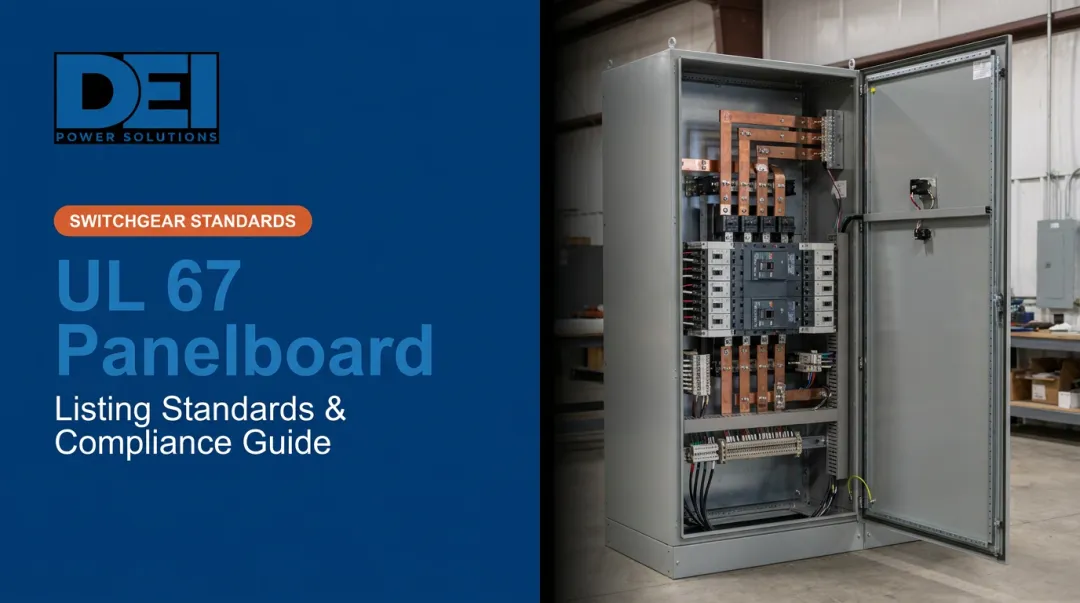
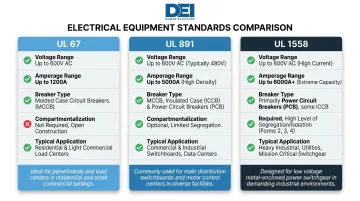
UL 67 is the standard for panelboards—wall-mounted units typically rated up to 1,200 A with breakers that snap onto the bus. UL 891 governs floor-standing switchboards that handle significantly higher amperage (up to 6,000 A) with bolted-on breakers.
Choose UL 67 panelboards for branch circuit distribution in smaller commercial spaces where wall mounting is practical and loads stay below 1,200 A. Step up to a UL 891 switchboard when your project demands higher amperage, a floor-standing footprint, or more complex distribution topology.
UL 891 vs. UL 1558
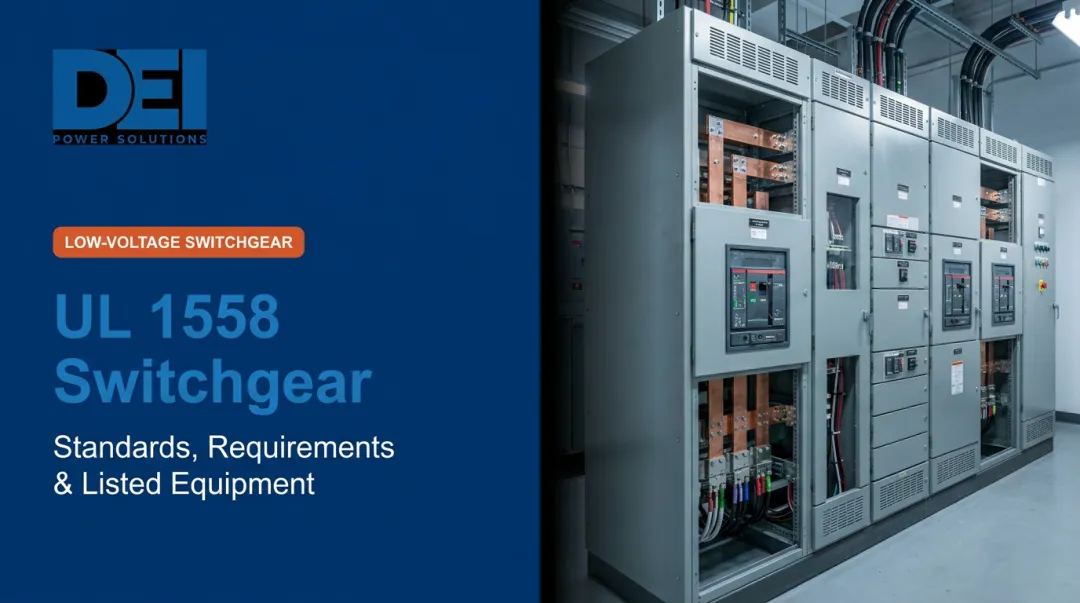
Where UL 891 covers most commercial and light industrial needs, UL 1558 covers metal-enclosed low-voltage power circuit breaker switchgear (up to 1,000 V AC) built for heavy industrial and mission-critical environments. The construction differences are substantial:
UL 1558 features:
- Individually compartmentalized draw-out breakers (tested to UL 1066) for live maintenance and higher continuity of service
- Insulated busbars with larger clearances
- Higher fault current interrupting capacity
- 30-cycle short-time withstand ratings
UL 891 features:
- Fixed-mounted MCCBs (UL 489)
- More compact footprint
- Lower initial cost
- Suited for commercial and light industrial applications that don't require draw-out breakers or elevated fault ratings
Decision Framework: UL 67 vs. UL 891 vs. UL 1558
| Standard | Voltage | Amperage Range | Breaker Type | Compartmentalization | Application |
|---|---|---|---|---|---|
| UL 67 | ≤600 V typical | Up to ~1,200 A | Plug-in MCCBs | No | Branch circuit distribution, wall-mounted |
| UL 891 | ≤1,000 V | Up to 6,000 A | Fixed/bolted MCCBs (UL 489) | No | Commercial/light industrial distribution, floor-standing |
| UL 1558 | ≤1,000 V | Up to 6,000 A+ | Draw-out power circuit breakers (UL 1066) | Yes | Heavy industrial, mission-critical infrastructure |
How to Specify and Source a UL 891 Switchboard
Essential RFQ Elements for UL 891 Compliance
Your specification must include:
- "UL 891 listed and labeled" stated explicitly (not "built to UL 891")
- Voltage and system configuration (e.g., 480Y/277V, 3-phase, 4-wire)
- Bus rating and material (copper vs. aluminum)
- SCCR and AIC requirements from the short-circuit study
- Metering and surge protection needs
- NEMA enclosure type (Type 1, 3R, 4, 12, etc.)
Critical: The nameplate on delivery must match the as-built documentation—this is how inspectors verify compliance.
Evaluating Manufacturers and Suppliers
Qualify suppliers on these criteria before issuing a purchase order:
- Manufacturer holds an active UL 891 listing (not just "compliant" or "built to UL 891" language)
- Ask whether they manufacture under an Annex G General Coverage file for layout flexibility
- Confirm they can provide utility-specific drawings if EUSERC compliance is required by the local utility (applies to 80+ utilities across 14 western U.S. states)
- Check whether they offer domestic manufacturing for BABA-compliant projects
DEI Power, for example, manufactures UL 891-certified switchboards in a 50,000 sq. ft. facility in Ontario, California as an approved Siemens OEM—with in-house engineering support, domestic manufacturing for BABA-compliant projects, and fast turnaround for time-sensitive bids.
Red Flags That Indicate Non-Compliance
Once you know what a qualified supplier looks like, the red flags become easier to spot. Avoid suppliers who exhibit these warning signs:
- Switchboards labeled as "manufactured to UL 891 standards" without an actual UL listing label
- Missing or incomplete nameplate documentation
- Inability to provide third-party test records
- No record of successfully completing utility inspections in EUSERC regions
Equipment without NRTL listing typically requires field evaluation at the jobsite, adding time, cost, and risk to your project.
Frequently Asked Questions
What is UL 891 and what does it cover for switchboards?
UL 891 is the UL Solutions safety standard for dead-front, low-voltage switchboards rated at 1,000 V or less. It covers design, construction, safety testing, materials, ratings, and markings for power distribution equipment used in commercial, industrial, and utility applications.
How do I get UL 891 certification?
UL 891 certification is obtained by manufacturers, not end-users. Manufacturers submit their switchboard design to UL Solutions for evaluation and testing; once approved, they receive authorization to apply the UL listing label to compliant assemblies.
How does UL 891 differ from UL 67 and UL 1558?
UL 67 covers panelboards (lighter-duty, wall-mounted, up to 1,200 A), UL 891 covers floor-standing dead-front switchboards (up to 6,000 A), and UL 1558 covers metal-enclosed power circuit breaker switchgear for heavy industrial or critical infrastructure with draw-out breakers, insulated busbars, and higher fault current capabilities.
What is the maximum voltage permitted by UL 891 for a switchboard section or interior?
UL 891 applies to switchboards rated at nominal AC voltages up to 1,000 V. For voltage limits specific to individual sections or interior configurations, reference Edition 12 (2019) of the standard directly.
Are circuit breakers UL listed?
Yes, circuit breakers used in UL 891 switchboards must be independently UL listed. Molded-case circuit breakers (MCCBs) must be listed to UL 489. The listing applies to each individual device, not just the overall switchboard assembly.
Who manufactures UL 891 switchboards?
UL 891 switchboards are manufactured by companies that hold an active UL listing under the standard. DEI Power is one such manufacturer — an approved Siemens OEM operating out of Ontario, California, that produces UL 891-certified switchboards for commercial, industrial, and utility projects nationwide.